


















By any normal standard, today’s November 4 statewide special election looks deceptively simple: one statewide question, Proposition 50, on whether to redraw California’s congressional lines mid-decade. But behind that single line on the ballot sits an enormous fight over who draws political maps, how early voting data is used, and how much confidence Californians have in a vote-by-mail system that now dominates our elections.
What Prop 50 actually does – and why Sacramento cares so much
In 2010, California voters took the job of drawing legislative and congressional districts away from legislators and handed it to the independent Citizens Redistricting Commission, a body deliberately insulated from day-to-day partisan pressures. That commission drew the maps used in the 2012, 2014, 2016, 2018, 2020 and 2022 elections, and again for this decade after the 2020 Census.
Proposition 50 would carve out a one-time exception to that system.
The “Yes on 50″ vote:
-
Temporarily suspends the current commission-drawn congressional map.
-
Directs a new panel – appointed through a process involving the governor, legislative leaders and retired judges – to draw a replacement map in time for the 2026 midterm elections.
-
Keeps that replacement map in place through 2030, when the next regular post-Census redistricting would occur.
Supporters, led by Gov. Gavin Newsom and Democratic legislative leaders, frame Prop 50 as a response to what they call “rigged” maps in states like Texas and Florida, where Republican-run governments used mid-decade redistricting to lock in congressional advantages after 2020. They argue California should not “unilaterally disarm” while other states redraw lines to favor one party.

But Prop 50 doesn’t just “fight fire with fire.” It also overturns – at least for this decade – a core choice voters made fifteen years ago: to keep politicians at arm’s length from district lines.
The “No on 50” vote:
-
Leaves the current independently drawn congressional map in place through 2030, as voters originally intended.
-
Keeps the Citizens Redistricting Commission as the only line-drawer for congressional districts, absent a future constitutional change.
How much money is behind Prop 50?
Why has so much money been poured into this “single question” special election?
-
Three main “Yes on 50” committees have reported well over $100 million combined in contributions, with the bulk coming from national Democratic donors and aligned groups focused on U.S. House control.
-
Additional independent expenditures have pushed the total pro-Prop 50 effort even higher, into the mid-nine-figure range when including media buys and national-level spending routed through outside organizations.
By contrast, the “No” side has raised a fraction of that total, relying on a coalition of good-government groups, some Republicans, and reform-minded Democrats who argue that once voters give politicians back control over the map, even “temporarily,” the incentive to try it again later will only grow.
What does a “Yes to suspending our control” really mean, historically?
California has a long history of partisan redistricting fights. Before the citizen commission, maps were drawn by the Legislature and governor, and mid-decade “incumbent protection” plans were common – not just here, but nationwide. Those maps tended to:
• Maximize safety for incumbents of both parties
• Reduce the number of truly competitive districts
• Trigger repeated court battles and legal challenges
Prop 50 doesn’t abolish elections, and it doesn’t cancel anyone’s right to cast a ballot. But it does transfer a power voters intentionally removed from elected officials in 2010 back into the hands of political actors for the rest of this decade. Even if that transfer is written as “temporary,” the congressional lines adopted under Prop 50 would stay in place until 2030, long after today’s campaigns are over.
Opponents warn about the precedent: If Californians agree that a sitting political class can rewrite the rules mid-stream once, it becomes easier to justify doing it again in a future crisis, with different players and different incentives. Supporters counter that they are responding to an extraordinary national environment in which other states have already moved first. Whichever side you’re on, that is the deeper stakes question buried inside this seemingly simple Yes/No vote.
Mail-in voting, early results data, and how today’s turnout numbers are already being used
California is now a vote-by-mail-dominant state. Every active registered voter is issued a mail ballot; they can return it by mail, through an official drop box, at a vote center or county election office, or choose to vote in person.
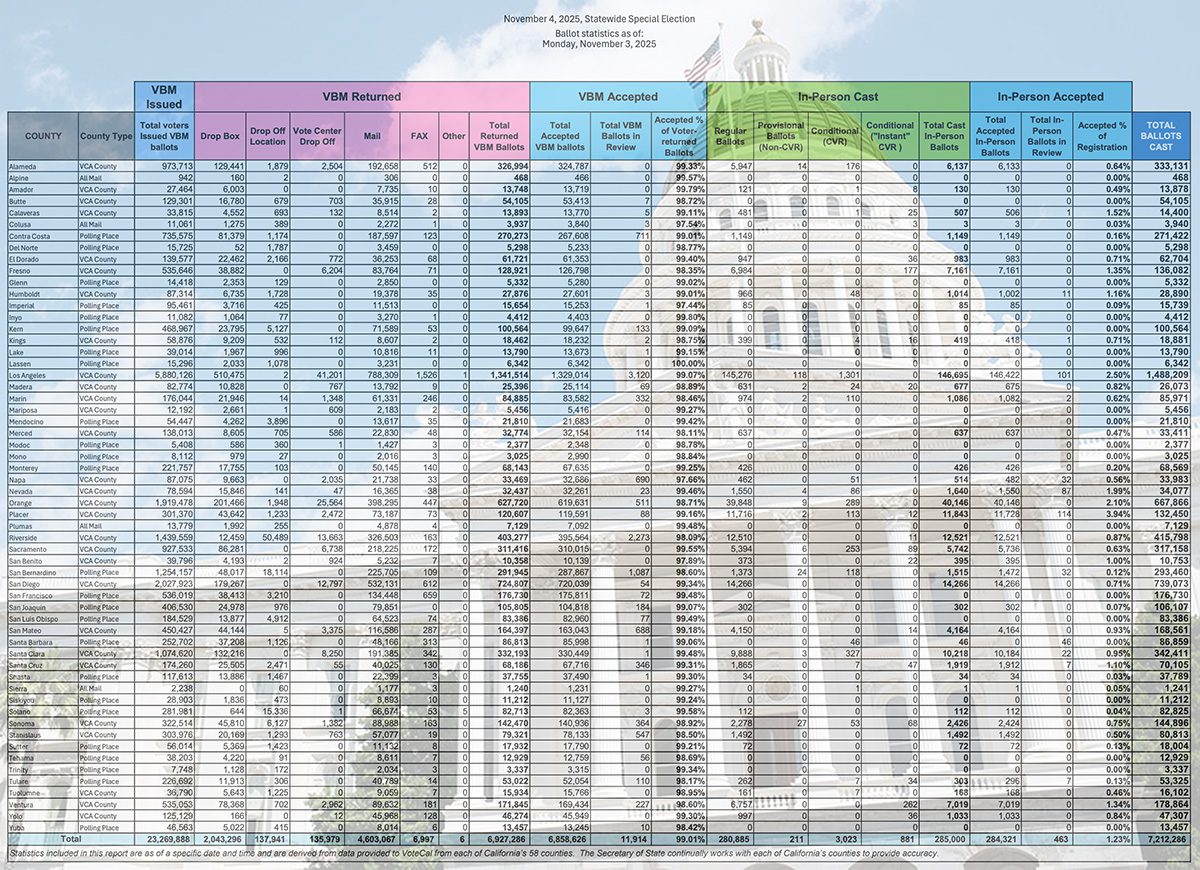
The statewide “Ballot Statistics” report compiled by the Secretary of State’s VoteCal system – gives a snapshot as of Monday, November 3, the day before Election Day:
-
23,269,888 vote-by-mail (VBM) ballots had been issued.
-
6,927,286 VBM ballots had been returned by voters.
-
6,858,626 of those VBM ballots had already been accepted.
-
Only 11,914 VBM ballots were in review, yielding a 99.01% acceptance rate for voter-returned VBM ballots.
-
Separately, 285,000 in-person ballots had been cast statewide, of which 284,321 had already been accepted.
-
In total, 7,212,286 ballots had been cast and recorded before Election Day even began.
In other words, a large slice of California’s Prop 50 electorate has already “spoken” — and both campaigns know it.
Convenience vs. risks: the debate over mail-in voting
For many voters, vote-by-mail is simply convenient: you can fill out your ballot at the kitchen table, review the voter guide, and drop it off without standing in line. Research going back decades shows that expanding mail voting does not, on average, systematically favor one major party over the other, but it does make it easier for occasional or lower-propensity voters to participate.
Studies of fraud in mail voting have consistently found that it is typically minimal – including in states that have used universal vote-by-mail for years. But mail-in fraud does exist nonetheless. Some elections, especially local elections, have been decided by narrow margins. When every vote counts, any mail-in voting abuse is looked at as a major problem.
Critics – in California and nationally – point to several structural concerns:
-
Chain of custody. Because mail ballots are filled out and transmitted away from public view, there is more opportunity for pressure, coercion inside families or workplaces, or mishandling than in a monitored polling place environment.
-
Reliance on mail and logistics. Delays or errors in postal delivery, mis-addressed ballots, and signature mismatches can lead to otherwise valid ballots being challenged or rejected.
-
Ballot collection (“harvesting”). California law permits a voter to designate another person to return their ballot. Both parties now make heavy use of this practice. The fact that unknown third parties can legally transport ballots makes some voters uneasy about transparency and control.
On the other side of the argument, election administrators and voting-rights researchers point out that California elections are built around multiple layers of safeguards – barcodes tracking each ballot, signature verification, tight controls on who can access voted ballots, and public audits – and that when fraud or improper handling does occur, it is typically detected and prosecuted as a rare exception, not a routine feature of the system.
Early results numbers, psychology, and campaign strategy
The ballot statistics report doesn’t show how anyone voted, only who has successfully returned a ballot and by what method. But even that limited information can shape the election environment in several ways:
-
Narrative and bandwagon effects. Media outlets and political operatives use early return data to build storylines: “Democrats are outpacing Republicans in early returns,” or “younger voters are lagging.” Analysts caution against reading too much into these numbers, but the narratives can still affect enthusiasm and expectations.
-
Real-time campaign adjustment. Modern campaigns – on all sides – ingest early-vote data daily. They can see which precincts or voter segments are turning out and which are not, then re-target mailers, door-knocks, text messages, and digital ads accordingly. That means early-vote statistics don’t just describe the election; they actively help shape the closing days of it.
-
Perception of “it’s already decided.” When nearly one-third of the eventual electorate has already voted, some late-deciding voters may feel their ballot no longer matters, or that the outcome is effectively locked in. Others may be spurred to vote precisely because they see how many ballots are already in.
Those are not questions of legal integrity; they are questions of fairness, psychology, and transparency in a vote-by-mail era. For a measure as consequential as Prop 50, understanding how much of the game is already on the scoreboard before Election Day matters.
What all those voting data categories actually mean?
The Secretary of State’s ballot-statistics report is dense – dozens of columns for each of California’s 58 counties – but the field definitions tell you exactly what you’re looking at.
A quick guide:
-
County Type
-
VCA County – Counties operating under the Voters Choice Act model, where all voters receive mail ballots and can use vote centers instead of neighborhood polling places.
-
All-Mail – Counties that conduct elections almost entirely by mail.
-
Polling Place – Counties still using the traditional precinct-based polling place model (though they also issue mail ballots).
-
-
VBM Issued
-
The total number of distinct voters who were sent a vote-by-mail ballot. This can exceed current registration because it includes people who moved or were inactivated after the mailing went out, and it excludes replacement ballots sent to the same voter.
-
-
Drop Box / Drop-Off Location / Vote Center Drop-Off / Mail / Fax / Other
-
These columns break down how returned mail ballots physically got back to the county – via an unattended official drop box, an attended county drop-off site, a vote center, the U.S. mail, fax (allowed in limited circumstances), or other approved methods. Undeliverable ballots and ballots for deceased or canceled voters are excluded from these counts.
-
-
Total Returned VBM Ballots / Total Accepted VBM Ballots
-
“Returned” is the universe of mail ballots sent back by voters intending to vote.
-
“Accepted” is the subset that have passed signature checks and other legal tests and have been added to the count. Any remaining VBM ballots are listed as “in review” while county staff examine issues.
-
-
Accepted % of Voter-Returned Ballots
-
This is the ratio of accepted mail ballots to all voter-returned mail ballots – a quick way to see how many are being challenged or rejected statewide or in a given county. As of November 3, the statewide VBM acceptance rate stood at 99.01%.
-
-
Regular / Provisional / Conditional (CVR) / “Instant” CVR
-
These categories apply to in-person voting:
-
Regular ballots are standard in-person votes that are immediately accepted.
-
Provisional (non-CVR) ballots are issued when there is a question about a voter’s eligibility or registration; they are counted only if the county later confirms eligibility.
-
Conditional Voter Registration (CVR) ballots are cast by voters who register or update their registration at the same time they vote.
-
“Instant” CVR refers to conditional registrations that can be fully verified and accepted on the spot.
-
-
-
Total Cast In-Person Ballots / Total Accepted In-Person Ballots / Total In-Person Ballots in Review
-
These roll up all the non-VBM ballots.
-
Statewide as of November 3: 285,000 in-person ballots had been cast, 284,321 accepted, and 463 in review.
-
-
Accepted % of Registration & TOTAL BALLOTS CAST
-
“Accepted % of registration” is the share of all registered voters whose ballots (mail or in-person) have been accepted so far.
-
“Total Ballots Cast” is the bottom-line number of accepted ballots plus those still in review. As of the latest report, that was 7,212,286 – a substantial chunk of the eventual electorate, before Election Day voting even began.
-
For voters and readers, the key takeaway from that wall of numbers is simple: by the eve of Election Day, millions of ballots were already locked in, and vote-by-mail is doing most of the work. Today’s in-person turnout will decide how much those early numbers tilt the final result on Prop 50.
Non-citizen voting, ballot harvesting, and what we actually know
A final set of concerns commonly raised in California debates over mail voting involves non-citizen voting and ballot “harvesting.”
Legally, the ground rules are clear:
-
To register and vote in California statewide elections, you must be a U.S. citizen, a resident of California, 18 or older, not currently in state or federal prison for a felony, and not judged mentally incompetent to vote.
-
Non-citizen voting is allowed only in very narrow local contexts (for example, San Francisco’s school board elections for certain non-citizen parents), and those ballots are kept separate and do not apply to statewide contests like Prop 50.
-
Claims that California is broadly registering non-citizens to vote have been repeatedly investigated and mostly debunked; one high-profile case in 2018 involved a motor-voter processing error that led to a small number of ineligible registrations, only a handful of which actually resulted in ballots being cast.
That doesn’t mean the system is flawless or that errors never occur. It does mean that documented non-citizen voting in California statewide races remains sparse, and when it is found, it is treated as a legal violation, not a tolerated feature of the system.
On ballot collection, state law permits third-party return of ballots under specified rules, and both major parties now use it aggressively in their turnout operations. Critics warn that this opens the door to undue influence or mishandling; defenders counter that it is often the only practical way for home-bound, disabled, or very busy voters to reliably return ballots. Those tensions – between access and perceived vulnerability – are not going away.
Eyes wide open
Today’s election is, formally, about a single proposition. In reality, it is also a referendum on:
-
Whether Californians are willing to set aside, even temporarily, the independent redistricting system they fought to create.
-
How comfortable we are with a system where most votes are cast days or weeks before Election Day, while campaigns mine early-vote data in real time.
-
How we balance convenience, access, and security in an era of near-universal mail ballots.
The one thing that hasn’t changed is this: the outcome will be decided by who actually votes. Whether you favor or oppose Prop 50, the “ballot statistics” show that millions of Californians have already made their choice. The rest will be decided by those who take the time – today – to add their voice to the total.