



















First — What Is a “Data Center,” Anyway?
Quick plain-English explainer, because this conversation falls apart if half the room isn’t sure what we’re talking about.
A data center is a giant building full of computers. Not desktop computers — racks of specialized servers, stacked floor to ceiling, running 24 hours a day. Each building can be the size of several Costcos lined up end to end. Some are bigger.
These buildings run almost everything we do online. Stream a movie, send a text, ask a chatbot a question, swipe a credit card — a computer inside a data center is doing the actual work. The screen in your hand is just a window.
What’s new is the scale. Artificial intelligence — ChatGPT, Google’s AI search, the tools driving the current Silicon Valley boom — requires enormous computing power. Tens of thousands of chips running at once, generating tremendous heat, drinking electricity at a rate that is shocking to the point of insane.
A single large AI data center can use as much electricity as a mid-sized city. A campus of them — the kind being built right now in Texas, Utah, Virginia, Georgia, and Nevada — can use more electricity than entire states.
They also need water. A lot of it, for cooling. Plus diesel backup generators tested weekly. Tall fences. Very few employees inside. They don’t generate the kind of local jobs a factory or warehouse of the same size would.
That is what is being built, all across America, right now, at unprecedented speed. That is what this editorial is about.
Are we, as a populous, sleep-walking into disaster? Read on…
We’ve had a housing crisis for 30 years. We’ve had a “national high-speed rail plan” for almost as long, and it lives mostly on PowerPoint slides. The electrical grid in much of this country was built before color television. Schools need roofs. Water systems run through pipes laid when Calvin Coolidge was president. Altadena, The Palisades and Lahaina Maui are still digging out from catastrophic city-sized fires. The Great Salt Lake is drying into a bowl of toxic dust.
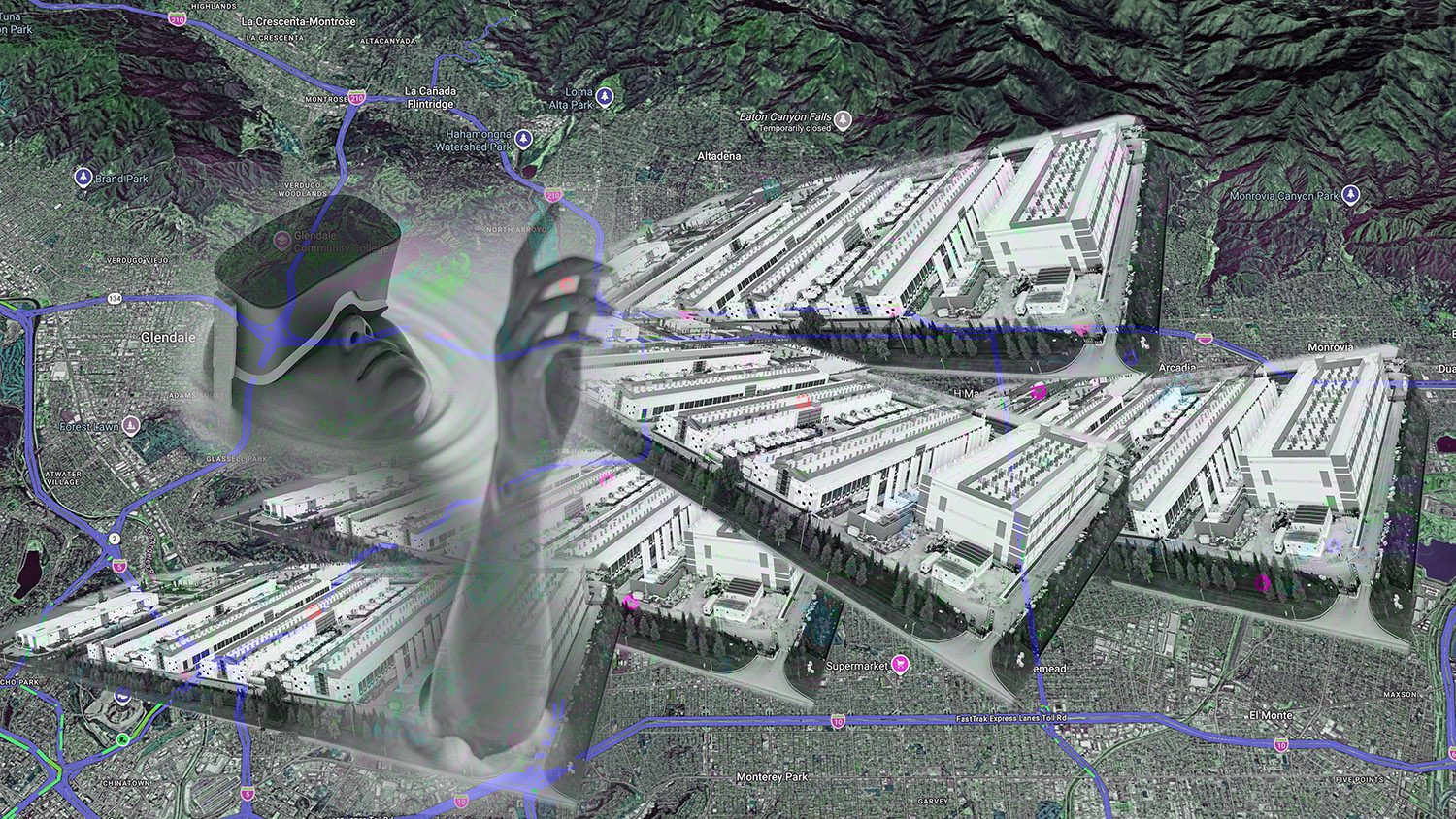
None of that has moved Washington Like: ‘We Must Build Massive Data Centers Immediatly’.

Then Silicon Valley said it needed warehouses full of computers to run chatbots, advertising engines, and surveillance software. Suddenly, Washington sprang into fast-action.
Executive orders. Federal land made available. Environmental reviews waived. Tax abatements. Permits fast-tracked. Half a trillion dollars in announced private money, cleared for takeoff in months. State agencies repurposed to override the votes of locally elected officials. Communities given a week’s notice before 40,000 acres get approved over their heads.
So let’s ask the question plainly. For forty-years we were told there isn’t enough money, isn’t enough political will, isn’t enough urgency for the things that hold an actual society together. Now we’re told — straight-faced — that the most pressing project in America is building data centers as fast as humanly possible, at scales that exceed the electricity use of entire states, in places where the water isn’t there, on a timeline that strips local communities of any meaningful say.
Why? For what? For whom?
These aren’t paranoid questions. They’re the questions every city council in the San Gabriel Valley should be answering on the record right now. Pasadena, Altadena, and adjacent locales are next on the map.
The Numbers Are Not Typos
Data center construction spending in the United States doubled between 2024 and 2025. It’s expected to nearly double again in 2026. Industry analysts put 2026 spending at about $86 billion — a 782 percent jump from $11 billion in 2022.
The four largest cloud and AI companies — Alphabet, Amazon, Microsoft, and Meta — plan to spend more than $350 billion on data centers in 2025 and around $400 billion in 2026. Power capacity for these facilities is projected to triple, from roughly 30 gigawatts in 2025 to 90 gigawatts or more by 2030.
For context: the PJM grid serves 65 million Americans across thirteen states (serving the Northeast US Region). Its annual capacity auction jumped from $2.2 billion to $14.7 billion in a single year. An independent monitor concluded data center demand was responsible for 63 percent of that increase.
No category of private commercial real estate has ever triggered a federal mobilization like this. Not housing. Not rail. Not the grid itself, much of which is over eighty years old.

How the Federal Government Cleared the Runway
January 21, 2025. President Trump’s first full day in office. He announces the Stargate Project — a venture between OpenAI, SoftBank, Oracle, and the investment firm MGX, with a stated commitment of at least $500 billion in AI infrastructure over four years. Construction was already underway in Abilene, Texas. More sites have since been announced in Texas, New Mexico, Ohio, and elsewhere.
July 23, 2025. The President signs a second executive order: “Accelerating Federal Permitting of Data Center Infrastructure.” The order tells federal agencies to streamline environmental reviews, hand out loans and tax incentives, and open federal land for data center development. It routes qualifying projects through a fast-track framework called FAST-41. It instructs the EPA to expedite reviews under the Clean Air Act, the Clean Water Act, and the federal Superfund law.
Buried in the order is one quietly extraordinary line: federal financial support representing less than 50 percent of a project’s total cost is presumed not to be a “major Federal action” under the National Environmental Policy Act — the law that for fifty years has required environmental review of federally backed projects.
Read that twice. With one administrative pen stroke, large portions of this buildout were defined out of the environmental review system entirely.
The same administration also rescinded a 2023 Biden order that had required AI developers posing risks to national security or public health to share safety test results with the federal government.
This is not normal infrastructure pace. This is wartime pace. The question is who decided this particular buildout, on this particular timeline, should override the ordinary processes by which communities get a say in what gets built next to their homes, schools, and groundwater.
The Trojan Horse — What Just Happened in Utah
If anyone still doubted the fast-track strategy was real, last week ended the debate.
May 4, 2026. Box Elder County, Utah. A three-member commission unanimously approved a hyperscale AI data center campus called the ‘Stratos Project’. The site: 40,000 acres in Hansel Valley, just north of the Great Salt Lake. That’s two and a half times the size of Manhattan. Roughly the footprint of Washington, D.C. The developer: celebrity venture capitalist Kevin O’Leary’s O’Leary Digital. The shepherd: a state body called the Military Installation Development Authority.
Oh, for local context: 40,000 acres is MORE THAN TWICE THE SIZE OF SOUTH PASADENA, SAN MARINO & PASADENA COMBINED.
The numbers are not typos.
The first phase alone will require three gigawatts of electricity. Utah currently uses about four. At full buildout, Stratos is projected to consume nine gigawatts — more than double the entire state’s current electricity use.
One impact analysis estimates the project would increase Utah’s planet-warming pollution by roughly 50 percent. A Utah State University physicist estimates waste heat from the cooling systems could raise local daytime temperatures by 2 to 5 degrees, and nighttime temperatures by 8 to 12. Water analysis was incomplete at the time of approval. The site sits on the northern shore of a lake already in ecological collapse.
The vote did not go quietly. The meeting was moved to the county fairgrounds in Tremonton to fit the crowd. Some 400 protesters packed the room. Signs read: No data center. You can’t drink data. Don’t sell us out. Save our water. When the commission approved, chants of “Shame! Shame! Shame!” filled the hall. One commissioner told the audience to “grow up.” Another said the vote wasn’t really about the data center — it was about “personal property rights.” That was, in effect, the entire public explanation.
Here is the part every reader in the San Gabriel Valley needs to understand.
Stratos was not approved by ordinary county zoning. It was routed through the Military Installation Development Authority — MIDA — a quasi-governmental body the Utah Legislature created in 2007 to develop land near military installations. MIDA has one structural feature that makes it extraordinarily useful for projects that need to dodge normal review: it operates outside of county land-use authority. When MIDA shepherds a project, local elected officials have only limited power to stop it, no matter what their constituents want. The state-appointed board, not the county commission, holds the cards.
The legal architecture was arranged before the public meeting ever happened. The plans themselves weren’t released until about a week before the vote.
The financial architecture removes any remaining doubt. To “lure” O’Leary, MIDA approved an energy transaction tax of 0.5 percent. The standard rate is 6 percent. An 80 percent tax break. Property tax rebates on top of that.
This is the template that is upon us.
This is what residents of every community in this country need to recognize on sight. A project of generational scale. A state-authority workaround that strips zoning power from locally elected officials. A public notice window measured in days. An environmental review that isn’t complete at the time of approval. Tax abatements granted before public hearings. That’s not a normal land use decision. That’s a managed outcome wearing the costume of a public process.
And California is not immune. We have our own quasi-governmental entities — joint powers authorities, redevelopment-successor bodies, military base reuse authorities, the California Infrastructure and Economic Development Bank — that could be repurposed the same way. The July 2025 federal executive order explicitly directs the Department of Defense to “competitively lease available lands” on military installations for AI infrastructure. That’s the MIDA model, federalized. California has multiple active and decommissioned military sites.

The mechanism exists. It’s just waiting for someone to use it.
The lesson of Box Elder County is not that opposition doesn’t matter. The lesson is that opposition only matters if it gets organized before the legal architecture is locked in. Once a project has been routed around the body that should have decided it, the public meeting is theater. Hundreds of residents shouted “Shame!” at three commissioners last week. The vote was 3-0. Those commissioners had been positioned, by design, to not have the authority to vote any other way.
They’re Already Taking the Houses
Picture, for a moment, a possible Tuesday morning three years from now.
You live on a quiet street in East Pasadena, or the East end of Alhambra. The doorbell rings. A representative from Southern California Edison, or from Pasadena Water and Power, is standing on your porch with a clipboard. He is polite. He explains that a new 500-kilovolt transmission line is being routed through your neighborhood to serve a hyperscale AI campus that was approved last year by a joint powers authority you have never heard of. Your house is on the easement. They will negotiate first. Eminent domain is, of course, a “last resort.” The construction window begins next spring.
Now picture another version of that morning. You open your utility bill. A letter is folded inside. Your power provider regrets to inform you that, beginning sometime after May 2029, it will no longer be able to deliver electricity to your address. The capacity has been committed elsewhere. The letter recommends you contact a smaller regional provider to arrange replacement service. The smaller regional provider does not yet know where the replacement power is coming from.
These are not hypothetical scenarios for residents of two other American communities right now. They are this week’s news.
Lake Tahoe — May 12, 2026
NV Energy, the Nevada utility that has supplied the bulk of Lake Tahoe’s electricity for decades, has notified Liberty Utilities — the small California provider that services the region — that it will stop delivering power after May 2027. That is roughly 75 percent of Liberty’s supply. The cutoff affects approximately 49,000 residents on the California side of the lake, along with a tourist region that draws 25 to 28 million visitors a year.
The reason is not a mystery. NV Energy needs the capacity for twelve proposed data center projects clustered around the Tahoe-Reno Industrial Center east of Reno. Google. Apple. Microsoft. The climate group Western Resource Advocates estimates those projects alone will demand nearly 5,900 megawatts by 2033.
Data centers consumed roughly 22 percent of Nevada’s total electricity in 2024. That figure is projected to reach 35 percent by 2030. Tahoe residents have already watched their electricity rates climb about 77 percent since late 2022, according to Bloomberg.
NV Energy’s official explanation is that the transition was planned “well before data center load growth was a consideration” and is “not a reaction to recent developments.” A new 525-kilovolt transmission line called Greenlink West is supposed to be ready by May 2027 to replace the lost supply. One industry analyst called it “the closest of shaves.” If the timeline slips, the lights go out.
One Tahoe resident summed it up for Fortune in five words: “It’s like we don’t exist.”
Coweta County, Georgia — Spring 2026
Georgia Power is building new 500-kilovolt transmission lines across four counties — Coweta, Fayette, Heard, and Fulton — to feed an 829-acre hyperscale data center campus called Project Sail. Over 330 private properties sit in the line’s path. Twenty-one homes will be destroyed outright. Construction begins early 2027. The utility says it will “negotiate first.” Eminent domain is, of course, a “last resort.” Residents have already been told they “don’t have a choice.”
The Coweta County commission rezoned the site from rural conservation to industrial use on a 3-2 vote. Eight thousand residents signed a petition against it. More than 1,200 homes sit within a mile and a quarter of the proposed site. Seventeen residents have now sued the county and the developer, Atlas Development, in Coweta County Superior Court, alleging the rezoning was “an abuse of policies and zoning powers” and a violation of state constitutional due process rights. The site sits inside the Middle Chattahoochee River basin, in an area Georgia’s Department of Natural Resources designates as a Most Significant Groundwater Recharge Area — one of the state’s highest environmental protection categories. The developer’s original regional impact study, the lawsuit alleges, stated incorrectly that it was not.
The deeper context: the Georgia Public Service Commission has approved a $16 billion Georgia Power expansion plan for nearly 10 gigawatts of new generation capacity. 90% of it is earmarked for data centers.
A Coweta County homeowner named Sandra White told WSB-TV in Atlanta: “I don’t know if any of us have a prayer stopping it, unfortunately.”
Three States. Three Mechanisms. The Same Outcome.
In Utah, a quasi-governmental authority strips zoning power from elected county commissioners and approves a project the size of Washington, D.C. over the shouts of 400 residents.
In Nevada, a utility commits a state’s generation capacity to private data centers and tells 49,000 residents to find their own power.
In Georgia, a utility prepares to take homes by eminent domain to run transmission lines for a private corporate campus that 8,000 of its neighbors petitioned to stop.
These are not three different stories. They are three different mechanisms producing the same outcome. Local communities discovering, often days before the decision is final, that decisions of generational scale have already been routed around them. Land. Power. Houses. The pattern is consistent. Only the legal vehicle changes from state to state.
Why the San Gabriel Valley Needs to Pay Attention Right Now
Here is the part where the cold-open story we started this section with stops being hypothetical.
California has 500-kilovolt transmission corridors. California has rural-to-industrial rezonings. California has a Public Utilities Commission with authority over utility easements. California has joint powers authorities, redevelopment-successor agencies, military base reuse authorities, and a state Infrastructure and Economic Development Bank — all of which could be repurposed along Utah’s lines. California has multiple active and decommissioned military bases sitting on land the federal July 2025 executive order specifically directs the Defense Department to make available for AI infrastructure.
The mechanism does not require a different country. It does not require a different state. It requires only that local elected officials in Pasadena, Altadena, South Pasadena, San Marino, and the surrounding cities not be paying close attention at the exact moment the legal architecture is being assembled.
This is the argument for staying in tight, continuous contact with our state legislators. State Senator Sasha Renée Pérez represents the central San Gabriel Valley. Her SB 978 — the Data Center Community Accountability Act — already addresses some of these vectors, including the separate utility rate class for large-load facilities and the upfront cost requirement for transmission upgrades. But SB 978 in its current form does not address quasi-governmental authority workarounds. It does not address eminent domain for transmission lines serving private data centers. It does not foreclose the Tahoe scenario, in which a regional utility simply re-commits residential capacity to a more profitable customer.
These gaps are not arguments against the bill. They are arguments for the bill and for amendments. The communities that wake up before the legal architecture is locked in get to shape it. The communities that wake up after get to live with it.
Three weeks ago, this newspaper could have written about Box Elder County in the future tense. Today we write about it in the past tense, because the vote already happened. Three weeks from now, the same will be true of whatever comes next, in whatever community is next on the list.
Pasadena. Altadena. South Pasadena. Stay close to your legislators. Show up to the Public Utilities Commission filings. Read the joint powers authority agendas. Demand that Pasadena Water and Power disclose every large-load interconnection inquiry it receives. The pattern from Utah, Nevada, and Georgia tells you exactly what’s coming if no one is watching.
The doorbell ringing on a Tuesday morning is not a metaphor. It is what happens when local communities stop paying attention three years before the doorbell rings.

The Surveillance Concern Is Not a Conspiracy Theory
There used to be a reflex — dismiss the surveillance worry as overheated. That reflex is no longer available. The documentation is on the record. From law schools. From the ACLU. From police technology vendors themselves.
The ACLU has documented that companies including Axon, Motorola, Flock Safety, and Genetec are rolling out AI-powered “real-time crime centers” — central databases fusing video feeds, license plate readers, facial recognition, and data-broker records. In the ACLU’s words: police can track where a person lives, works, worships, protests, and gets healthcare, “not just to one of us, but to all of us, with the mere click of a button.”
The Brennan Center for Justice at NYU has reported that Flock Safety launched a data-fusion tool called Nova that correlates a person’s vehicle information with public records and commercially purchased data from data brokers. The Brennan Center also notes that police departments have “chronically failed to provide a public accounting of their predictive policing tools.” That information usually only surfaces through litigation.
More than sixty U.S. police departments deployed predictive policing systems in 2024, including Los Angeles, Chicago, and Atlanta.
In September 2025, the Trump administration issued National Security Presidential Memorandum 7, directing the Department of Justice to investigate civil society organizations, activists, and donors. Private surveillance vendors provide much of the underlying infrastructure for that work.
All of these systems run on data center compute. A non-trivial share of the buildout being fast-tracked right now is going to support exactly this kind of work, alongside consumer AI products and corporate advertising.
The public official whose rant triggered this editorial wasn’t wrong about that. He was telling people something true.
About the Money — Stablecoins, Not a “Digital Dollar”
Here precision matters, because the public conversation has been muddled.
A federal ‘Central Bank Digital Currency’ — a “digital dollar” issued directly by the Federal Reserve — has been formally rejected in the United States. Executive Order 14178, signed in January 2025, prohibits federal agencies from establishing, issuing, or promoting one. Fed Chair Jerome Powell has testified the Fed will not issue a CBDC under his leadership. The House passed the Anti-CBDC Surveillance State Act in 2025. On that narrow question, the worst-case scenario has been blocked.
That’s not the end of the story. It may be the beginning.
July 18, 2025. The President signs the GENIUS Act into law. It’s the first federal regulatory framework for stablecoins — privately issued digital tokens, backed one-to-one by dollars and Treasury bills. The law authorizes banks, bank subsidiaries, and approved nonbanks to issue them. Dollar-backed stablecoins already topped $260 billion in circulation in the third quarter of 2025. Monthly transaction volume crossed $1 trillion.
Now read one provision of the GENIUS Act carefully. All stablecoin issuers must possess “the technical capability to seize, freeze, or burn payment stablecoins when legally required” and must comply with lawful orders to do so. Issuers are subject to the Bank Secrecy Act, sanctions screening, and customer identification rules.
This is the architecture the rant was reaching for. It’s not a federal “FedCoin.” It’s something arguably more flexible from the standpoint of an enforcement state — a constellation of privately operated digital wallets and tokens, regulated by federal banking law, with mandatory freeze-and-seize capability written into the statute.
It is worth saying out loud: this mechanism is not theoretical.
February 2022. The Canadian government invoked the Emergencies Act and directed banks to freeze the accounts of people associated with the Ottawa trucker protests. Over 200 accounts. Roughly $8 million. No court orders. No due process. In some cases, donors who simply contributed to the protest’s crowdfunding campaign. A Canadian federal court later ruled, in 2024, that the use of those emergency powers was “unreasonable and ultra vires” — beyond the government’s authority — and violated Canada’s Charter of Rights and Freedoms.
That ruling came after the fact.
The point is not whether one supported the protest. The point is that the financial-system kill switch existed, was used, and was found by a court to have been used unconstitutionally — only after the damage was done.
“Debanking” Is Already Happening
Here the speaker’s instinct becomes very hard to dismiss.
December 10, 2025. The Office of the Comptroller of the Currency — the federal regulator for the largest U.S. banks — released preliminary findings from an investigation of the nation’s nine biggest banks. The OCC concluded that between 2020 and 2023, those banks “made inappropriate distinctions among customers in the provision of financial services on the basis of their lawful business activities.” Some banks, the OCC noted, had “continued to insist that they did not engage in debanking” even when the policies were undertaken in plain sight. Comptroller Jonathan Gould called these “harmful debanking policies” and committed his agency to ending the “weaponization of finance.”
This is not a partisan finding.
Senator Elizabeth Warren — ranking Democrat on the Senate Banking Committee — wrote to the President in February 2025, “strongly agree[ing] that debanking is a serious issue” and asking for federal action. Senator Tim Scott, the Republican Banking Committee chair, has introduced legislation to bar regulators from using “reputational risk” to pressure banks into closing accounts. On August 7, 2025, Trump signed Executive Order 14331 — “Guaranteeing Fair Banking For All Americans” — directing federal agencies to ensure account decisions are based on individualized, objective risk assessments. Not ideology. Not public profile. Not association with controversial-but-legal activities.
On October 30, 2025, the OCC and FDIC jointly proposed rulemaking that would prohibit regulators from instructing banks to close accounts based on a customer’s “political, social, cultural, or religious views or beliefs.” In late 2025 and early 2026, the FTC sent warning letters to payment processors — including Stripe — and to the major card networks, putting them on notice that politicized account closures could be treated as deceptive and unfair business practices.
So whether the targets are firearms dealers, cryptocurrency firms, conservative religious groups, energy companies, cannabis businesses, sex workers — or, under a different administration, climate activists, immigrants, or anti-war donors — the mechanism is the same. A private payment infrastructure with discretion to cut individuals off from the financial system. Exercised quietly. Without due process. Explained to the customer in a form letter, if at all.
PayPal has been the public face of this for almost twenty years. Class-action and individual lawsuits have alleged PayPal froze accounts for 180 days, refused to explain why, and in some cases retained the funds. One pending settlement covers users whose funds were held between 2019 and 2024.
PayPal is not unique. It is simply the largest visible example. The same complaint pattern shows up at Square, Stripe, Venmo, and every major payment processor. And now, increasingly, at the chartered banks themselves.
This is the de facto compliance score the speaker was warning about.
There is no single government-administered “social credit score” in the United States. What there is — and this is the harder truth — is a patchwork. Privately operated risk scores. Fraud algorithms. Payment processor blacklists. Reputational-risk policies. “Know your customer” determinations. In aggregate, they can produce many of the same outcomes for the same person.
• You will not be told the score.
• You will not be told why your account was closed.
• You will be told, in writing, that you’d “have to get a subpoena” if you want answers.
When the digital token your account holds is a stablecoin with mandatory freeze-and-burn capability, the mechanism gets faster, more granular, and harder to appeal.
A formal state-run social credit system on the Chinese model does not currently exist in the United States. That should not be a comfort. The decentralized version — running through banks, card networks, payment apps, stablecoin issuers, data brokers, and AI-driven risk-scoring — is being assembled in pieces. With growing federal acknowledgment that it has already been weaponized in the past, and could be weaponized again under a different administration with a different list of disfavored views.
This is the foresight a serious editorial owes its readers. It is not paranoia. It is the trajectory.
The Local Story — Pasadena, Altadena, and South Pasadena
April 14, 2026. The Los Angeles County Board of Supervisors unanimously approved a motion by First District Supervisor Hilda L. Solis directing county departments to study the health, environmental, and community effects of data center development across the county. The motion stopped short of a moratorium. Solis was explicit that the vote “does not limit the County from taking any future actions found to be within our purview once the report is released.”
Altadena is unincorporated. That means the county’s regulatory authority applies there directly, in a way it does not in Pasadena or South Pasadena, which control their own zoning. Any data center proposed for Altadena will be evaluated against whatever framework the county study produces.
Pasadena is already on the developers’ map.
December 2025. Amazon Web Services paid approximately $78.8 million for a 168,000-square-foot industrial property at 2964 Bradley Street in East Pasadena — the former EarthLink site, along the 210 corridor. Amazon told Pasadena Water and Power that no application has been submitted. Data Center Dynamics reported in March 2026 that Amazon plans to use the site as a quantum research center rather than a traditional data center. We’ll see. Commercial real estate analysts cite Pasadena’s municipally owned utility — which provides about 1,000 gigawatt-hours of electricity annually and has been planning capacity increases — as a major draw for technology tenants.
The local cautionary tale is Monterey Park.
Residents there fought a proposed 247,000-square-foot HMC StratCap data center on Saturn Street for more than a year. The city initially noticed only 40 households within 500 feet of the proposed site, in English only — in a neighborhood that is 65 percent Asian and 27 percent Latino. Volunteers built a multilingual coalition. Collected 4,500 signatures. Pressed the city council. The council unanimously voted to call a special election on June 2, 2026, to permanently ban data centers citywide. The developer withdrew.
The lesson is not that residents are powerless. The lesson is that when notice is rigged and reviews are streamlined, residents have to fight a war just to be heard.
State Senator Sasha Renée Pérez (D-Pasadena), whose district covers Pasadena, Altadena, South Pasadena, San Marino, and most of the central San Gabriel Valley, has introduced SB 978 — the Data Center Community Accountability Act. The bill would ban diesel backup generators at data centers, create a separate electricity rate class for facilities operating above 75 megawatts, require local skilled workers paid prevailing wages, and require data centers to pay upfront for transmission upgrades. Pérez’s office has explicitly cited concerns that development pressures could move into disaster-impacted communities. In plain English: Altadena and the Eaton Fire footprint.
Who Pays — The Ratepayer Squeeze
Utilities across the country requested more than $29 billion in rate increases in the first half of 2025 alone. Double the amount requested in the first half of 2024. An estimated 40 million customers faced rate increases last year. Average U.S. electricity prices rose to about 19 cents per kilowatt-hour by the end of 2025 — roughly 27 percent above 2019 levels. They’re projected to rise as much as 40 percent more by 2030.
A Bloomberg analysis of wholesale electricity prices across tens of thousands of grid nodes found prices in some locations near significant data center clusters had risen as much as 267 percent over five years. More than 70 percent of the nodes with major price increases sit within 50 miles of significant data center activity.
The Harvard Law School Electricity Law Initiative summed it up: utilities build infrastructure to serve large new customers, then recover the costs from everyone connected to the grid. Which is to say — from us.
A November 2025 Consumer Reports survey found that 78 percent of Americans are concerned new data centers will drive their energy bills higher. Some companies, including Anthropic and Microsoft, have publicly pledged not to pass data center power costs onto residential consumers. Whether those pledges hold up under real-world rate cases over the next decade remains to be seen.
The jobs promise has been oversold. A Food & Water Watch study estimated the entire U.S. data center industry employed as few as 23,000 people at the end of 2024. Most jobs in the sector are construction and security — not the high-wage tech employment that gets pitched at city council meetings. A November 2025 academic paper found “no clear evidence that data centers stimulate local growth in tech employment.”
Some economists argue that in the long run, increased load spreads fixed grid costs and lowers per-unit prices. Maybe. In the short run — in the Mid-Atlantic, and increasingly in parts of California — bills are climbing fast. Residents near the new clusters are paying the bill.
The Health and Environmental Case
The county motion was supported by a 2026 report from Community and Environmental Defense Services finding that pollutants emitted from data centers may pose health risks for people living within 0.6 miles of a facility. Data centers typically rely on diesel backup generators for grid outages. Many run those generators for weekly testing. That means nitrogen dioxide and fine particulate matter — both linked to respiratory illness — released into the surrounding air on a regular schedule.
Water is also a concern. Industry analysts project that by 2027, U.S. data centers will consume as much as 1.74 trillion gallons of water annually for cooling. About half the annual water usage of the United Kingdom.
Los Angeles County already has more than 70 data centers operating. More are on the way.

Pushback Is Working – For Now
At least 188 local opposition groups now operate across 40 states. Construction-ban or moratorium proposals are under consideration in more than a dozen states. Maine has a bill on the governor’s desk that would block new builds over 20 megawatts until late 2027. Virginia developers shelved a campus proposed near the Manassas National Battlefield.
According to one industry tracker, more than $64 billion in data center projects have been blocked or delayed by community opposition.
The communities that win share three traits. They organize early. They demand multilingual public notice. And they refuse to accept the watered-down environmental review documents — the “Mitigated Negative Declarations” — that developers routinely propose in place of full Environmental Impact Reports.
What We Should Demand Locally
This editorial is not arguing that data centers are evil. It’s not arguing that AI should be banned. It is arguing that decisions of this scale — facilities that draw enormous amounts of electricity and water, emit diesel exhaust, run twenty-four hours a day for decades, and increasingly support surveillance and financial-compliance infrastructure that touches every resident’s life — should not be made on a federal fast-track timeline while local communities are notified by a postcard mailed to forty households in one language.
For Pasadena, Altadena, South Pasadena, and the broader San Gabriel Valley, the minimum standards should be these:
A full Environmental Impact Report for any proposed data center facility. Not a Mitigated Negative Declaration.
Multilingual community notice extending well beyond a 500-foot ring. Public hearings held at hours working families can actually attend.
A separate utility rate class for any large-load facility above a defined threshold, so residential ratepayers are not subsidizing hyperscaler infrastructure.
Binding ratepayer protections written into any utility agreement, with penalties for cost-shifting.
Public disclosure by Pasadena Water and Power of all large-load interconnection inquiries from technology tenants. Timely public hearings before any commitment is made.
A public position from every city council in the San Gabriel Valley on SB 978 before that bill leaves the legislature.
And — taking the Box Elder County lesson seriously — explicit local resolutions stating that no data center project may be routed through any joint powers authority, redevelopment-successor body, military base reuse authority, or other quasi-governmental entity in a way that circumvents ordinary city council zoning review. If MIDA can be repurposed to fast-track a 40,000-acre project over 400 protesters, California’s equivalents can be repurposed the same way — unless local governments preemptively close that door.
Beyond the zoning fight, there are larger questions no one council can answer alone.
Whether a federal executive order can override local land use by classifying private commercial buildings as national-security infrastructure.
Whether the financial-system kill switches now being built into stablecoin law — and increasingly into the AI-driven compliance systems behind ordinary bank accounts — will be subject to meaningful due-process protections.
Whether the surveillance and predictive-policing infrastructure flowing into these data centers will face independent oversight. Or whether each successive administration will simply train it on a new list of disfavored groups.
These conversations are not paranoid. They are overdue.
A Note on the Motivation to Research and Write this Piece
This editorial was prompted by a rant from an insider expert, after a long lunch, in which he let loose on most of the themes above. He was angry. He was urgent. He got some details wrong, the way people do when they’re talking from instinct rather than from notes.
For the record: There are many rumors and influential social media posts that are just factually incorrect. For example, the United States has not launched a federal central bank digital currency. That specific worst case was blocked by executive order and is unlikely under the current Fed leadership. Many people conflate the CBDC question with the rapidly expanding stablecoin framework under the GENIUS Act, which is a different mechanism for many of the same concerns.
But on the broader picture — the infrastructure for pervasive surveillance, financial-system kill switches, behavior-shaped advertising, predictive policing, and de facto compliance scoring is being built at unprecedented speed, with unprecedented federal backing, and with diminished community input — the expert was telling readers something the public record now plainly supports.
The pieces are in place.
The OCC has acknowledged that the financial sector has already been weaponized against lawful customers across the ideological spectrum.
The data centers required to make AI-driven enforcement of such systems work at scale are being permitted, right now, on a fast-track basis. Including, potentially, in our own neighborhood.
Communities that wake up to this early – get to negotiate. Communities that wake up late – get to comply.

The South Pasadena News welcomes reader letters and op-ed responses on this topic. Public comment on Los Angeles County’s data center impact study is expected later this year; this paper will publish hearing dates as they are released.