


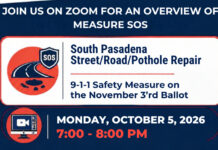














The South Pasadena City Council will decide Wednesday night whether to ask voters for $80 million to rebuild the city’s deteriorating streets and aging infrastructure.
The item on the June 17 agenda would place a general obligation bond of up to $80,000,000 before South Pasadena voters at the November 3, 2026 General Municipal Election. Under California law, a city general obligation bond requires a two-thirds majority to pass, so even if the Council sends the measure forward Wednesday, the final decision rests with voters in the fall.
For a city of roughly 26,000 people packed into 3.4 square miles, $80 million is an enormous sum — and, as Assistant City Manager and Chief Financial Officer Nick Kimball acknowledges, it still would not cover everything. The City estimates the true cost of bringing local streets and infrastructure up to standard exceeds $135 million. What the bond would buy, how the work would be sequenced, and what it would cost each household are the questions residents are weighing as a second major bond lands on their property tax bills, just months after voters approved a $128 million school bond.
The South Pasadenan interview with Kimball was a highly valuable, information rich, real world look at what’s going on behind the scenes and the clockwork that it takes to fix our streets as well as the finances. Nick Kimball has run the city’s finance operations since July 2025.
How the Bond Would Reach the Ballot
Wednesday’s action is procedural, but consequential. The Council will consider adopting Resolution No. 8016, declaring that the public interest and necessity demand the reconstruction, rehabilitation or replacement of the city’s streets, roadways and sidewalks, and introducing Ordinance No. 2416, the measure that would place the bond before voters in November.

If the Council advances the measure Wednesday, the ordinance would return for a second reading before the bond is formally certified to the November 3 ballot. Placing the question before voters does not, by itself, approve any specific construction project; voter approval would authorize the borrowing, and the city could not issue any of the $80 million in bonds without it.
The proposal grew out of last year’s budget process, the City says, when the City Council directed staff to find a way to make real progress on street conditions. After weighing the options, staff concluded that a voter-approved general obligation bond was the only tool that would deliver a large amount of funding immediately. The idea was first discussed publicly in August 2025 during budget adoption, and again in December 2025 and February 2026.
Why the Worst Streets Are Not First in Line
The single most counterintuitive part of the plan, and the one Kimball says residents most often misread, is this: the city does not intend to start with its worst, most deteriorated streets.
The reason comes down to three very different price tags. A street still in decent shape can be preserved with a slurry seal for roughly $50,000 a mile — cheap, routine maintenance. A street that is cracked and failing needs resurfacing, which means grinding off the top layers of asphalt and relaying them, at more than $1 million a mile. And a street that has completely failed needs full reconstruction — digging out the asphalt and rebuilding the base and sub-base underneath — at about $2.5 million a mile.
Here is the logic. A street that has already failed is, by definition, already in the most expensive category, and it will not get dramatically worse while it waits. A street still in fair condition, by contrast, keeps deteriorating with every car that drives over it — and if the city waits, that $1 million-a-mile resurfacing job becomes a $2.5 million-a-mile reconstruction. So the plan front-loads the streets in fair condition, not the ruined ones, because every dollar spent on a fair street prevents a far more expensive failure later and resurfaces more total miles than the same dollar spent rebuilding a street that is already gone.
The practical upshot is that some of the most visibly broken streets are scheduled later in the plan, which Kimball acknowledges can look backward to a frustrated resident. “They [South Pas. residents] are going to think we don’t know what we’re doing,” he said — and the City concedes that explaining this math is exactly the kind of communication it has not always done well.
What $80 Million Would Buy — and Why Streets Cost So Much Here
When the city rebuilds a street, Kimball said, it is rarely just laying asphalt. A full reconstruction can include new sidewalks, curbs and gutters — some South Pasadena streets have none at all — along with drainage and storm drains, some of which were designed more than a century ago and are no longer deep enough. “If it were literally just blacktop, it probably would be a bit cheaper,” he said, “but if we’re going to do it, we might as well do it right.”
California adds its own costs. Kimball said nearly every street project must be designed by a licensed engineer, largely as protection against liability claims — “civil engineers have become sort of like the lawyers of California,” he said — and the work must pay prevailing wage and meet state labor-compliance rules. Post-pandemic, he added, materials costs have climbed sharply. As a point of scale, Kimball said the Fremont/Huntington corridor project alone — covering two of the city’s busiest streets — carries a price tag of roughly $46 million, before any underground utility work.
The bond would pay for this kind of capital work — large, one-time investments such as rebuilding failed roads, replacing water lines and modernizing corridors. It would not pay for day-to-day maintenance such as pothole patching, which the City says runs through its operating budget. And it would not cover the full need: the City has said the $80 million was calculated to bring streets to acceptable levels in line with surrounding communities, not to finish everything at once, with other funding tools planned for the rest.
What It Would Cost a Homeowner, and Property Owners
The City estimates the bond would cost an average of about $33 a year for every $100,000 of a property’s assessed value. By that math, a home with an assessed value of $1 million would pay roughly $330 a year toward the bond.
A key distinction: the figure is based on assessed value, not market value. Assessed value is set by the Los Angeles County Assessor and, under Proposition 13, is generally tied closer to a property’s purchase price than to what it would sell for today — which is why two identical homes can carry very different tax bills depending on when they were bought.
Kimball did not dodge the fairness question that newer residents raise. “It’s extremely slanted in the favor of people that have been longer homeowners,” he said, recalling that years ago he and a neighbor owned identical houses while he paid about $5,000 a year in property taxes and the neighbor paid roughly $500 — for the same city services. He called the disparity a real issue but one largely outside the city’s control, since state law sets how assessed values work. Because those values vary so widely, the City encourages every resident to look up their own assessed value to estimate their actual cost.
How Costs to Residents Compare to Nearby Cities
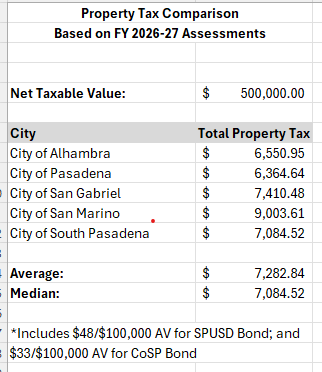
To put the cost in context, the City prepared an illustrative property tax comparison among adjacent cities, based on a $500,000 assessed value and publicly available Los Angeles County Assessor data.
For that sample home, the total annual property tax would run about $6,551 in Alhambra, $6,365 in Pasadena, $7,410 in San Gabriel and $9,004 in San Marino. South Pasadena would land at $7,085 — exactly the median of the group and below the five-city average of about $7,283. The South Pasadena figure already assumes the street bond passes; even with it included, the City says South Pasadena would sit in the middle of the pack among the communities it competes with for housing and services.
The comparison folds in both major local bonds on a South Pasadena tax bill: roughly $48 per $100,000 of assessed value for the school district bond, and about $33 per $100,000 for the proposed city street bond.
The School Bond on the Same Tax Bill
South Pasadena voters approved a separate $128 million school facilities bond for the South Pasadena Unified School District in June 2026, with more than 73 percent support. The City stresses that the school bond and the proposed street bond are unrelated — one funds school facilities, the other funds city streets and infrastructure — but both appear on the same property tax bill, which is why the comparison table counts them together.
What Happens If Voters Say No
If the measure fails, the City says street conditions are expected to keep declining without a dedicated funding source. Its draft Pavement Management Plan, due for adoption this summer, projects the city’s pavement score sliding from the mid-50s today into the mid-40s if no new money is added.
There are concrete consequences already in view. Kimball said the city is currently designing its first two years of bond-funded streets, including the Indiana Avenue project, which he expects to cost $5 million to $7 million to reconstruct. Those designs would be shovel-ready if the bond passes; if it fails, they would sit on the shelf while the city accumulates enough money to build them. South Pasadena collects only a couple of million dollars a year for streets from local sources such as Measure R, Measure M and the state gas tax — not enough, the City says, to keep pace as conditions and costs worsen.
Why the Streets Fell So Far Behind, and the ‘Because Fighting the 710’ Question
Part of the public’s wariness, Kimball acknowledged, is a track record of slow and sometimes poorly received street work. He pointed to a recent repair project on Milan and Edgewood, begun in fiscal year 2019-20, that took about seven years to finish — a timeline he called “unacceptable” — and noted that today’s staff inherited those problems and is trying to “put our money where our mouth is.”
A common explanation for decades of deferred maintenance is that the city poured its resources into fighting, and ultimately stopping, the 710 freeway extension from bifurcating South Pasadena. Asked to quantify that trade-off, Kimball said the city simply cannot produce the comparison: its financial system only goes back to about 2014, the city fought the freeway for roughly 40 years, and 710 costs were never tracked as a separate line item. The most active years of that fight, he noted, predate the city’s available records, and the last decade was the quietest of the battle.
In short, the often-repeated claim that the “710 fight crowded out street repairs” is not something the city’s books can confirm or refute.
What Stops the City From Neglecting the Streets Again
If voters approve the bond, the City says the measure carries accountability requirements: mandatory spending disclosure, independent public audits, and a legal restriction keeping all funds inside South Pasadena, with none transferable to the state. The ordinance would also require the city’s Chief Financial Officer to issue annual reports detailing how bond money was spent, and the City says it can use its Pavement Condition Index to report progress publicly.
On the longer-term question of whether the streets could simply fall apart again once the money is gone, Kimball pointed to two things. First, the city plans to launch an ongoing slurry seal program next year to maintain recently rebuilt streets — turning what might be a 30-year street into a 50-year street through cheap, routine upkeep. Second, the city is exploring new funding mechanisms so it does not have to return to voters for a bond every couple of decades.
He framed the funding gap as a statewide problem. When California eliminated redevelopment agencies in 2012, he said, cities lost a major tool that had let them capture new property-tax value from development and reinvest it in streets and sidewalks — “that spigot was turned off and never replaced.” The city is now studying enhanced infrastructure financing districts and community facilities districts, which can capture net-new property-tax value in high-development areas and redirect it toward future infrastructure.
Those tools, Kimball noted, add no extra cost to developers and take five to seven years to accumulate meaningful funds, and he was candid that they may not fully close the gap — “there may still be some delta between the need and what we have.” The City did not commit to a guaranteed, fixed maintenance line in every future budget.
The Bigger Picture
The City frames the bond partly as a function of its size. South Pasadena’s relatively small sales-tax base, it said, makes funding both public services and infrastructure a persistent challenge, and a dedicated bond is one way to pay for street improvements without cutting services such as parks and public safety. If approved, every dollar would stay local.2
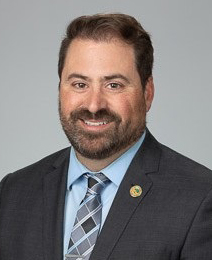
Assistant City ManagerChief Financial Officer
Kimball offered a candid assessment of why projects like this are harder than they should be. City staff, he said, “are not dumb, we’re just not always good at communicating” — public agencies tend to do the work without explaining it, which tends to erode the community trust these projects depend on. This kind of perception is especially intense in South Pasadena, where the residents are leery of City Hall activities based on the last several years of very bumpy City Managers, and ineffective city staff. When speaking to South Pasadena people on street about these kinds of issues, the undertow seems to be: “trust, but verify – with prejudice.”
It should also be noted that when speaking to South Pasadena residents about the effectiveness of the current city staff, especially the current City Manager Todd Hileman and our “newly positioned” assistant city manager and Finance Director Nick Kimball, South Pasadenans predominantly exclaim that “…We are on solid footing and elated to have professionals doing great work so far…”
What’s Next, and What to Watch For
The City Council takes up the bond Wednesday, June 17. If the Council adopts the resolution and introduces the ordinance, the measure moves toward a second reading and then to the November 3 ballot, where it would need a two-thirds yes vote to pass.
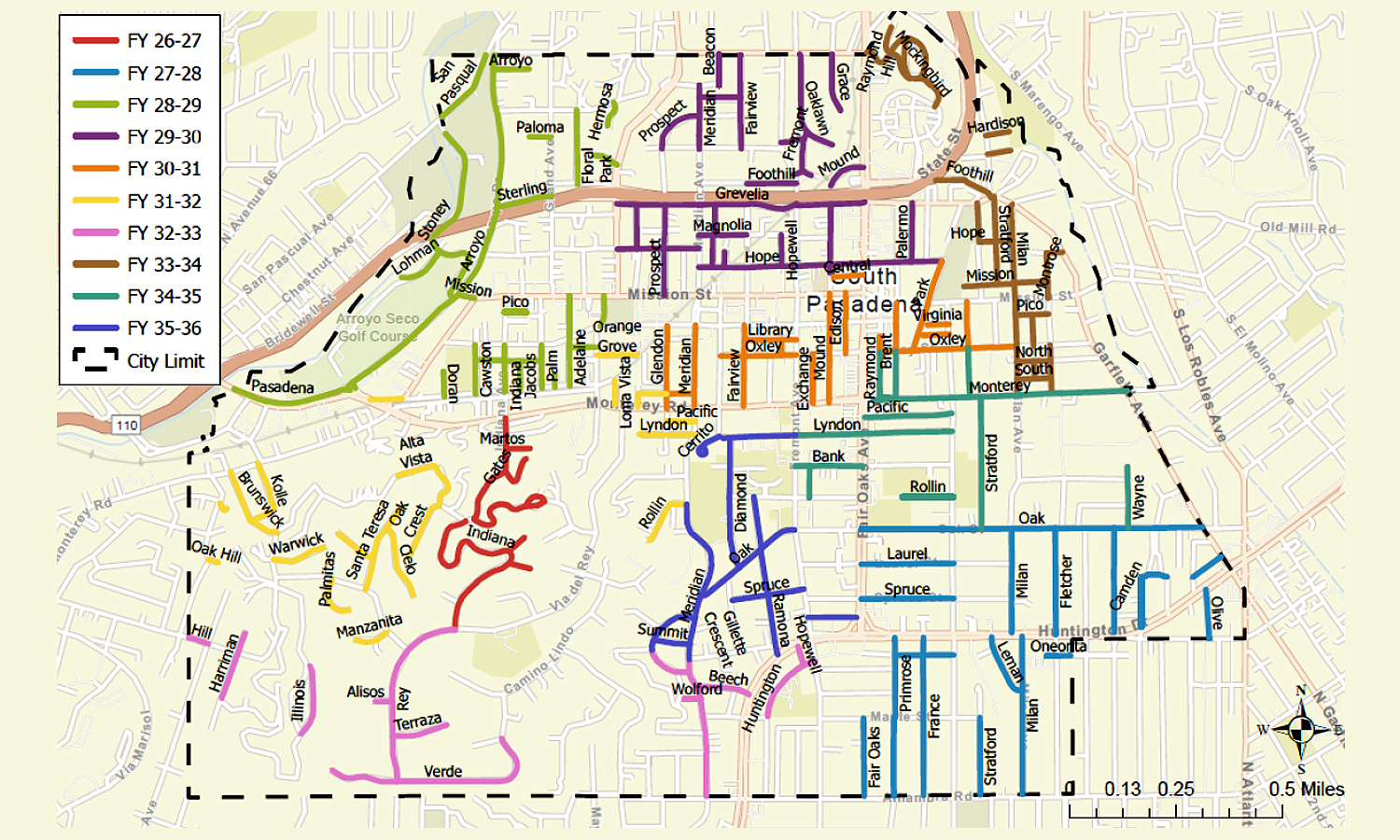
Residents can review the phased 10-year street plan — a color-coded map showing the anticipated year for each street, contingent on voter approval — and additional information at SouthPasadenaCA.gov/Infrastructure.
This news report is based on the City of South Pasadena’s written responses to questions submitted by The South Pasadenan, supporting city documents, and an interview with Assistant City Manager and Chief Financial Officer Nick Kimball. The City consolidated its answers through the City Manager’s office; individual councilmembers may address policy questions separately.