













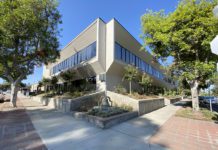



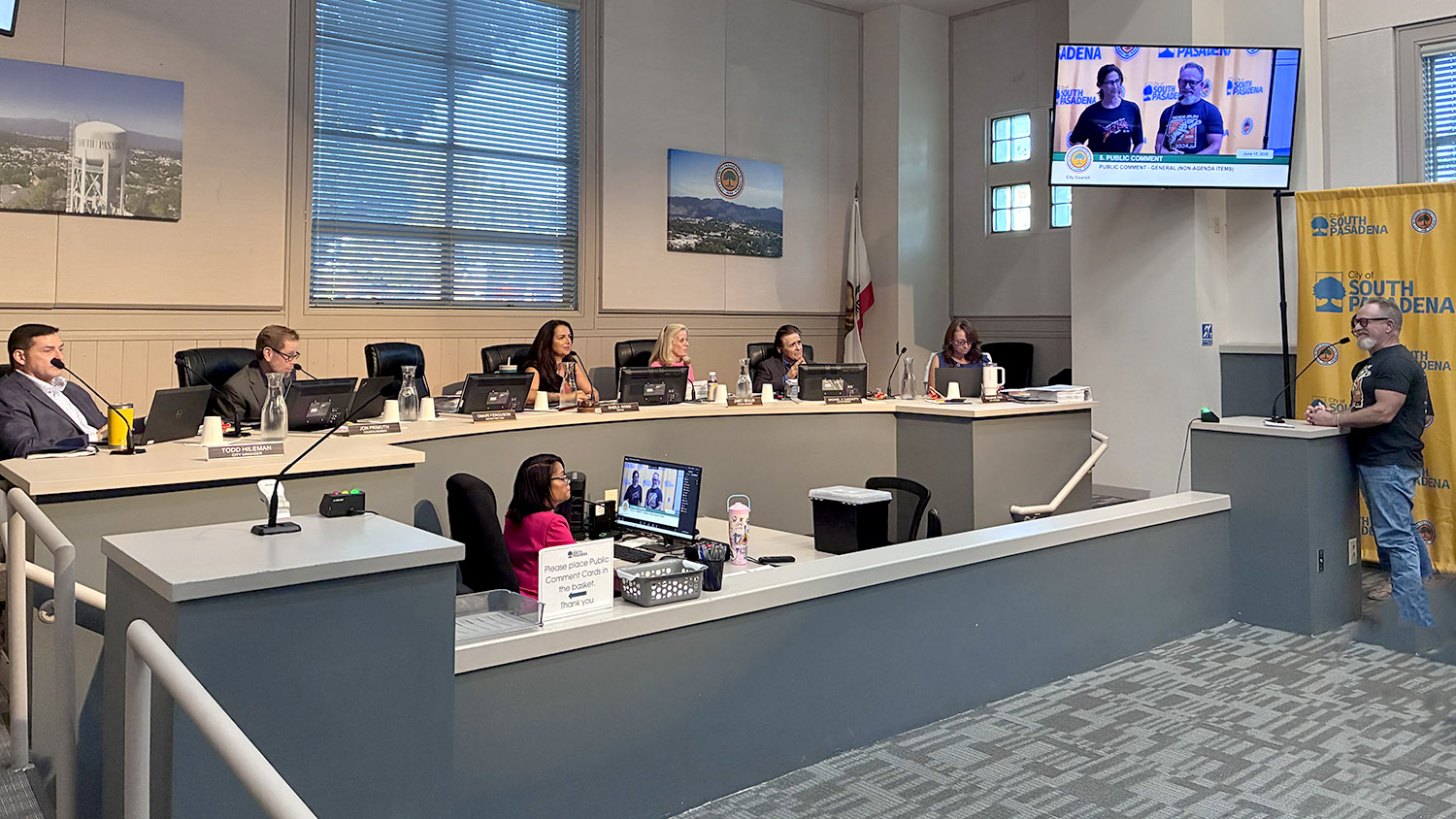

Two June meetings of the South Pasadena City Council bookended the same question that has shadowed City Hall for decades: how to pay to fix the city’s streets. On Wednesday, June 10, the council and the Finance Commission held a joint study session on the proposed budget for fiscal year 2026-27 and the Capital Improvement Plan. One week later, on Wednesday, June 17, the council adopted that budget and took its first formal steps toward asking voters in November for an $80 million bond to repair the roads.
Mayor Sheila Rossi presided over both meetings. Here is what residents need to know.
Two Meetings, One Budget – South Pasadena Can Finally Exhale
The headline action on June 17 was adoption of the fiscal year 2026-27 budget and Capital Improvement Plan, the end of a process that, by the city’s count, included seven public budget meetings since the proposed budget was posted on May 14. Assistant City Manager and Chief Financial Officer Nick Kimball, who walked the council through the numbers at both meetings, framed the spending plan as a path to sustainability, a budget that for the first time in years sets aside ongoing money for things like equipment replacement, facility maintenance, and rising insurance and claims costs, rather than repeatedly dipping into reserves.
A late schedule of changes trimmed both general fund revenues and expenditures by about $250,000, reflecting duplicate line items found during staff review and modestly higher user-fee projections. Following direction from the June 10 study session, the council also moved $650,000 from reserves to build level-three EV chargers at the police station and to fund an urban forest management plan, a council priority. After all the adjustments, the city’s unassigned general fund reserve sits at roughly $13.7 million, about 30 percent of operating revenues and comfortably above the 25 percent minimum the city requires of itself.

One unresolved item surfaced during budget adoption. Mayor Rossi said she was troubled to learn, after a recent Planning Commission meeting, that the city’s objective design standards work may not deliver the broader vision for Mission Street that the council set as a priority, a concern with real stakes given the roughly 800 to 900 housing units already entitled and major developments expected to break ground in the coming year. Mayor Rossi pushed for a council subcommittee to work alongside the Planning Commission, and City Manager Todd Hileman agreed to take it up, saying he would meet with the design consultant and report back.
The Death of Fund 400
If the budget had a hero, it was an accounting change. Across both meetings, staff and elected officials returned, with unusual enthusiasm, to the dissolution of Fund 400, a catch-all capital fund that for years swept money in from every other fund to pay for projects, then swept unspent dollars back out at year’s end. Officials described it as a reconciliation nightmare that could swing a single budget by tens of millions of dollars and made it nearly impossible to see how much any one fund actually held. Mayor Rossi welcomed what councilmembers jokingly called the death of Fund 400, and finance staff explained that unwinding it lets the city build five-year projections fund by fund, similar to balancing a checkbook.
The cleanup showed up in a performance number staff highlighted on June 10. A year ago, the city was spending only about 20 percent of its budgeted capital dollars. As of mid-May, that figure had climbed to roughly 60 percent, with much of the remainder already committed under signed contracts. Staff credited dedicated Capital Improvement Plan positions, so engineers are no longer split across competing tasks. Finance commissioners, who have pressed on the issue for years, called it a milestone, noting that every year of delay makes deferred maintenance more expensive to fix.
Inside the Department Budgets – Herding Cats, Mastered
The June 10 study session featured operating-budget presentations from the police and fire departments. Police Chief Derek Elmore, who joined the department from Phoenix earlier this year, presented a budget of about $14.8 million and 54 full-time-equivalent positions, unchanged from last year. He and the mayor were careful to explain that a roughly 12 percent increase is not new spending but a cost-accounting change that now charges vehicle-replacement and self-insurance costs directly to the departments that use them. Elmore reported more than 25,000 calls for service over the year, said the department is close to fully staffed, and previewed a recommendation on the future of its license-plate-reader program coming to the council in August. The department is also hiring a civilian crime analyst and has expanded its county mental health clinician to nearly full time.
Fire Chief Greg Lloyd presented a budget of about $9.2 million for 23 employees, likewise driven mostly by reallocation. He highlighted a recruiting breakthrough, a new firefighter trainee position that drew 250 applications in seven days compared with about 15 for a typical paramedic opening, and grant-funded equipment, including power-assisted gurneys that reduce a chronic injury risk. The department, he said, is now fully staffed.
THE $80 Million Bet on South Pasadena Streets & Infrastructure
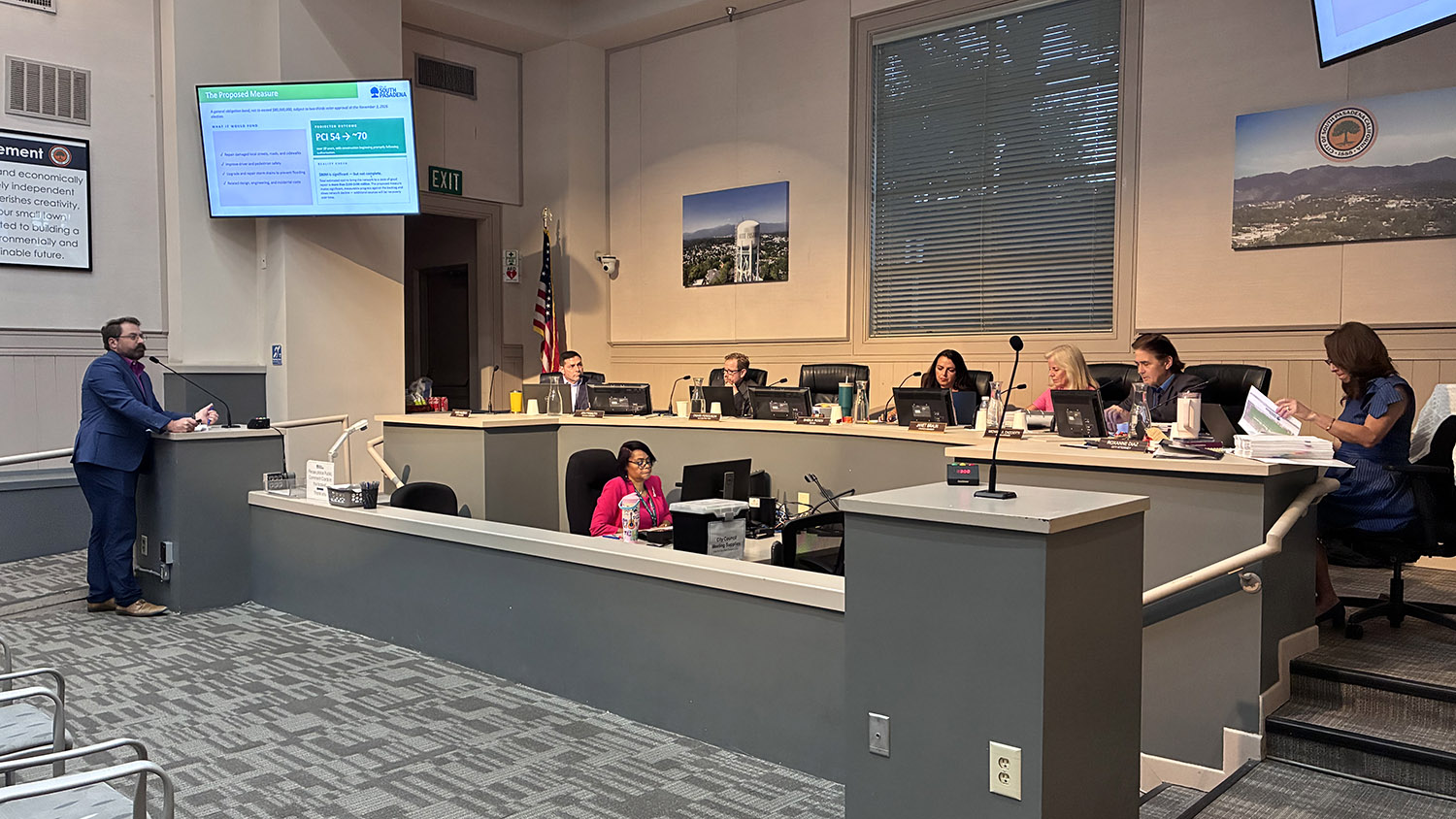
The centerpiece of June 17 was the bond. By unanimous votes, with Ferguson absent, the council adopted a resolution of public interest and necessity and held the first reading of an ordinance, the first two of several steps required under state law to place a general obligation bond of not to exceed $80 million before voters on November 3. The measure would need two-thirds approval to pass, and the council does not formally call the election until July 7.
The case for it, as Kimball laid out, is blunt (Click Here for Details). South Pasadena’s pavement condition index sits in the mid-50s, rated poor and, by several speakers’ accounts, the lowest in the San Gabriel Valley, where neighboring cities score in the 70s and 80s. The city maintains a balanced budget but has, in Kimball’s words, very little to no discretionary general fund money for infrastructure, and its roughly $2 million in annual pothole-and-repair work cannot keep pace. Independent engineering analysis estimates the bond would lift the pavement index from the mid-50s toward about 70 over ten years, while pegging the full cost to bring the entire 69-mile network to good repair at $150 to $200 million. The $80 million, officials stressed, is not a complete fix but a down payment meant to slow the decline and make measurable progress.
Staff laid out the punishing economics of deferral: A slurry seal that extends a street’s life runs roughly $50,000 a mile, a resurfacing about $1 million a mile, and a full reconstruction many times more, which is exactly why letting a road slide all the way to reconstruction is so expensive. Many South Pasadena streets, neglected for years, are already at that point. To put bond dollars to work quickly, the first two years of the plan target projects already in design but lacking construction money, Indiana Avenue and the Orange Zone reconstruction among them, so they are shovel-ready. Later years are sequenced to fix streets before they fail and to avoid conflicts with other work, such as the Fremont and Huntington Drive corridor project and the Westside Reservoir.
For property owners, the city’s fiscal consultant estimates the bond would cost an average of about $33 per $100,000 of assessed value each year, with the actual rate depending on market conditions and timing. The accompanying ordinance builds in accountability: proceeds could be spent only on the specified street, sidewalk, safety and storm-drain improvements, not on non-project salaries or operating costs, held in a separate account, with an annual report to the council, and the funds stay local and cannot be taken by the county or state.
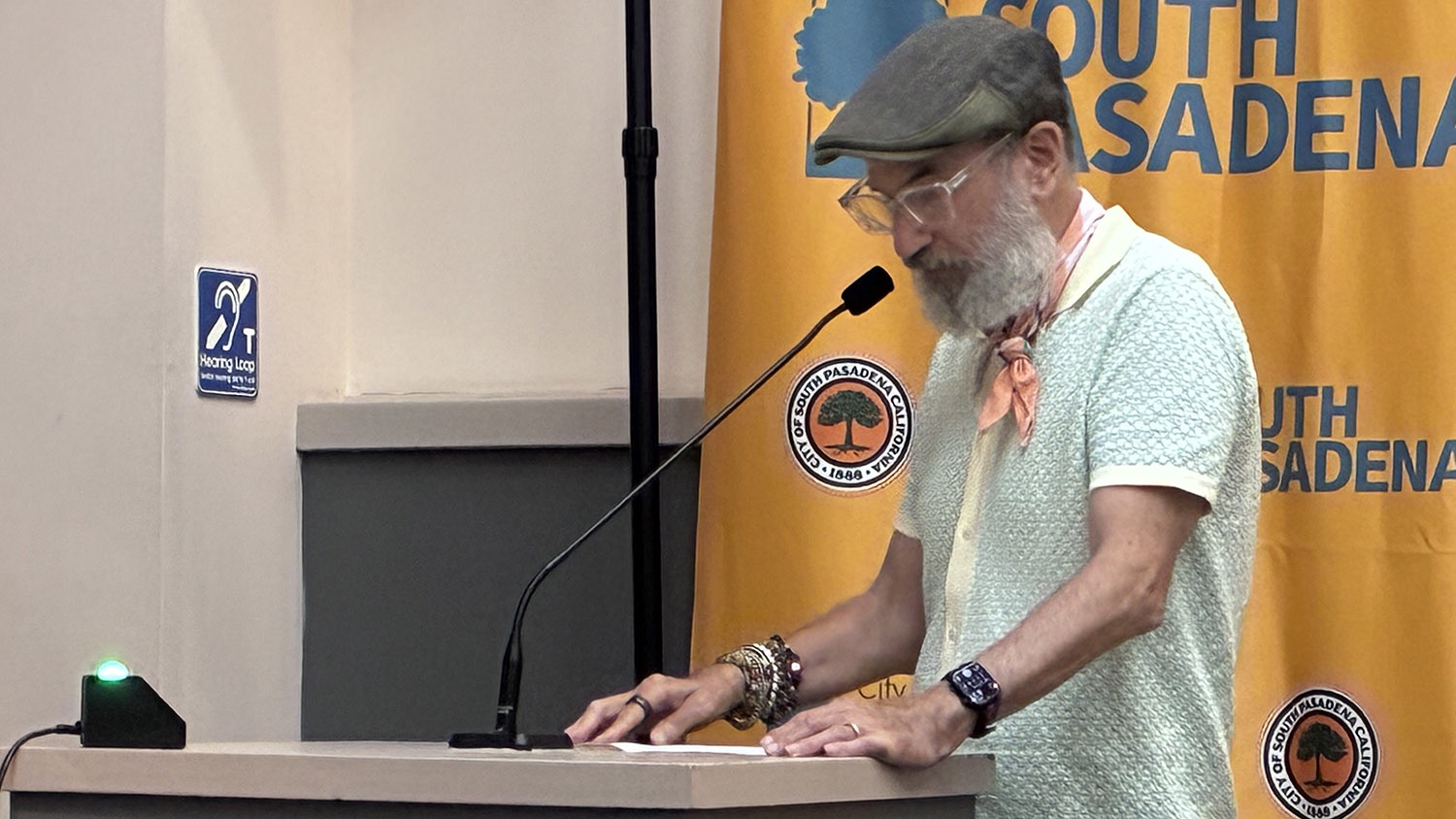 Public comment ran strongly in favor. A letter endorsed by 50 community leaders, among them former officials, commissioners, business owners, school board members and nonprofit heads, urged the council to put the measure on the ballot, noting that nearly 45 percent of city streets need reconstruction or significant repair. Former City Clerk Sally Kilby recalled a mayor two decades ago describing the roads as ox cart level, and said little has changed since. Resident Dean Serwin cited a staff figure that poor streets and sidewalks have generated more than 200 liability and property-damage claims, totaling over $7 million, in the past decade. Finance Commissioner Peter Giulioni, calling in, said he could not overstate his support. SPUSD board member Patricia Martinez Miller, speaking as a private citizen, thanked the council for backing the school district’s recent bond, which passed with 77 percent, and pledged the board’s help in return. And resident Bianca Richards, a life-long resident and now new homeowner, urged that the work emphasize safety for walkers, cyclists, strollers and wheelchairs, not just cars.
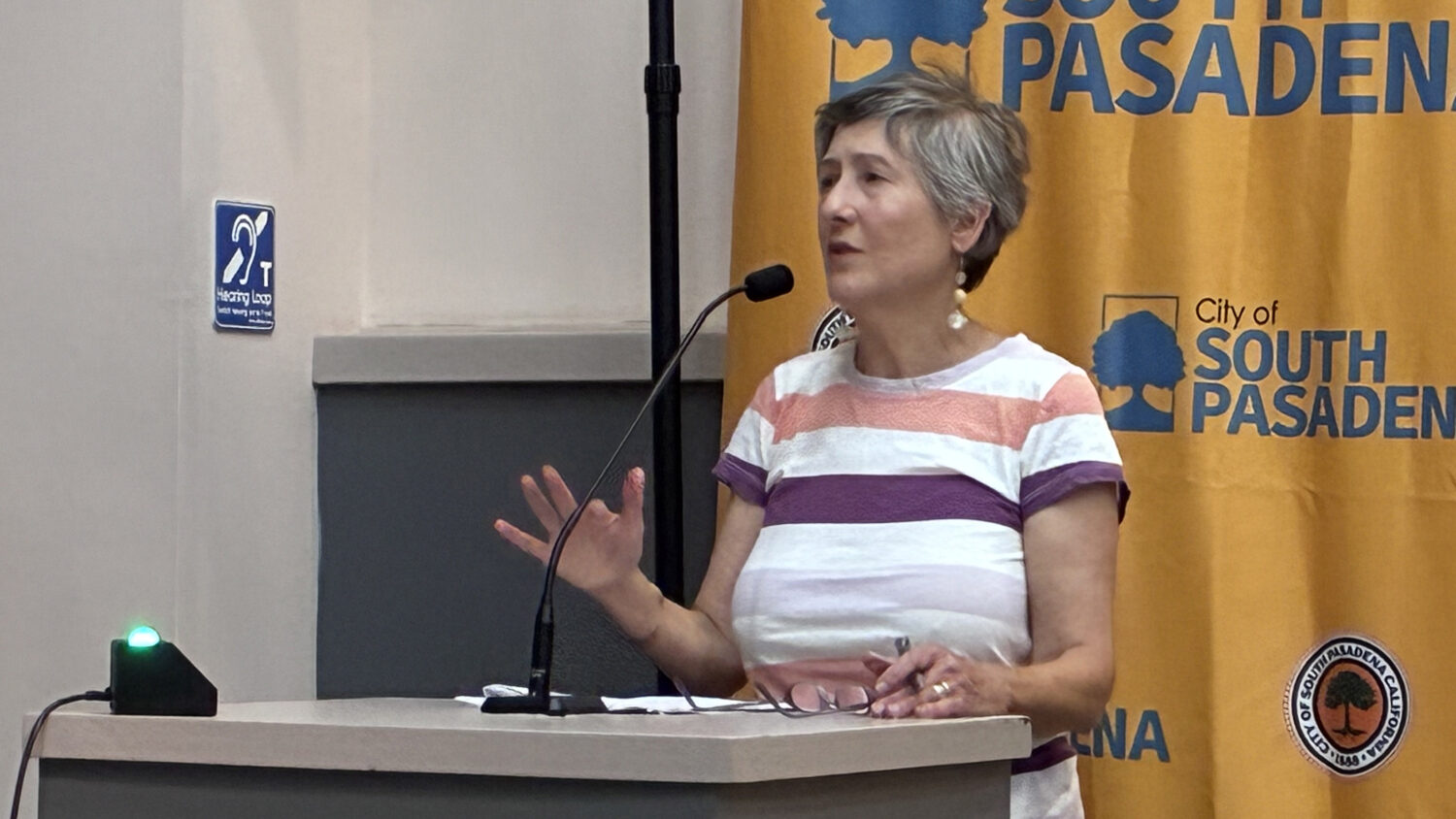
Councilmembers framed the moment in historical terms. Michael Cacciotti, on the council since 2001, recounted inheriting three failing systems, water, sewer and roads, and choosing water first, after finding a reservoir that had been out of service for 15 years with a fallen eucalyptus through it. For 40 years, he said, money that might have maintained the streets was diverted to fight the 710 freeway extension. With the water system now largely rebuilt and the last reservoir, Westside, still to come, he said, now is the time for the roads. Other members credited a year of financial cleanup for making the bond possible at all, with one noting the city had made a decade’s worth of progress in a year. If voters approve in November, the council will turn to the second reading of the ordinance and the formal call of the election, coming up on July 7.
Goats, Toyon, and the Fire Line
The council also revised its approach to wildfire fuel reduction in the Monterey Hills. On June 17, it rescinded a May 20 agreement with Capra Environmental Services, pulled back after a Brown Act cure-and-correct letter raised a question under the California Environmental Quality Act, and approved a new, tightened agreement for a targeted goat-grazing and vegetation-management pilot in designated high and very-high fire hazard zones, finding it exempt from CEQA.
Fire Chief Greg Lloyd described the wildland-urban interface as a tension to be managed, not a problem to be solved, and said staff had walked the sites, reviewed a comparable Pasadena project, and narrowed the scope in response to residents’ concerns. He did not sugarcoat the trade-offs. Goats can damage native plants like toyon, and field photos confirmed it, but the research and Pasadena’s experience show toyon recovers from a single season of browsing, with permanent damage occurring only under repeated year-after-year overgrazing, which is not what this pilot does. The result is a hybrid program combining goats with exclusion fencing and, where needed, hand or mechanical clearing, plus an evaluation to follow. Councilmembers credited the change to public pushback. Jon Primuth said nuance is the word. Invoking the Eaton and Palisades fires, Lloyd said his aim was simply to protect the community. The item passed unanimously.
Questions About the FLOCK Surveillance Cameras
Residents used public comment to keep pressure on the city over automated surveillance. After the council declined to renew its contract with Flock Safety, several speakers asked what has become of the cameras: whether they have been removed, whether they are still operating, whether the city is still paying, and what is happening to the data. Resident Bill Kelly asked staff to report the cameras’ status to residents. Lorraine Triola urged the council to take down other cameras whose contracts are coming up, and pointed to a recent report, via 404 Media, that 18 police officers around the country had misused license-plate-reader systems to look up romantic interests and others without a warrant. The comments land just ahead of the license-plate-reader recommendation Chief Elmore said would come to the council in August.
Also Approved on June 17
The rest of the agenda moved quickly. The council adopted its annual Community Development Block Grant allocation, combining three years of federal funds into a single sidewalk and ADA curb-ramp project with no general fund contribution, following last year’s project that built 43 curb ramps largely along Meridian Avenue. It renewed the Lighting and Landscaping Maintenance District assessment with no rate increase; the levy generates about $900,000, roughly half the district’s nearly $1.7 million annual cost, of which more than half is tree maintenance. Councilmembers asked staff to chase cost savings, including LED conversions, drought-tolerant tree selection through the urban forest plan, and regional bulk purchasing, before considering any future increase, which would require voter approval.
The council adopted the 2025 Urban Water Management Plan and Water Shortage Contingency Plan, a state-required five-year update. The city pumps about 3,300 acre-feet a year, drawing 98 percent of its supply from the adjudicated Main San Gabriel Basin, whose water level has risen well above its operating range. Councilmembers pressed on whether population assumptions, based on regional projections from April 2024, adequately capture recent growth and the state’s SB 79 zoning changes, and asked the regional water body to update its two-year-old data.
After three years of steep decline, the council voted to discontinue the school-year Camp Med after-school program. Enrollment had fallen to about 12 students from three schools, with revenue down nearly 70 percent and cost recovery well below target, largely because a state program now provides after-school care at the schools themselves. Five of the remaining students are aging out to middle school. On the Community Services Commission’s 5-0 recommendation, the council chose to wind the program down now, so families can plan, while directing staff to explore expanding popular break and summer camps and other youth services. Finally, after three trips to the council, members adopted a block-party permit program that drops residents’ costs from $700 to $900 per event to a $175 permit with insurance included, plus rentable city barricades and a refundable deposit.

Proclamations, Preservation, and a Town in a Good Mood
The June 17 meeting opened with proclamations recognizing Pride Month and Juneteenth, and a presentation from South Pasadena Preservation Foundation president Jenny Bright, who reported a year of growth: membership more than doubled, more than 15,000 visitors to the South Pasadena Historical Museum the foundation has run for 38 years, a record 1,000 guests in a single day during the Rialto’s Route 66 centennial, and hundreds of third graders through the museum’s local-history program. In public comment, organizers of the Tiger Run announced the race’s 29th running on December 5, with the Fragomen law firm sponsoring finisher medals.
A lighter note ran through the budget talk. A recent international soccer viewing party, the mayor said, drew the happiest crowd she had seen in the community in years, and the council directed staff to host at least one more before the tournament ends. Rossi closed by looking ahead to the city’s Fourth of July, its 250th-anniversary edition, with the morning parade and an evening event at the high school.
The council then adjourned to a special meeting on Tuesday, July 7, at 5 p.m., where it will take the bond ordinance’s second reading and officially put the measure on the November ballot.