


















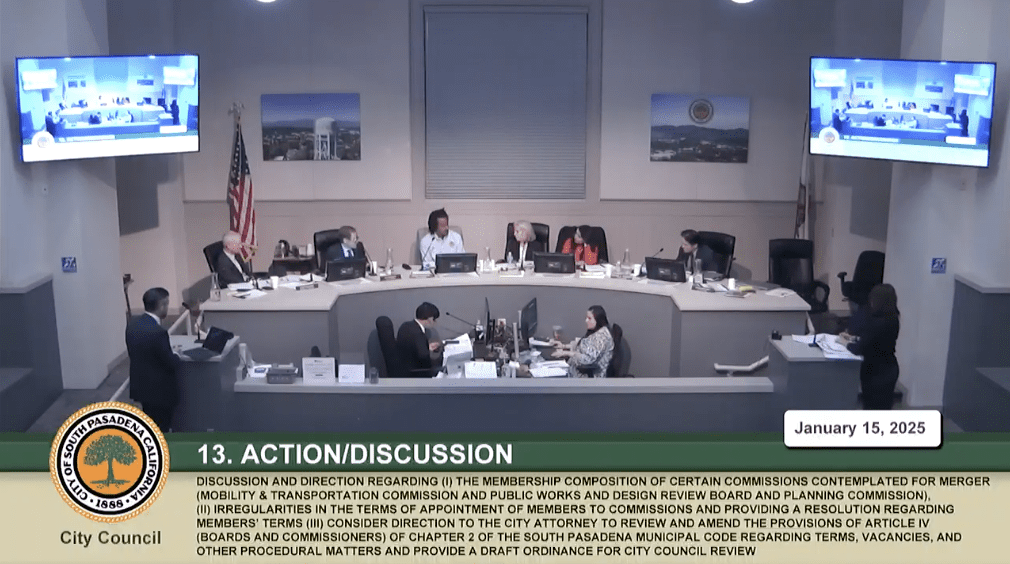

The City Council last week discussed a renewed effort to broach the always-sensitive issue of city commission consolidation. The city currently has about a dozen community volunteer-staffed commissions with responsibilities to conduct city business or provide input and/or review of ongoing or one-time policy matters.
As an initial matter, the Council agreed to postpone until March a discussion on the creation of two new Council Committees, one on traffic corridors and one on infrastructure financing, both of which will include members from the City Council and the community.
The delay was largely because the Council is considering a reorganization of some of its highest-profile commissions, in particular the merger of the Mobility and Transportation Infrastructure Commission (MTIC) with the Public Works Commission, and merger of the Design Review Board with the Planning Commission. Each of these commissions currently has five members.
Generally, new commission members are appointed to three-year terms at the start of each year by the mayor and approved by the Council. That and the prospective mergers occasioned a review by City Attorney Roxanne Diaz of the relevant ordinances and recent appointments and vacancies which, according to a staff report, revealed some “irregularities in the terms of appointment of members to commissions,” mostly due to older language at odds with a 2019 ordinance that sought to limit commissioners to two terms or six years, and some issues with the rules pertaining to “youth” commission members.

Mayor Janet Braun and Mayor Pro Tem Sheila Rossi said they spent hours sorting through previous full- and partial-term appointments and determining how to fold those into the prospective consolidation plan.
The upshot is the Council will shortly adopt amendments cleaning up the inconsistencies and taking action under which MTIC and DRB commissioners who are or will soon be at risk of exceeding the six-year limit will, as Diaz put it, be asked “nicely” to resign while the others would be reassigned to their respective merged commissions. That would provide some institutional continuity. Membership of each remaining commission would be expanded but only until year’s end, when the number of positions would revert back to just five members.
“Some people have been on commissions for seven years,” Mayor Braun said. “The whole point of that amendment in 2019 was to get some new people.” She said she already has “some amazing new applicants” lined up to fill commission slots.
The Council also voted to create a new at-large position on the 14-member Library/Community Center Comprehensive Site Plan Ad Hoc Committee, and to name Bianca Richards to the position, as well as to appoint Council Member Rossi as one of the Ad Hoc’s City Council reps. This action stemmed from a slightly different problem, namely, the preservation of continuity of representation from those portions of the Ad Hoc that are composed of members of city bodies (the City Council, the Library Board of Trustees and the Community Services Commission), all of whom, unlike the community representatives, are subject to term limits.
Council also approved Mayor Braun’s appointments of Council liaisons to the various commissions, such as Planning (Rossi) and MTIC (Omari Ferguson); and the City’s representatives to various regional bodies, such as the Clean Power Alliance (Ferguson) and the San Gabriel Valley Council of Governments (Braun).