















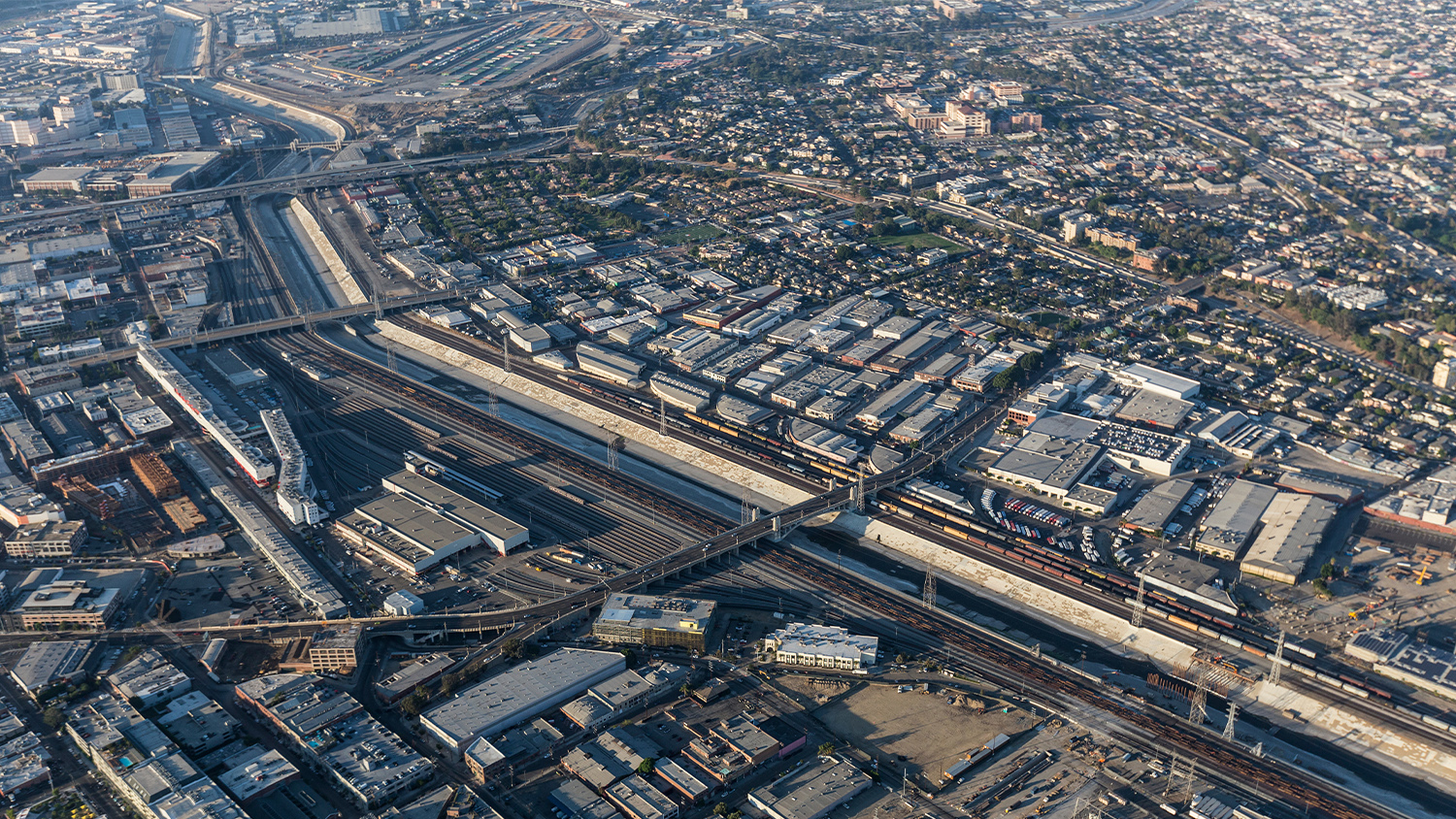

Fire Situation Updated 10:30 p.m., Saturday, June 20, 2026
The warehouse fire that has been pushing smoke across South Pasadena, San Marino, Highland Park and the greater Pasadena area is still burning Saturday night, nearly four days after it started, and the official response has escalated sharply. Gov. Gavin Newsom declared a State of Emergency for Los Angeles County on Saturday evening, hours after Los Angeles Mayor Karen Bass declared a local emergency, as fire crews continued their defensive battle against the stubborn blaze at a Boyle Heights cold-storage warehouse and air quality across the region worsened.
For readers here, the situation comes down to a few practical points. The smoke has not cleared. The air quality advisory that covers the San Gabriel Valley has been extended through midday Sunday. And from Friday night into Saturday, monitors recorded pollution at levels considered unhealthy across our part of the county. There is still no shelter-in-place order for South Pasadena or any neighboring foothill community; those orders applied only to the blocks immediately around the fire and have since been lifted.
Huge Fire, Thick Smoke, Biohazard Looming
Nearly four days in, the fire at the Lineage Logistics cold-storage facility in the 1400 block of South Los Palos Street continues to heavily smolder and flare-up. Los Angeles Fire Chief Jaime Moore has described the 500,000-square-foot building as essentially a giant cooler, built with corrugated steel walls packed with dense foam insulation and reinforced interior panels, with an ammonia refrigeration system that helped fuel the fire in its first hours.

Because the fire is burning deep beneath the roof, structural debris and rooftop solar panels, and because there is near-zero visibility inside, it has been unsafe for firefighters to go in. Crews have instead fought it from the outside for days, using continuous water drops from helicopters alongside ground-level ladder pipes.
Fire officials reported progress overnight in keeping the flames confined to the section where they started and away from an adjacent cold-storage building and homes to the north, which they called a meaningful step. Even so, flare-ups have continued, including renewed smoke visible Saturday, and officials expect residual smoke to keep spilling from the building through the weekend. No injuries have been reported. The cause remains under investigation; the building’s operator, Lineage, has said the fire may have originated with work a third-party contractor was performing on the rooftop solar array, and arson investigators are on scene as a matter of routine.
A ‘State of Emergency’ Has Been Declared, and What It Means
Governor Newsom’s proclamation, issued Saturday evening, directs the California Governor’s Office of Emergency Services and other state agencies to support the local response, suspends certain public-contracting rules to speed the work, and clears the way for additional state aid and recovery resources. The state said it has pre-positioned significant supplies in case they are needed, including 5.5 million N95 respirator masks for affected communities, commercial-grade air purifiers for shelters and public spaces, bottled water, and enhanced air-quality monitoring, along with Cal OES fire and rescue specialists with expertise in complex warehouse and hazardous-materials fires. As of the proclamation, local officials had not formally requested those additional state resources, but the state made them available should conditions warrant.
The state action followed Mayor Bass’s local emergency declaration earlier Saturday, which activated the city’s emergency operations apparatus, ordered damage and cost assessments, and formally requested state assistance. This is a major, multi-jurisdictional incident, Bass said, adding that the city would keep working around the clock to put the fire out completely and to keep the community safe.
Air Quality in South Pasadena & San Gabriel Valley Areas
This is the part that matters most for local readers. On Saturday afternoon, the South Coast Air Quality Management District extended its Particle Pollution Advisory through 12:30 p.m. Sunday. Since the fire reignited Friday night, monitors and sensors have detected elevated levels of fine particulate matter, known as PM2.5, the microscopic soot that is the main health hazard in wildfire and structure-fire smoke. According to the district, air quality has ranged from “Unhealthy for Sensitive Groups” to “Very Unhealthy” on the Air Quality Index across central Los Angeles County, the San Gabriel Valley, the eastern San Fernando Valley and the northwest San Bernardino Valley. South Pasadena, San Marino, Pasadena and Highland Park all sit within that affected zone, and Highland Park in particular lies along the smoke’s path between the fire and the foothills.
The advisory is not a shelter-in-place order. It is guidance to limit exposure, and conditions can change quickly hour to hour as winds shift the plume. Residents are urged to check real-time readings for their own neighborhood rather than rely on any single number, because levels have swung between moderate and unhealthy depending on the wind.
Is the Smoke Toxic?
The recurring question from residents has been whether the smoke is poisonous. Fire officials have repeatedly said their monitoring does not show it. Chief Moore said in statements that air sampling by the Los Angeles fire and county hazardous-materials teams and the air district has not detected toxic chemicals or hazards beyond what is found in ordinary fire smoke, comparing the smoke itself to that of a brush fire even though different materials are burning. An ammonia line was breached early in the fire but was addressed in the first day, and brief, seconds-long spikes of bromine and chlorine measured inside the plume earlier in the week stayed below short-term health thresholds. The dominant concern for our area, then, is fine-particle pollution rather than a toxic chemical cloud, which is why the guidance centers on staying out of the smoke.
An Emerging Biohazard Concern
A separate worry is taking shape as the fire drags on. The warehouse held an estimated 85 million pounds of frozen food, including poultry, beef and other meat as well as bread products, and with the refrigeration knocked out, that inventory is slowly warming and beginning to spoil.
Moore said the building’s interior was still around 45 degrees at last check but would not stay cold for long. Mayor Bass likened the situation to food rotting during a long power outage, saying the gas that decaying food gives off is the biohazard officials are concerned about. Authorities are already preparing for an extensive cleanup once the fire is out, which will involve hauling thousands of tons of spoiled food to landfills.
What Health Officials Recommend
The guidance for residents in smoke-affected areas is consistent across the city, county and air district. If you can see or smell smoke, stay indoors with windows and doors closed, and run air conditioning on recirculate or use an air purifier. Avoid whole-house fans and evaporative swamp coolers that pull outside air in. Limit strenuous outdoor activity, and take extra care with children, older adults, pregnant residents and anyone with asthma or heart or lung conditions. If you must be outside for any length of time in the smoke, wear a well-fitting N95 or KN95 mask, and bring pets indoors. Avoid adding to indoor pollution with candles, incense, grilling or gas-powered equipment. Watch for symptoms such as coughing, shortness of breath, chest tightness or eye irritation, and seek medical care if they worsen. Officials also asked residents to check on neighbors who may be more vulnerable to the smoke.
Where to Get Real-Time Updates
Because conditions are shifting hour to hour, residents should monitor live air quality through the South Coast AQMD and the federal AirNow service, and follow the Los Angeles Fire Department and Los Angeles County Fire Department for the status of the firefight. The current particle pollution advisory runs through 12:30 p.m. Sunday and could be extended again if the fire keeps smoldering. The South Pasadenan will continue to update this report as the situation develops.