













City Council, June 3, 2026 — Report
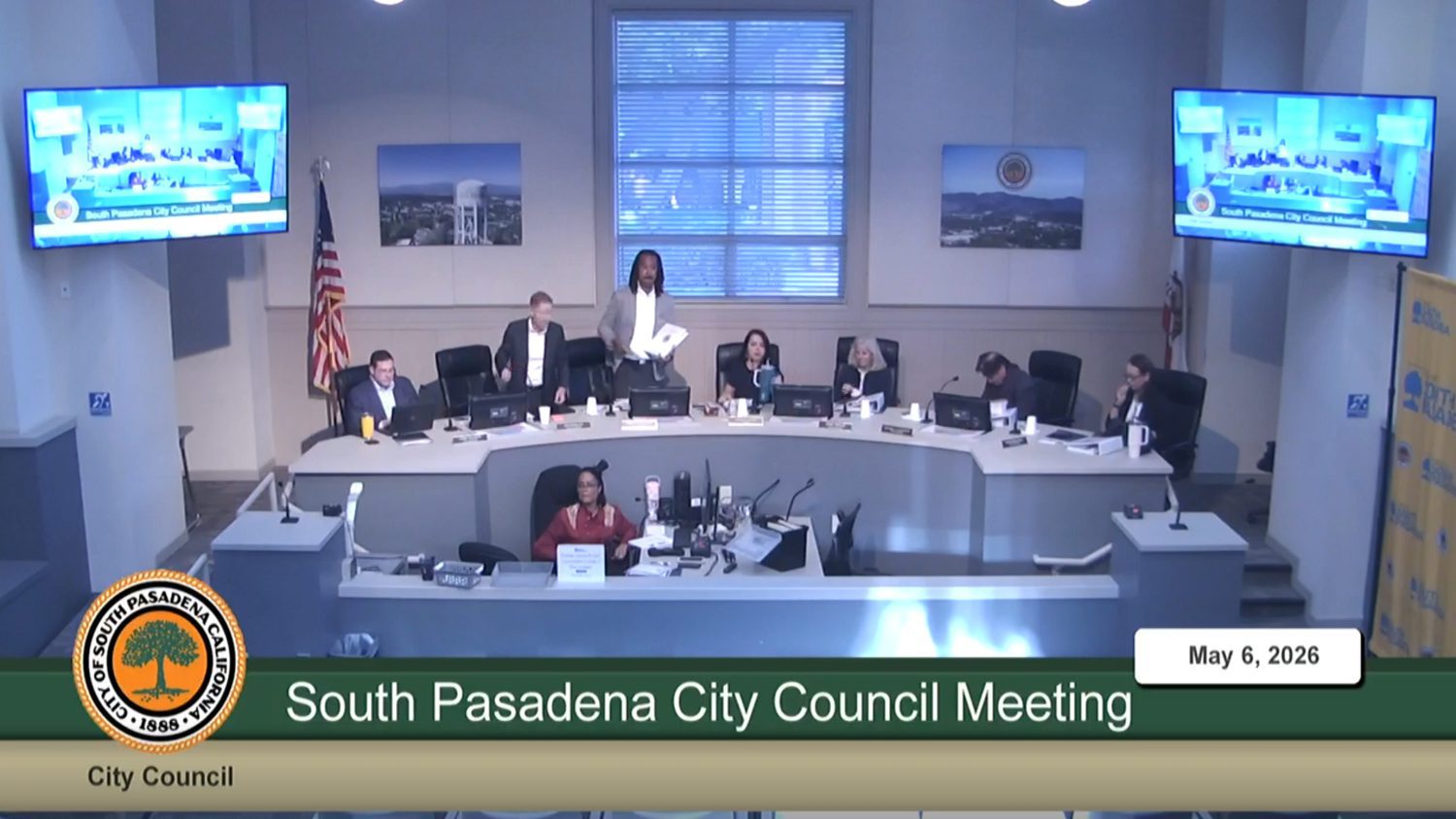
The South Pasadena City Council voted unanimously on June 3 to put a protected bike lane down the full length of Fremont Avenue and to build two new roundabouts, clearing the way for the city’s most ambitious street-safety project in decades. Hours later, the same council pumped the brakes on its transit-housing plan tied to state law SB 79, pointing to guidance from Sacramento that has changed so many times the city cannot yet draw an accurate map.
The Fremont decision capped a study session that began at 6:20 p.m. and ran through more than a dozen public speakers. It was a continuation of a May 7 meeting, where the council approved a design for Huntington Drive but sent the Fremont segment back to staff for a closer look at parking, roundabouts and design alternatives.
Fremont: A Protected Lane, Corridor-Wide
The approved design, labeled Option 2A by consultant Kimley-Horn, puts a two-way cycle track on the east side of Fremont, separated from traffic by a raised barrier, while preserving the center turn lane that fire and emergency crews rely on. The trade-off is parking: most of the spaces removed under 2A come off the east side of the street.

Kimley-Horn divided Fremont — running from Alhambra Road north to Columbia Street — into five segments. The council adopted 2A across all of them except Segment 1, the narrow stretch between Columbia and Grevelia bordering Pasadena, where the tighter right-of-way limits the city to a simpler Option 2 treatment.
The motion, which carried 5-0, also approved two roundabouts at Fremont’s intersections with Hope Street and Oxley Street, designed to slow traffic without forcing full stops, and directed staff to begin the design phase.
Council members weighed 2A against an alternative, Option 5, that would have preserved nearly all on-street parking by routing cyclists and pedestrians onto a shared multi-use path. They rejected it, citing safety and liability. Mixing fast e-bikes with walkers, dogs, seniors and schoolchildren on a single path, several members said, invited exactly the conflicts the project is meant to prevent — particularly at the heavily used crossings near the high school, middle school and Holy Family on Segment 3.
Councilmember Michael Cacciotti, who described himself as a longtime cyclist and a former Caltrans attorney, said Option 5 also carried an unacceptable risk of litigation and would force the removal of far more trees than 2A. Citywide, the consultant’s figures bore that out: across the corridor’s existing 258 parking spaces, 334 trees and 98 palms, Option 2A removes roughly 97 parking spaces while replacing 57 trees, at an estimated $23 million. Option 5, by contrast, would have actually added a handful of parking spaces but required replacing 97 trees, at about $26 million. A “hybrid” approach landed in between at roughly $25 million.
The council was direct about the human cost on Segment 3, where parking demand is highest and many homes that look like single-family houses are in fact multi-unit. Members asked staff to work closely with affected residents on driveway access and to begin a serious conversation about residential preferred-parking permits, noting that nearby schools, churches and the Trader Joe’s and Pavilions grocery stores all draw on the same curb space.
“It’s because they don’t feel safe”
Public comment ran heavily in favor of 2A. Andrea Knopf, an Arroyo Vista parent and co-leader of the school’s “bike bus,” told the council that more than 100 riders joined the group the morning before, and argued that residents who say no one bikes on Fremont have it backward. “It’s not because they don’t want to,” she said. “It’s because they don’t feel safe.” She noted the city has seen three pedestrian-involved collisions near its schools in under two months.
Wes Rudeman of Active San Gabriel Valley pressed for separated infrastructure as the safest option as e-bikes and scooters proliferate, and flagged the corridor’s downhill slope as a reason to keep faster riders away from pedestrians. Several speakers also backed the roundabouts as a tool to tame traffic spilling over from the 710 corridor.
Not everyone was sold. One resident urged the council to scrap the roundabouts, warning that crosswalks set just one car-length back could cause backups, and asked what becomes of Metro bus stops on a narrowed street. A commissioner cautioned that Class 3 e-bikes, capable of nearly 28 mph, may be legally barred from a shared path — a wrinkle the city could address through a local ordinance — and floated a shared-parking agreement with the school district to ease demand on Segment 3. A Segment 3 resident phoned in to describe the difficulty the parking loss would create for elderly, disabled family members, and said outreach to her stretch of Fremont had been thin.
SB 79 plan continued to July
The council’s housing item produced no vote at all. A package of ordinances and a resolution that would adopt a transit-oriented development (TOD) alternative plan under SB 79 — the state’s “Abundant and Affordable Homes Near Transit Act,” which takes effect July 1 — was continued to July 15. The public hearing was opened and left open.
The reason, City Manager Todd Hileman explained, is that the city keeps receiving conflicting and changing instructions from the Southern California Association of Governments (SCAG) and the state Department of Housing and Community Development (HCD) on how to measure the distance from the Metro station that determines which parcels fall under the law. The methodology, council members said, has lurched from a single center point to two points to five, with “radius” guidance shifting underneath them. Staff learned late the week of the meeting that the maps already prepared were, once again, based on outdated rules.
Mayor Sheila Rossi, who sits on both a SCAG committee and the San Gabriel Valley Council of Governments’ SB 79 committee, said she would keep pushing regional bodies to issue consistent guidance in writing — a frustration shared, she noted, across the many cities trying to comply. SB 79 allows local governments to craft their own TOD alternative plan rather than accept the state’s default upzoning, and South Pasadena is attempting to do exactly that.
Senior Nutrition funds & EV Fleet Update
Senior Center South Pasadena: The council unanimously decommitted $17,604 in federal Community Development Block Grant (CDBG) money from its Senior Center Nutrition Program. New Los Angeles County guidance would have required the city to verify participants’ citizenship or immigration status and keep documentation on file — paperwork the council declined to take on for a program it can fund instead from the general fund.
The meal program continues uninterrupted, and the freed CDBG dollars are expected to be redirected to sidewalk and ADA ramp work. One member called the federal requirement an exercise in “national pettiness.”
EV Fleet Movement: The council also authorized Hileman to apply for a South Coast AQMD grant covering 50% of the cost to convert two heavy public works vehicles — a sewer truck and a water-services truck — to electric, using aftermarket conversions where electric models are not yet sold by manufacturers. The city’s share, with the grant, runs about $225,000. That measure passed 3-1, with Councilmember Janet Braun opposed and Mayor Pro Tem Omari Ferguson abstaining.
During general public comment, two residents pleaded for traffic calming: longtime resident Larry Eckholm asked for a stop sign at Oak Street and Diamond Avenue, and a second resident, calling in by Zoom, urged a three-way stop and clearer sightlines at Meridian Avenue and Hope Street.
The council adjourned at 9:27 p.m. Its next regular meeting is set for Wednesday, June 17, at 7 p.m.