

















A bill that began with neighbors comparing notes in an online community-collaborative chat room has passed the California State Senate, carrying with it the frustrations — and the organizing muscle — of the Altadena and Pasadena families still trying to rebuild from the Eaton fire.
Senate Bill 877, the Fair Claims Practices and Transparency Act, cleared the Senate floor last week with bipartisan, unanimous support, 34 to 0. Authored by Sen. Sasha Renée Pérez (D-Pasadena) and co-authored by Sen. Ben Allen (D-Santa Monica), the measure now heads to the State Assembly. For a region where, by survivors’ own counts, only a sliver of destroyed homes have been rebuilt nearly a year and a half after the January 2025 fire, its passage marks one of the first concrete legislative wins to come directly out of the recovery.
What SB 877 does is deceptively simple. When a home suffers a covered loss, the insurer would have to hand the policyholder every version of the documents used to calculate that loss — within 15 days of each version being created. Crucially, the bill requires insurers to name the person who changed an estimate, state their title, and explain in writing why the number moved. Today, California law lets insurers revise loss estimates internally and present only the final figure. Florida closed that loophole after a national investigation exposed widespread underpayment; California has not — until, supporters hope, now.
THE $40,000 CHECK AND THE $98,000 ESTIMATE
To understand why a paperwork requirement matters this much, consider Rossana Valverde, a senior citizen whose standing Altadena-area home was left contaminated with toxic residue from the fire’s smoke. According to the Eaton Fire Survivors Network, State Farm sent Valverde a loss estimate of roughly $40,000, along with a check for that amount.

Then a clerical slip changed everything. The insurer also, apparently by mistake, sent her the original loss estimate prepared by the restoration contractor ServPro. That figure was about $98,000.
The gap between those two numbers is, in practical terms, the difference between remediating a poisoned house and walking away from it. “SB 877 is simple,” Valverde said in testimony cited by sponsors. “It requires insurers to show homeowners the original loss estimates.” Without that disclosure, most policyholders never learn that an earlier, higher number ever existed.
Supporters argue that scenario is not an isolated error but a documented pattern. Roughly 70 percent of Los Angeles fire survivors report that insurance delays and underpayments are slowing their recovery. The San Francisco Chronicle’s “Burned” series — awarded the 2026 Pulitzer Prize for Explanatory Reporting — detailed how insurers using algorithmic valuation tools systematically undervalued homes, leaving Californians who believed they were fully covered unable to rebuild. SB 877’s premise is that survivors can only challenge a lowball figure they’re allowed to see.
HOW IT UPHOLDS THE BARGAIN HOMEOWNERS ALREADY PAID FOR
Sen. Pérez frames the bill less as a new entitlement than as enforcement of a promise. “The insurance industry must uphold their commitment to policyholders,” she said, calling insurers to be “better partners in the region’s recovery.”
That is the throughline of SB 877 and its two companion bills. Survivors paid premiums for years on the understanding that, in a catastrophe, the policy would make them whole. The transparency requirement is meant to restore the most basic term of that contract — that the payout reflects the actual cost of the loss, not a quietly edited version of it. For a homeowner deciding whether they can afford to break ground, an accurate, verifiable estimate is the precondition for rebuilding at all.
Two related measures moved alongside it. SB 878, also by Pérez, penalizes insurers for unjustified delays, requires them to pay undisputed amounts promptly, and attaches interest to late payments. SB 1301, authored by Allen, protects homeowners from abrupt, unexplained policy non-renewals by requiring clearer notice and a real chance to fix any problem before coverage is dropped. Both cleared the Senate this week. If all three survive the Assembly, they head next to the Assembly Insurance Committee.
AN ALTADENA INITIATIVE, BUILT BY MANY HANDS
The story that arguably matters most to neighbors here is how the bill got written in the first place — and the answer is that survivors wrote it.
The Eaton Fire Survivors Network grew out of an Altadena pickleball group chat that Joy Chen and Matt Craig started in the days after the fire. Chen, a former deputy mayor of Los Angeles who now serves as the network’s executive director, watched the group balloon into a mutual-aid and advocacy hub of more than 10,000 survivors and allies, with dozens of moderated channels — roughly half of them devoted to insurance. Pérez named Chen her 2026 Woman of the Year for the district; the network says it has helped unlock more than $100 million in delayed payouts.
Chen has described the bill’s origin candidly. Reading the insurance channels, she kept seeing the same complaint: estimates that left out most of what a home needed. Then a whistleblower adjuster called with an explanation — that the estimates weren’t sloppy, but altered downward before reaching policyholders, and that California’s lack of a disclosure law made it possible. That tip, paired with months of research, became the policy brief that became SB 877.
But Joy Chen is the first to insist she did not do this alone, and the record bears that out. The bill is co-sponsored by Consumer Watchdog, whose Carmen Balber spent months with survivors building the broader insurance-reform package now moving through Sacramento. Some 40 organizations — survivor networks, consumer groups, labor, environmental and civil-justice organizations — signed on in support.
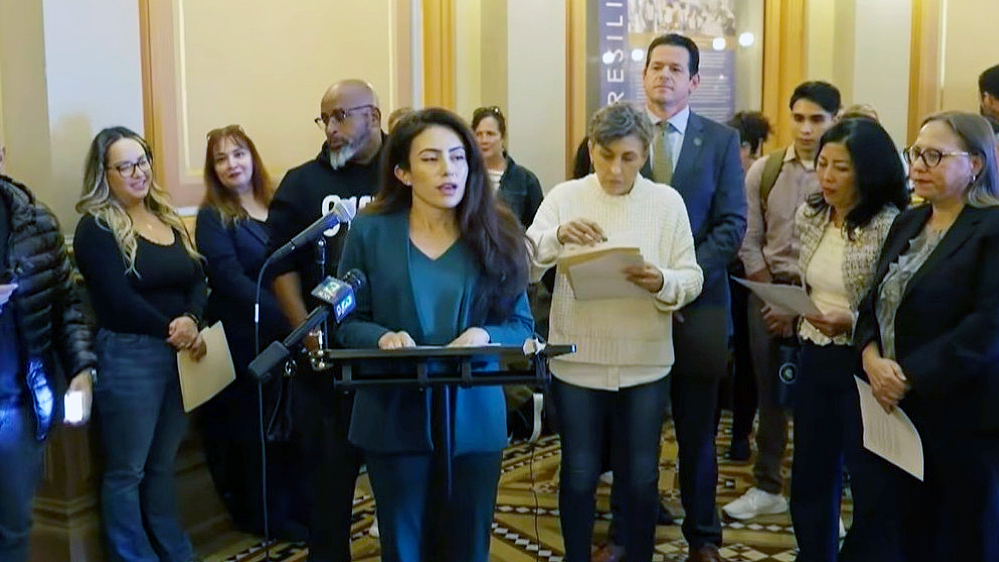
And the pressure that carried the bills to the floor came from a coalition far larger than any single group. On May 19, more than 80 Eaton fire survivors boarded buses to the Capitol in what organizers called the largest survivor-led recovery mobilization in the state this year. That effort was led by the Dena Rise Up coalition, with on-the-ground organizations including My Tribe Rise — whose co-founder Heavenly Hughes has distributed emergency cash grants to neighbors paying mortgages on homes that no longer exist — along with Eaton Fire Residents United (EFRU), the National Day Laborer Organizing Network (NDLON), and others.
Survivors put their own names and stories on the line. Damon Blount, who lost his home and his livelihood in the fire, testified for the accountability bill. Shimica Gaskins traveled north to press lawmakers to protect Altadena’s historic Black homeownership — the community is among the largest concentrations of Black homeowners in Los Angeles County and one of the most diverse neighborhoods in the state. Others, like survivor Esther Lopez, put the stakes plainly: what insurers paid, she said, is not enough to rebuild what was lost, which is why so many families are afraid to even start.
WHAT’S AT STAKE, AND WHAT COMES NEXT
The Eaton fire killed at least 19 people and destroyed more than 9,400 structures, ranking among the deadliest wildfires in California history. The toxic-contamination problem flagged in Valverde’s case remains live: recent testing found that nearly one in five Altadena properties still exceed the state’s residential lead standard even after federal crews declared the cleanup complete.
Against that backdrop, SB 877 is narrow by design — it does not write anyone a check. What it does is hand survivors the documents they need to argue for the money their policies already promised. As the package moves to the Assembly, the survivors who built it intend to keep showing up.
“Los Angeles fire survivors have become civic leaders,” Chen said, “fighting not only for our own recovery.” For South Pasadena and its neighbors watching the region’s slow climb back, the bill is a reminder that the most consequential recovery work has been happening close to home — in church basements, group chats, and chartered buses bound for Sacramento.
SB 877, SB 878 and SB 1301 now await action in the State Assembly. Survivors with information about insurer claims practices can reach the Eaton Fire Survivors Network at [email protected].
Publishers note: information provided by Joy Chen’s ENSN email broadcast contributed to the content of this story.
From the Org’s Website: “The Every Fire Survivor’s Network (EFSN) connects 10,000+ fire survivors and allies across Eaton, Palisades, Malibu, and Topanga. Together, we remove barriers and help families get home. Join us: efsurvivors.net”