













The meeting opened with a moment of silence for Sam Laksman, a local imagineer-builder-craftsman who was active in ‘Buy Nothing’ and ‘South Pas Fix It’ who also helped many residents after the fires. He’ll be missed by many.
After much deliberation: South Pasadena’s pickleball players got their last hour back Wednesday night – court-play until 10PM. Noise and all.
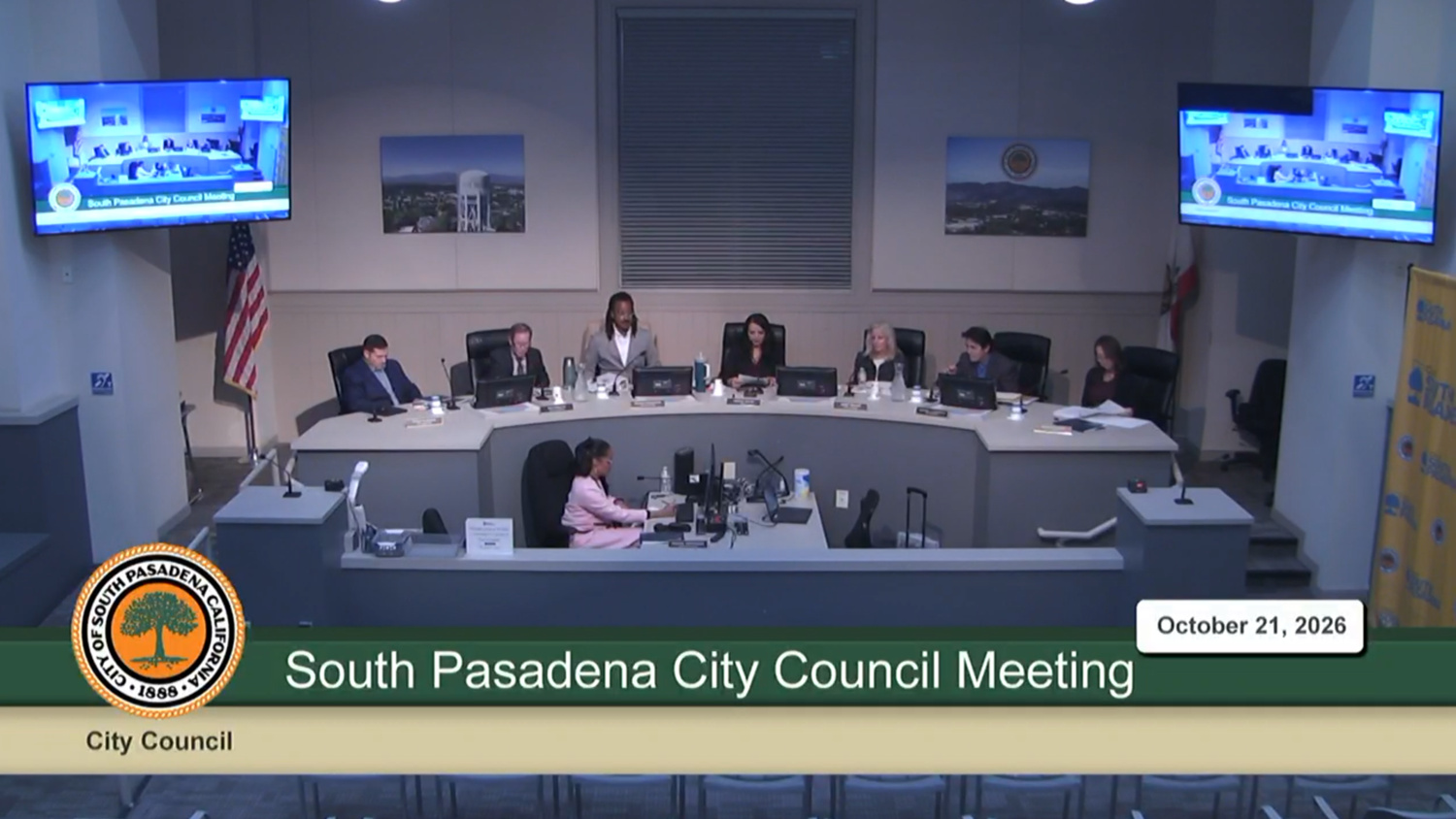
After nearly two hours of public comment, a failed vote, a revived vote, and a mayor openly asking whether anyone on the dais was interested in compromise, the City Council voted to keep the tennis and pickleball courts at Orange Grove Park and Garfield Park open until 10 p.m. That rejects the Community Services Commission’s recommendation to shut the lights off at 9.
The October 21 meeting ran about three hours, and pickleball took up close to two of them. In most cities, a fight over a plastic ball with holes in it, hit by paddles, would take 15 minutes. South Pasadena is not most cities.
What Changes at the Orange Grove and Garfield Park Courts
Court hours will be 7 a.m. to 10 p.m. at both parks. That is a two-hour cut on the front end, since courts currently open at 5 a.m. The 10 p.m. close stays. Councilmember Jon Primuth, who made the motion, attached a condition: players should be off the courts and packed up by 10, not starting to pack up at 10.

First come, first served stays the primary rule at both parks. One court at each park will also be available for optional reservations of up to 60 minutes. If nobody reserves it, it stays open to walk-on play. No-shows lose the court after a 10 to 15 minute grace period.
Groups of 25 or more, along with leagues, tournaments, instruction, commercial use and other organized activities, will need a city permit. Staff will come back with a clearer definition of what counts as “organized.” Staff said a church group or a weekly meetup that recruits players would likely qualify.
Court striping stays the same. Garfield Park keeps its two tennis-only courts. Orange Grove keeps its two multi-use courts, which hold eight pickleball playing areas.
The courts are about to close for resurfacing. Orange Grove is tentatively scheduled for Monday, October 26 through about November 2, weather permitting, with Garfield to follow. The pilot starts when the courts reopen.

The pilot runs six months. The first 30 days focus on education and voluntary compliance. Staff will review at about 60 days. Recreation leaders will be on site roughly 18 hours a week, mostly evenings and weekends. They can enforce rules and settle disputes but cannot write citations; repeat problems can bring warnings, permit suspensions or police. The baseline pilot costs $12,600 and fits in the existing department budget.
How the Pickleball Votes Played Out
Councilmember Michael Cacciotti recused himself because he owns a home within 500 feet of Garfield Park. That left four votes, exactly enough to deadlock.
The hours motion passed 3-1, with Mayor Sheila Rossi voting no. The reservation and permit framework passed 4-0. The first motion to keep striping as-is failed 2-2, with Primuth and Councilmember Janet Braun voting yes and Mayor Pro Tem Ferguson and Rossi voting no.
Ferguson wanted pickleball lines at both parks, arguing the courts are a community resource and should be used as fully as possible. Rossi’s objection was different. She said she would support the existing striping if the council gave something back to the neighbors, such as a 9 or 9:30 close or a cap on how many people can crowd onto the courts. She floated 32.
“I haven’t heard compromise on this,” Rossi said, adding that she had not heard much consideration for “other people’s children and other people’s needs.”
With the courts about to be resurfaced, the city manager told the council it had to give the contractor some instruction. Without one, the courts would likely be restriped tennis-only. Primuth brought the like-for-like motion back, Ferguson switched, and it passed 3-1 with Rossi voting no. The full pilot program then passed 4-0.
After the pilot vote, Rossi said she wanted to change her earlier no votes on hours and striping, on the condition the matter comes back in six months. The city attorney said the votes had already been taken but the minutes can note her support.
During the striping debate, Rossi also raised what she called an ethics question.
The Noise Problem and the $30,000 Sound Barrier
The whole fight comes down to noise. Code enforcement measured sound at Orange Grove between 51.7 and 72.4 decibels, though staff said that alone does not prove a violation.
As of September 22, code enforcement had no formal court noise complaints for 2026. Police logged one related call, and Community Services received one resident complaint. One more complaint came in this week.
Rossi said those numbers don’t tell the whole story. She said she had sat in the home of a family across the street who cannot get their small children to sleep because of the nightly noise. She also said one group tied to the park on the app Pickleheads lists 366 players and 27 private coaches, though the city does not allow private instruction there. She said the problem is less the sport itself and more the size of the crowd after 9 p.m., with reports of meetups reaching 60 people.
The council voted 3-1 to direct staff to install sound-dampening panels along the Orange Grove fence, with Ferguson voting no. Staff estimates up to $30,000 with installation, and no money is budgeted yet. If staff needs a budget change, it will return November 18.
Ferguson preferred to collect sound data first and avoid spending unbudgeted money before the November 3 election, noting that the new resurfacing could change how sound bounces off the courts. Rossi supported the panels but warned that if Measure SOS fails and the city has to cut, court hours are on the table. “Time is going to be what’s cut,” she said.
What Pickleball Players Told the Council
Eight residents spoke, six in person and two via Zoom. Seven opposed the 9 p.m. close.
Stephen Wang said he puts his five-year-old to bed by 8 or 8:30, and that’s when his window to exercise opens. “It’s not a preference,” he said. “It’s the only realistic option.” Without the last hour, he said he’d be driving 20 minutes each way to play in San Gabriel.
John Michael Rebus, a resident since 2008, asked why the city would cut the 9 to 10 hour before the pilot even studied it. Dennis Kwok asked whether a group of friends who meet twice a week through a group chat suddenly become an “organized event” needing permits and insurance. Annie Chen, Simon Law and Sarah Yamada, who spoke via Zoom, urged sound barriers and quieter paddles instead of shorter hours.
Community Services Commission Chair Anthony Eli, speaking for himself, pushed back on claims his commission had not done its homework. He said commissioners visited the park, heard from neighbors about loud play and amplified music, and recommended 9 p.m. partly because net teardown was running past the 10 p.m. park closing.
Council Formally Endorses Measure SOS Streets Bond
Before the pickleball fight, the council adopted Resolution 8041, formally supporting Measure SOS, the $80 million general obligation bond for streets, sidewalks, curbs and gutters on the November 3 ballot.
Assistant City Manager Nick Kimball laid out the numbers. South Pasadena’s pavement condition index is about 54 on a 100-point scale. The city faces a $7 million to $8 million annual gap in street funding and gets about $2.5 million a year in dedicated street money. Over the past decade, bad streets have cost the city more than $7 million in damage and injury claims.
The bond needs two-thirds voter approval. The cost is about $33 per $100,000 of assessed value, per property, not per resident.
Kimball said the money is legally restricted to streets and sidewalks, with annual reporting and quarterly project updates to council. He also noted that gas tax money is handed out by population, not traffic, which shortchanges a city of 26,000 that sees more than 100,000 cars a day.
If the measure fails, the city goes back to saving its $2.5 million for three or four years to afford one big project at a time. Yes on SOS supporter Dean Serwin said finding the money elsewhere would mean cutting roughly 10 percent of the general fund.
Rossi and Braun Named to Olympics Planning Committee
The council formed an ad hoc committee to prepare for the 2028 Olympic and Paralympic Games, with Rossi and Braun as members. Rossi said she has been working on it since January 2025 with a small group that includes Chamber of Commerce leaders and South Pasadena Educational Foundation President Rob Clyde.
Nobody expects a windfall. The committee’s first job is a preliminary plan for the council’s February goal-setting session. Ideas floated include a two-week trial closing Meridian Avenue as public space.
Police EVs and Smarter Signals on Fair Oaks
The council approved, 5-0, the purchase of two 2027 Chevrolet Blazer EVs and one 2027 Chevrolet Silverado EV for police, paid for through a California Highway Patrol Cannabis Tax Fund grant. The city will compare them against its Tesla patrol cars, with a fleet recommendation, possibly including hybrids, expected next spring. Cacciotti, who drove a Blazer on a ride-along, said it handles as well as the Tesla, sometimes better.
The council also approved, 5-0, plans for new traffic signal technology on Fair Oaks Avenue. The upgrade gives pedestrians a few seconds’ head start before cars get the green, automatically, no button required.
What Residents Raised in Public Comment
A resident who read the 1,000-plus page Huntington-Fremont corridor traffic study warned that removing the right-turn lane from northbound Fremont onto Huntington, used by about 300 of 800 cars, would cause backups. A resident via Zoom asked the city to replace the locked gate near the Arroyo Seco stables with posts that block cars but let cyclists and wheelchairs through.
Next Meeting Canceled for Eddy Awards
The council’s next regular meeting is canceled. South Pasadena is a finalist for an Eddy Award for economic development in the small-city business-friendly category, and the ceremony conflicts.
The prescription drug take-back is this Saturday, 10 a.m. to noon, at the Police Department. Ferguson also asked for a report on how the city’s tree ordinance applies to palm trees.