















The South Pasadena Unified School District (SPUSD) Board of Education adopted its generative AI policy, approved a new three-year Strategic Plan, cleared the way to sell up to $46 million in Measure SP bonds, and ratified raises for teachers and staff on Tuesday night, while longtime board member Dr. Michele Kipke delivered her final board report.
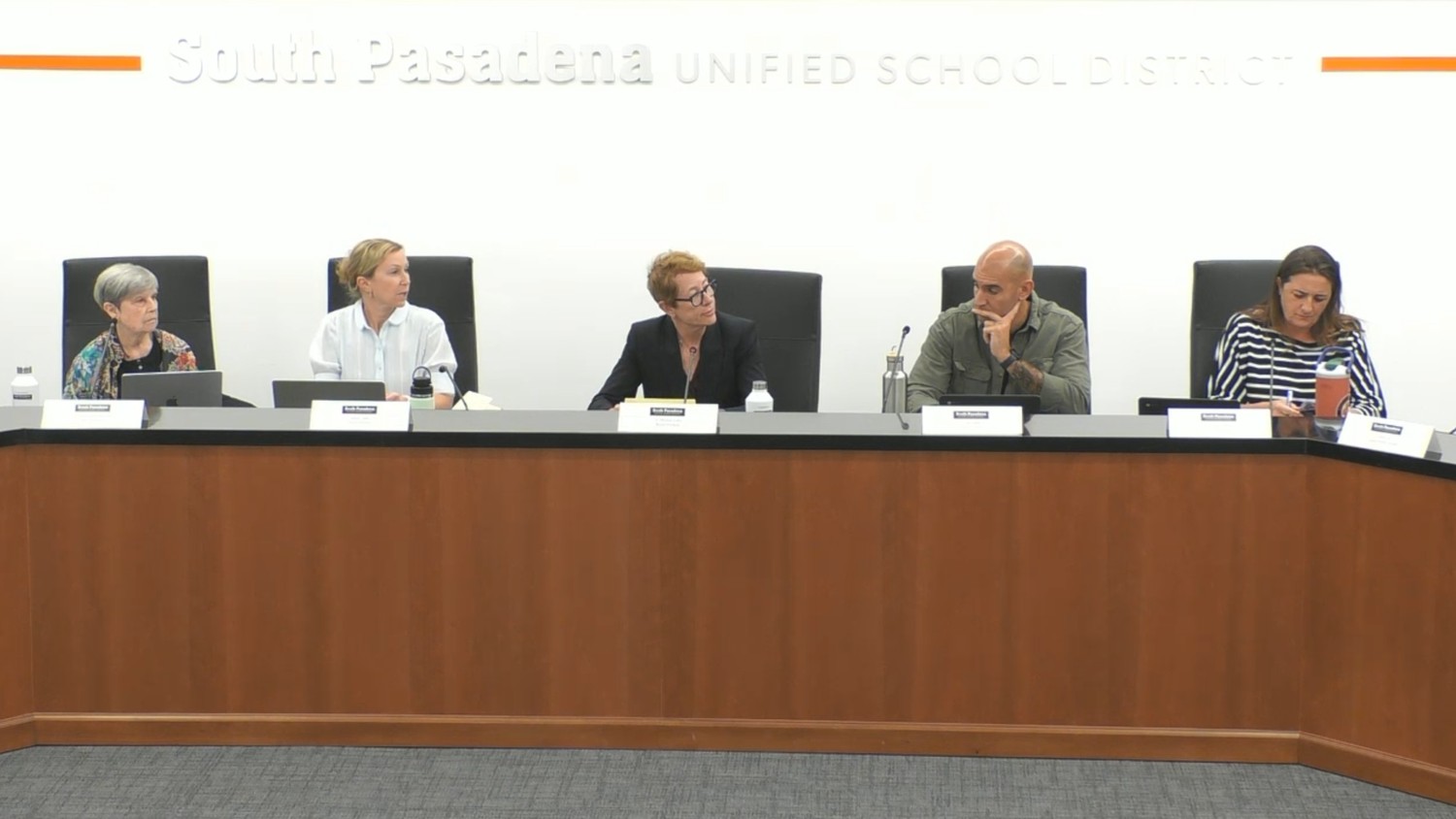
The board met on November 10, 2026, in a meeting that began with a closed session and reconvened in open session at 6:30 p.m. All five board members were present: Dr. Michele Kipke, Karissa Adams, Dr. Patricia Martinez-Miller, Zahir Robb and Karen Tamis, along with the student board member. Every action item for which a vote was recorded in the transcript passed with unanimous “aye” votes.
Closed Session Report
Returning from closed session, the board reported that it approved two settlement agreements involving students, each by a 5-0 roll call vote. No public comment was offered on the closed session items before the board recessed.
Board Adopts Generative AI Policy After Public Comment
The board approved a package of new and revised board policies, first presented on October 13, that included Board Policy 0441 on generative artificial intelligence. Speakers said the policy blocks generative AI on student devices except when a teacher explicitly assigns it. Student use must be disclosed, and existing plagiarism and academic integrity rules apply.

The vote followed a second round of public comment on the policy, which came after a similar round at the October meeting (read our Oct. 13 meeting coverage). Parents praised the changes made since October but urged the board to go further:
- Alyssa Misinga, the parent of a University of California, Irvine sophomore and an SPHS senior, said she is not against AI, Chromebooks or cell phones but opposes introducing them at too young an age. She asked for four additions: age-appropriate guidelines, clear expectations for independent work at home, evaluations that measure what students learn, and a commitment to revisit the policy as research emerges. “Let’s make sure they learn how to think before we teach them how to outsource their thinking,” she said.
- Sophie Ellsberg, a member of Touchgrass South Pass and parent of an Arroyo Vista first grader, said the policy does not go far enough but that the board took public comment from the last meeting “to heart.” She said parents have asked the board for the research behind its decisions and pointed to districts such as New York City and Los Angeles Unified that have changed technology policies.
- Nick Ellsberg called the changes “a step in the right direction” but said the policy’s exception for teacher-assigned AI use should be removed unless a benefit can be demonstrated. He also asked that staff be required to disclose their own AI use to students and parents, and that the policy ban generative AI on student personal devices used at school. “However, the time for that refinement is now,” he said.
- Andrew Adjemovich, an architect and a parent of three Arroyo Vista students, said he uses large language models in his work but argued that in the classroom they are “shortcuts to thinking.”
- Dr. Sadie Jefferson, an Arroyo Vista PTA officer who said she was not speaking for the PTA, said she leads the Los Angeles Unified School District’s education foundation and helped LAUSD write its own policy. She called the teacher-permission exception a “loophole,” saying classroom-by-classroom carve-outs create inequities and burden teachers. She urged a uniform block until peer-reviewed research shows academic benefits.
- Heather Bland, a parent, urged the board to use policy to encourage human connection, and thanked parents and students who speak at board meetings.
Board members said the policy reflects the community’s values and was strengthened by public feedback. One board member said district staff spent hours writing code to turn off Google’s Gemini after it appeared on district accounts, and that teaching departments had already written their own AI rules into course syllabi. Another described a teacher exercise in which students completed writing prompts themselves, then had generative AI answer the same prompts and compared the results. Students concluded they did not want to use it, the board member said.
Board members said the policy covers students’ use on any device, requires disclosure if students use AI, and applies existing plagiarism rules. They also said teachers are working on changing assignments, such as writing essays in class, so AI does not become a way to cheat, and that AI should not be used to grade student work. One board member called the policy “a beginning” rather than an ending, and members said it will be revisited as the technology changes.
Strategic Plan Approved
The board approved the district’s Strategic Plan, which district leaders said was developed over several weeks, including two special board meetings and input from the spring 2026 Local Control and Accountability Plan (LCAP) survey of students, parents, teachers and staff. Administrators outlined four goals:
- Goal 1: Empower future-ready students. The goal includes partnerships with local businesses, higher education institutions and community organizations for real-world opportunities; sustaining world language opportunities and culturally relevant teaching; developing a fully realized multi-tiered system of supports (MTSS); embedding digital literacy, project-based learning and college and career readiness; and maintaining dual enrollment courses.
- Goal 2: Cultivate relational and restorative school communities. The goal includes helping students find ways to connect through athletics, activities, arts and academics; equitable access to mental health supports and restorative practices; evidence-based social-emotional learning; and elevating student voice.
- Goal 3: Retain, recruit and support teachers, staff and administrators. The goal calls for a culture of belonging among employees and professional development grounded in current research.
- Goal 4: Maintain long-term financial sustainability and operational excellence. The goal includes realizing the Measure SP bond program to upgrade and modernize campuses, improving physical security and energy efficiency, and revising financial projections to ensure long-term stability.
Board members praised the plan as a roadmap. Dr. Martinez-Miller asked that the district make more explicit how actions under the plan are carried out and what impact they are having, reporting on a monthly or every-few-months basis rather than only annually, so the public can see in real time what needs to change. The student board member said the goals reflect the “soul and spirit” of the high school and that she looks forward to seeing them implemented.
Measure SP Bond Actions and Insurance Change
The board took four actions on the Measure SP school bond approved by voters in the June 2, 2026, election, thanking the community for its support.
- It adopted a resolution certifying the Los Angeles County Board of Supervisors’ proceedings on the Measure SP election results.
- It established the independent citizens’ bond oversight committee and approved its bylaws. District staff said oversight committees are how the district ensures accountability and transparency, and thanked past volunteers.
- It authorized the sale of South Pasadena Unified School District 2026 General Obligation Bonds, Series A, in an amount not to exceed $46 million. Staff said the resolution allows the district to go out and sell the bonds within the next 60 days and that the first draw would probably be in the range of $24 million to $26 million, with the higher cap giving room if the tax base changes.
- It approved a lease-leaseback procedure under Education Code Section 17406 for the larger Measure SP projects. Staff said the district will interview general contractors and select one based on more than the lowest price. The board also approved pre-qualification bids for general contractors on its consent calendar, which staff described as the first step for contractors seeking to be selected.
In a separate action, the board approved a resolution to withdraw from the Schools Excess Liability Fund (SELF) joint powers authority. Staff said the district gets its liability insurance through ASCIP, which will now also provide excess liability coverage with a much higher limit; SELF has a coverage limit that it would not raise despite years of requests. Board members said they were glad to have coverage “under one roof.”
Raises for Teachers, Classified Staff and Management
The board approved tentative agreements with the Teachers Association of South Pasadena (TASP) and the California School Employees Association (CSEA), South Pasadena Chapter 17, concluding negotiations for the 2026-2027 school year. District officials said TASP and CSEA members had ratified the agreements. The TASP agreement covers salaries and class size. CSEA negotiations began in the summer, concluded in October and covered salary and language articles.
The board also approved the same salary increase for management and confidential employees, as well as the public disclosure of the agreements’ costs required by Assembly Bill 1200. According to the posted agenda, the increase is 5%, with costs of $1,490,750 for TASP, $419,553 for CSEA and $331,529 for management and confidential groups.
The board also approved amendments to the employment agreements of the executive director of student support services, the assistant superintendent of human resources and the assistant superintendent of business services, with salary increases in line with those for the other employee groups.
Dr. Michele Kipke Delivers Final Board Report
During board reports, Dr. Kipke said it was her last board report and that it has “truly been an honor” to serve on the school board for nearly 20 years. She thanked the community, past board members, current colleagues, district leaders, principals, educators and employees, noting that her two daughters went through SPUSD from kindergarten through 12th grade. “I will forever be grateful for what has truly been a gift for a third of my life,” she said.
Parents Raise Questions About Advisory Committees
The board held a first reading of revised Board Policy 1220, Citizens’ Advisory Committees, which will return for action at the next meeting. District staff said the policy distinguishes committees required by the Education Code or the Brown Act, such as the citizens’ oversight committees for the parcel tax and bond, from committees established by the superintendent or staff, such as the EdTech Committee.
Kristen Swift, a parent who recently joined the EdTech Committee, asked the board to clarify the two types of committees and how members are selected, saying parents had been unable to get answers about how the EdTech Committee was formed. She also asked for more communication, including announcements when the district’s “Tech Tidbits” page is updated.
The student board member said students on the EdTech Committee were selected from the high school’s Associated Student Body, about 36 students among roughly 1,500, which she said is not very diverse or representative. She asked whether recruitment could reach more students.
Staff said the Education Code sets diversity and parity requirements for some committees, and that tying all of them to the policy would lock the district in if the code changes. The superintendent said any future superintendent’s committee would be communicated widely. Board members suggested that the practice of public communication could be strengthened without changing the policy.
Parent Raises Special Education Concerns
Megan Kaiser told the board that her daughter still has no services or access to education three months into the school year. Kaiser said she attended an individualized education program (IEP) meeting Tuesday, at which she received signatures for assessments she has sought all year, and that it was the first time she was asked whether her daughter has a Chromebook.
Kaiser said her daughter’s teacher and caseworker have told her they are not allowed to communicate with her outside of an IEP meeting. She said she has been banned from campuses where her program is located, which she said has affected her employment. She urged the board to hold people accountable, saying the district is spending money on attorneys for due process proceedings even though the parties agree on the assessments. The board did not respond to her comments, citing the Brown Act, which limits board discussion of items not on the agenda.
Student Board Member Opens With Academic Milestones
In reflections on the district’s vision and mission statement, the student board member said SPHS has 669 students registered for 1,648 Advanced Placement exams, up from 626 students and 1,577 exams last year, and that late registration could push the total to about 1,800. She also reported that 361 students took the October 17 PSAT, scoring well above state and national averages, and that two students earned perfect scores of 1520. SPHS will hold its National Merit Breakfast next Wednesday for the class of 2027, honoring nine semifinalists and more than 20 commended scholars.
The student board member also reported on SPHS activities, including:
- Homecoming: 98 student organizations sold items at the picnic, the Tigers won 31-0 over San Gabriel, and 572 students attended the dance at the Pasadena Convention Center.
- Band: The Tiger Marching Band took first place overall at the WBA 1A competition at Don Lugo High School on Halloween, with section awards in general effects, high percussion and high guard, which she said was the color guard’s first win in that category in a decade. The band is headed to semifinals this Saturday and finals in Fresno next Saturday.
- TAG Day: “Tigers Achieving Greatness” honors more than 600 students with GPAs above 3.5 or 1.5-point improvements. Upperclassmen were recognized last Friday and freshmen will be recognized next Friday.
- Fall play: SPHS Drama’s “Rio Hondo” had two shows on Nov. 6 and 7 and has three more this Friday, Saturday and Sunday.
- Upcoming: a Lifestream Blood Bank drive on Nov. 19 (students 15 and older may donate with signed parental consent); the California Scholarship Federation application, open in room 923; an eLaunchpad entrepreneurship workshop in the SPHS cafeteria for middle and high school students on Saturday; the Wellness Fair on Dec. 1; the Winter Dance Concert on Dec. 4 and 5; and the annual Tiger Run on Dec. 5. Veterans Day on Wednesday is a no-school day.
Another board member, who reported on the high school, added that the football team earned its 12th consecutive CIF playoff berth under head coach Jeff Chi and went undefeated in its new league. Both cross country teams were league champions and advanced to CIF, girls golf and tennis competed in CIF, boys water polo finished second in the league, and the school completed the first season of flag football. The board member noted that the volleyball seniors were sophomores on the team that won the school’s first state championship. The board member also asked families to support the Tiger Run and the Bingo committee, saying Bingo brings in outside money for extracurricular activities and is losing volunteers.
Board Liaison and Superintendent’s Reports
Other board members highlighted a Monterey Hills, SPMS and SPHS collection drive for unhoused neighbors throughout November, the SPMS holiday book fair with Roman’s on November 30 through December 7, an SPMS art cart every Wednesday, and a retro game night at the library on Friday from 3 to 5 p.m. At Arroyo Vista, a board member reported on work toward a sensory playground and sensory classroom. At Monterey Hills, fourth graders learned basket weaving from Native American guides in connection with “Island of the Blue Dolphins.” The Special Needs Committee has a representative from each school site, with upcoming events including special tickets to the Rose Parade and the adaptive all-city track meet.
During the instructional update, a district administrator thanked transitional kindergarten and kindergarten teachers for embracing play-based learning and thanked EdTech Committee volunteers. The committee has so far addressed mobile device use, Chromebook parent monitoring (the district piloted Custodio) and generative AI, and is now working on screen time and technology guidance. In the human resources update, officials thanked the TASP and CSEA negotiating teams. The district also highlighted the Harvest of the Month program, in which the food and nutrition services director spends three days each month at an elementary school.
The meeting also recognized the 17 SPMS students who took part in this year’s PTA Reflections Art Program, on the theme “What Does Your Culture Mean to You?” Mike Brennan, the middle school’s PTA Reflections chair, said all 17 deserve recognition for creating and sharing their work. “There isn’t one way to express an idea,” he said.
Consent Calendar and Next Meeting
The board approved consent agenda items 1 through 34 without any being pulled for discussion.
The board meets in person at the SPUSD District Office, 1100 El Centro Street, and livestreams its meetings. Community members who wish to speak at a future meeting can submit a speaker card and have three minutes. The revised Board Policy 1220 is expected to return for action at the next meeting. For agendas, policies and the meeting schedule, visit spusd.net. Read our preview of the November 10 agenda.