













UPDATE: Now extended through December 8
East West Players opened it’s third production of Stephen Sondheim’s “Pacific Overtures”, directed by Tim Dang, on Sunday and I can’t think of a better way to be in community at this moment in history and to kick off a new era at East West Players under the direction of the company’s fifth Artistic Director, Lily Tung Crystal.
The company has a history with this show having produced it in 1979, starring their founder, Mako, after he originated the role of The Reciter on Broadway in 1976. When the company moved into their permanent home at the Union Center of the Arts in downtown Los Angeles in 1998, “Pacific Overtures” was their inaugural show, directed by Dang. He returns now, in 2024, for this new stunning and timely production that runs through December 1st.
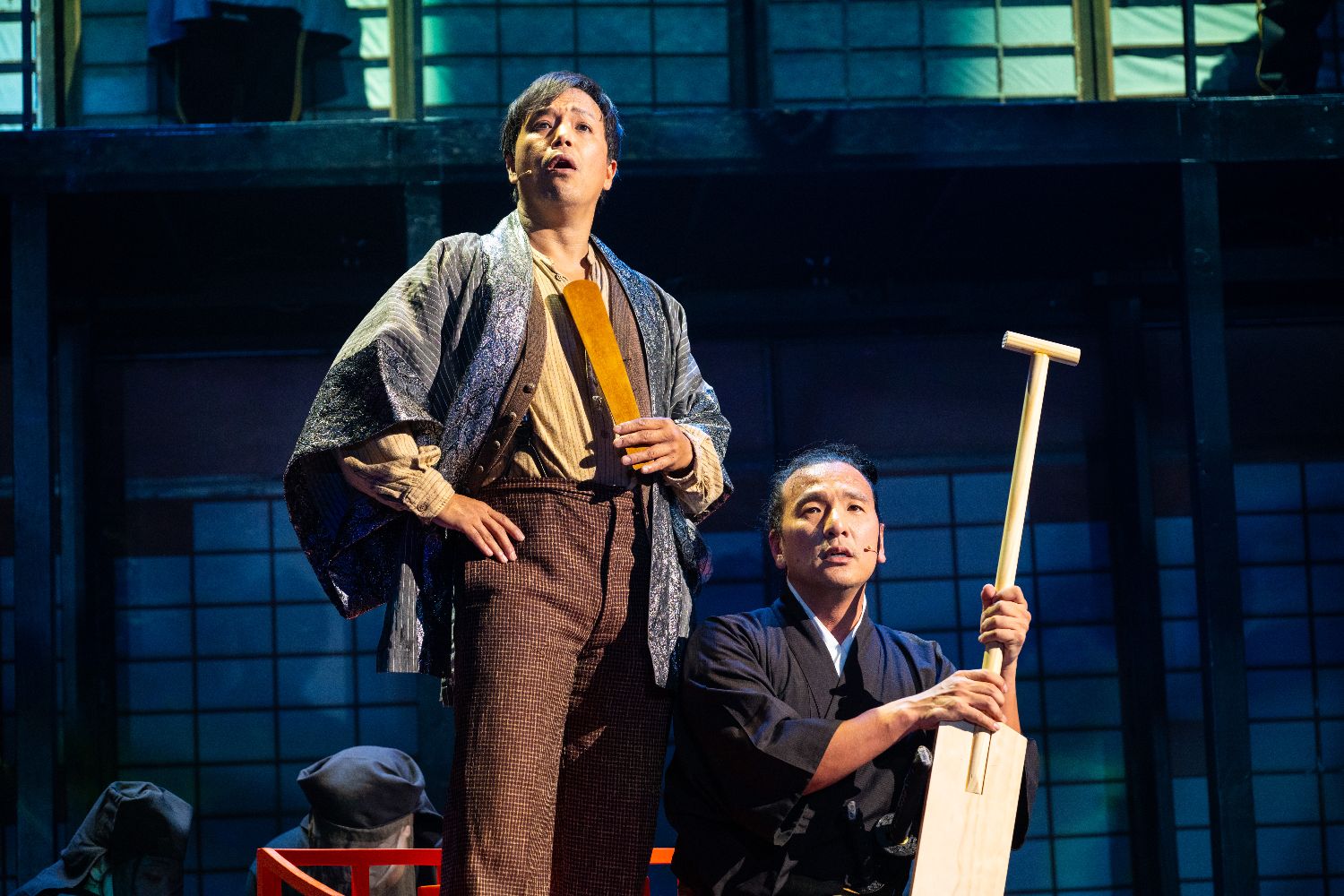
I am unsure I will be able to convey the depth of emotion I felt watching this show. Let me be clear, it is an extraordinary production for anyone, but as an Asian-American, it was a profoundly moving experience that came with layers of emotions. No matter who you are though, you’re going to feel some kind of way.

John Weidman wrote the book and Sondheim wrote the music and lyrics to this historical piece that centers around the moment when Japan went from 260 years of isolationism to being forced to Westernize with the appearance of American gunboats in their harbor. As the Emperor is still a child, his Shogun is largely in charge, and his councilor, Lord Abe, engages a samurai (Kayama) and an Americanized fisherman (Manjiro) to row out to the gunboats to negotiate. They end up devising an elaborate plan to have these negotiations in a temporary teahouse that technically doesn’t touch Japanese soil, enabling them to ultimately disregard the treaty. However, foreigners eventually do power their way through, from Americans to the Dutch, French and English force trade treaties and so begins the eventual Westernization of Japan, for better or worse.
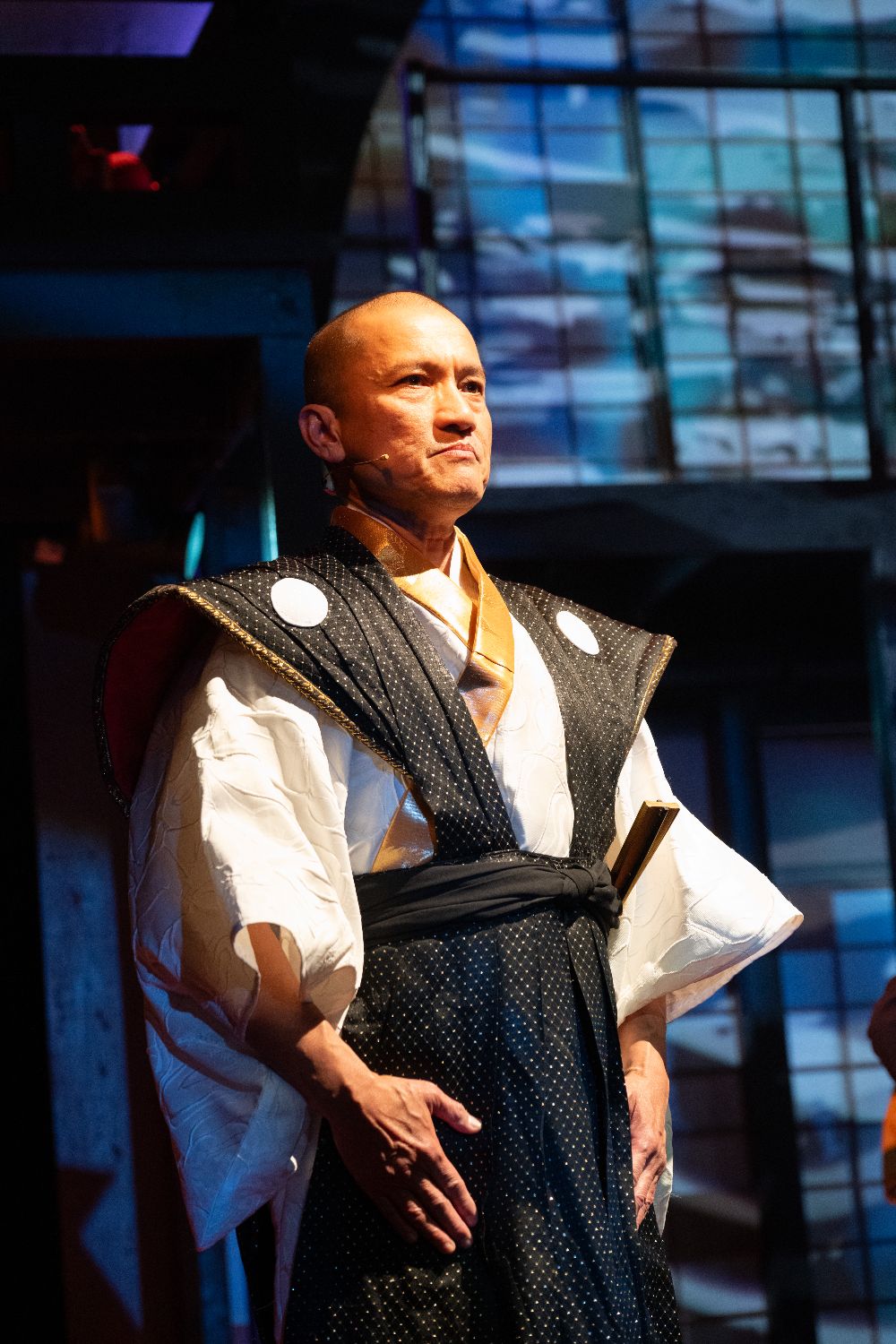
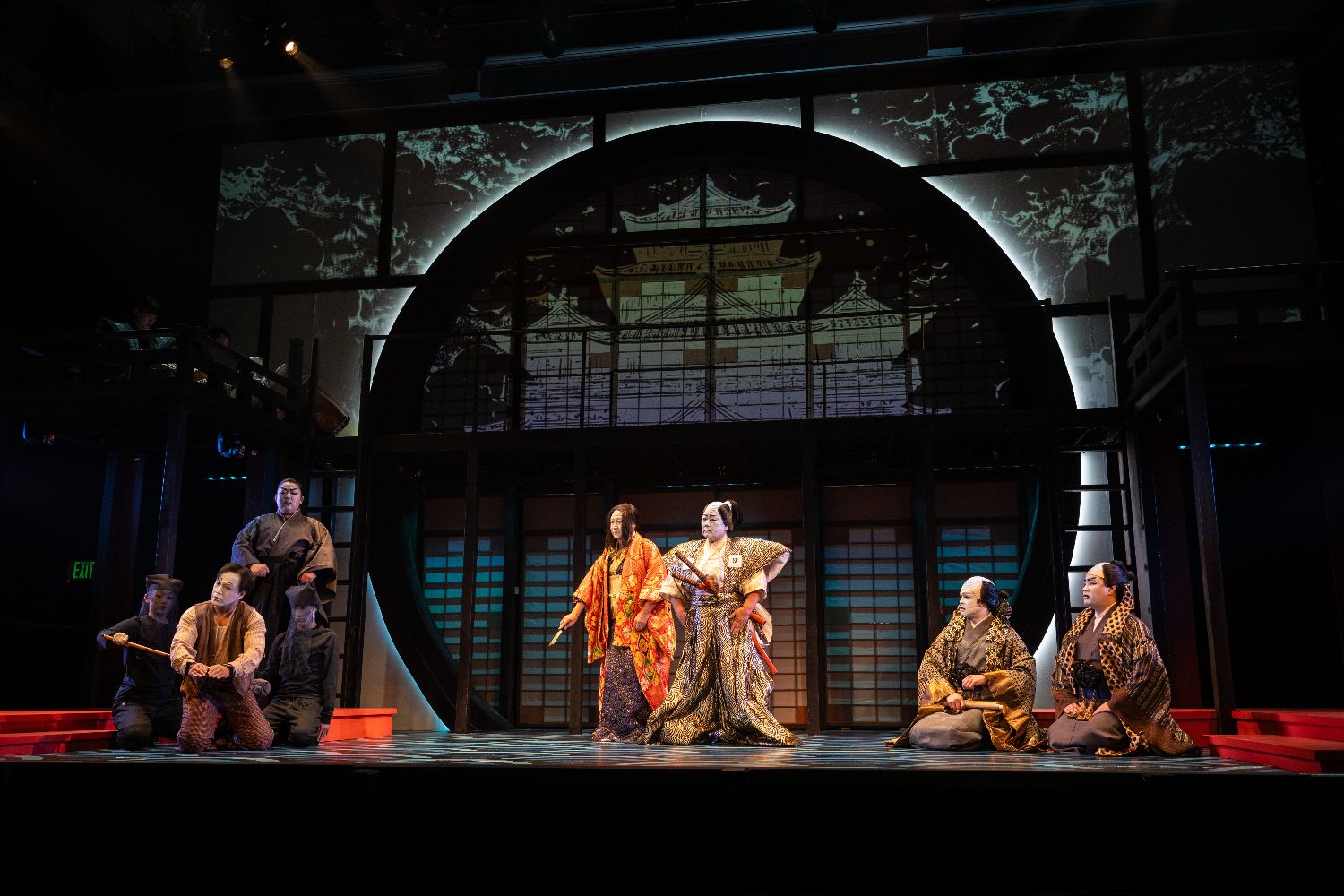
It’s a story of a country on the brink of change and the musical focuses on themes of shared history and how it marches on and how we find our place in it, which is at once miniscule and immense. The David Henry Hwang theatre is an intimate space and although the themes of Overtures are expansive, putting it in a smaller space allows the focus to be on the characters and the music. There is a live orchestra led by Marc Macalintal that incorporates traditional Japanese winds and Taiko drums that expertly takes on the score that is dizzying in its intricacy. While I have loved seeing lush, large-scale Sondheim productions, I appreciated the intimacy of Sondheim done small, while still incorporating the absolute big, bold expressiveness, mask work and puppetry traditions of Kabuki and Noh theatre. I felt transported to a small village in 19th century Japan.
The Naomi Yoshida costumes feel authentic and highly glamorous, working in contrast yet seamlessly with the sleek, naturalistic and traditional Tesshi Nakagawa set design. There are teahouse screens that allow for clever entrances and for the David Murakami projections that punctuate and further illustrate the action on stage.
This cast is a dream starting with the captivating performance of Jon Jon Briones as The Reciter, who acts as narrator, as well as the Shogun and Emperor. Briones is coming off his run as Hermes in Hadestown on Broadway, having had an illustrious career including the role of the Engineer in the West End and Broadway revival of Miss Saigon. He elevates the proceedings with his precision, stillness and beautiful voice. Kerry K. Carnahan is a formidable presence as Lord Abe and brings a subtle poignancy to Abe’s bewilderment as all the foreign emissaries descend in the menacingly humorous “Please Hello”. Adam Kaokept is a wide-eyed and ardent Manjiro while Brian Kim McCormick brings an earnest and quiet dignity to the samurai, Kayama.
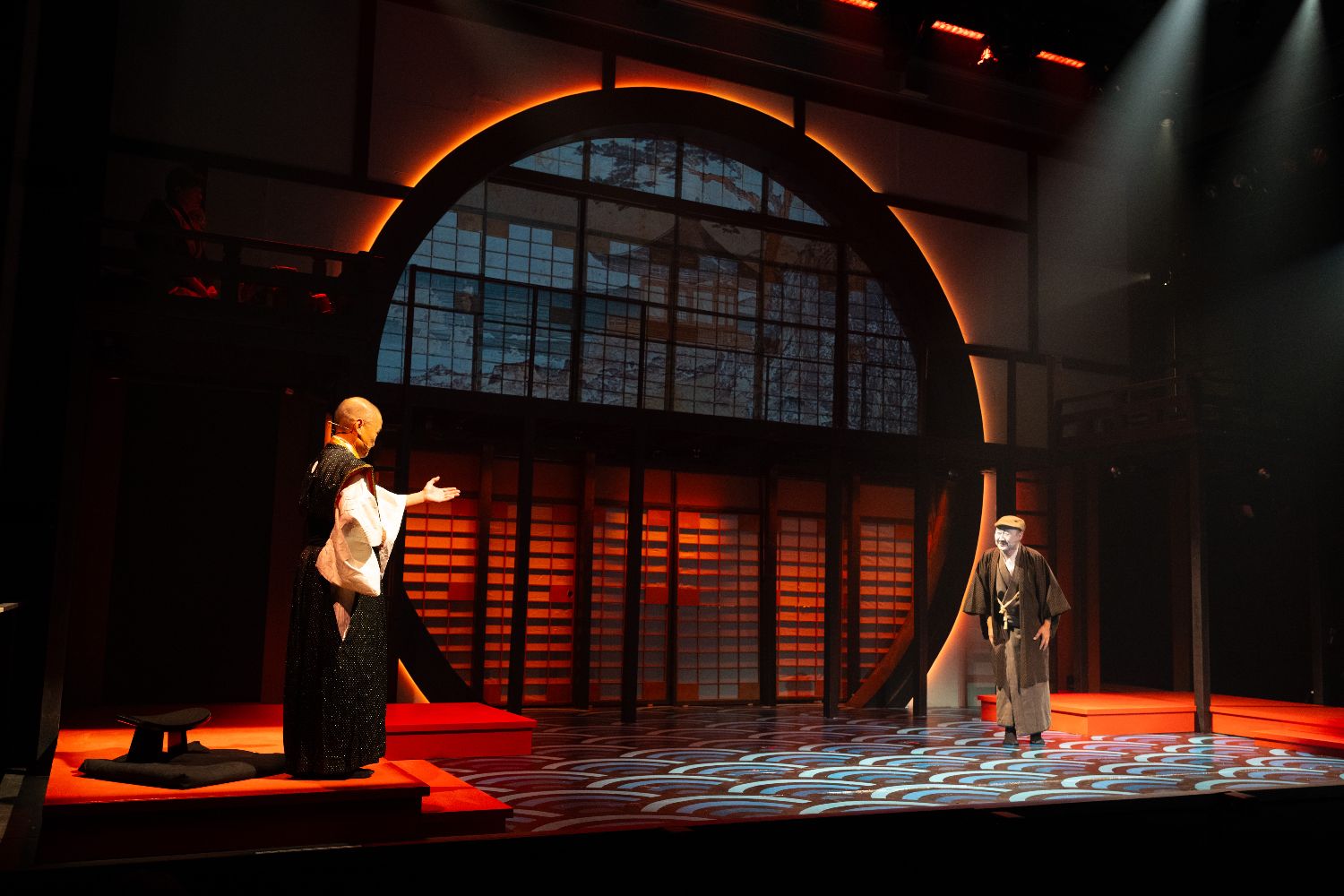
There is an arresting moment that comes at the end of Act I when The Reciter tells the audience that no one really knows what happened during the treaty discussion that took place between America’s Commodore Perry and the Shogun in Kanagawa. An old man comes forward to offer that he was in fact there and saw everything, to which The Reciter expresses doubt. The old man says he was a boy of ten who climbed a tree and says, “I was younger then.” The irrepressible Gedde Watanabe plays the old man (as well as Shogun’s Mother and the Imperial Priest) and witnessing the almost 70 year-old sing with his younger self in “Someone in a Tree”, knowing Watanabe played the boy in the tree in the original Broadway production 48 years ago, was a profound honor. He sings it with such depth of emotion and nostalgia that it crystalizes everything the show is about in one extraordinary song – arguably one of the most perfect songs ever written for musical theatre.
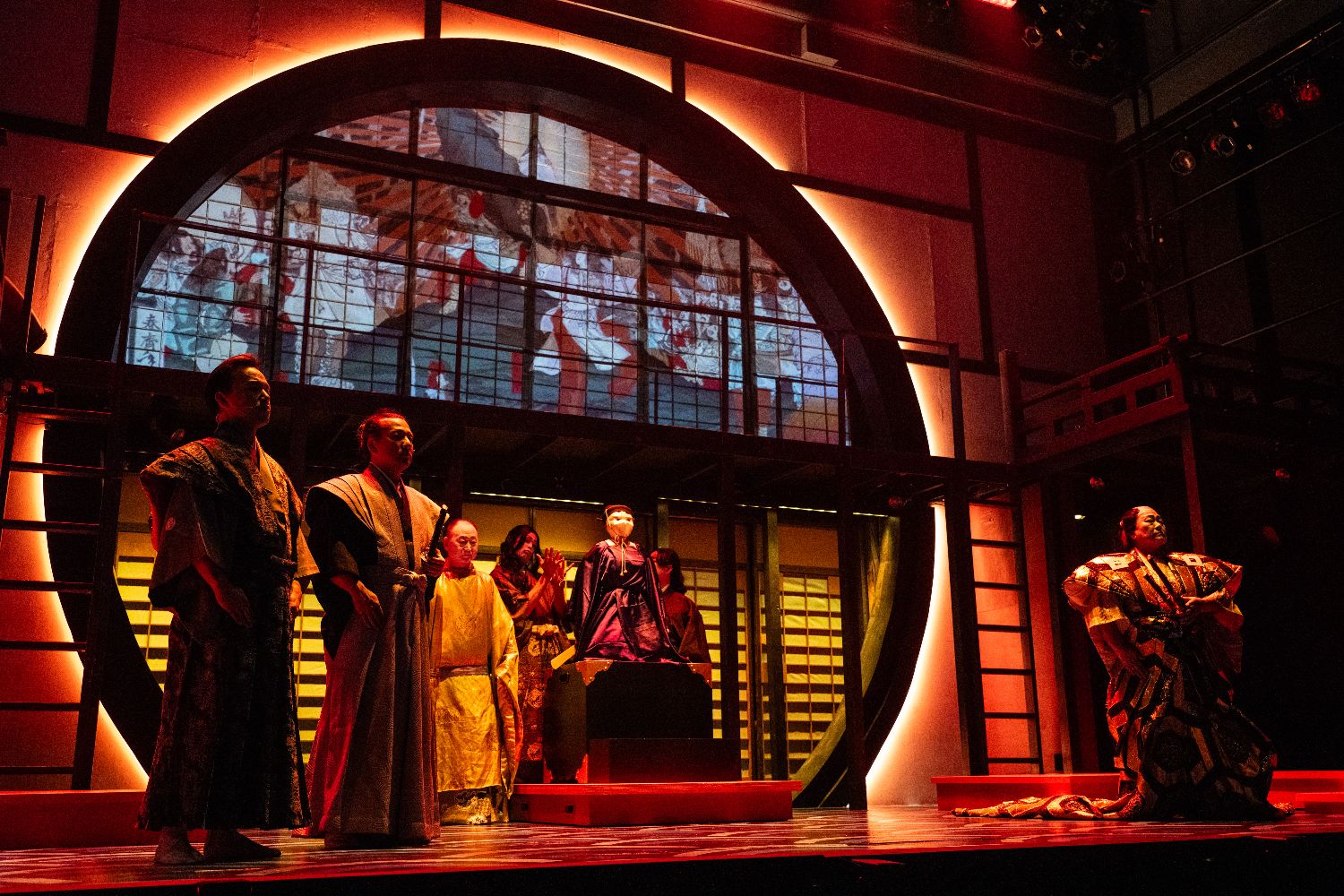
The complexity of Sondheim’s scores is renowned and this entire cast handles it with aplomb. Every cast member plays multiple roles and they are all outstanding. They are Sittichai Chaiyahat, Kit DeZolt, Kurt Kanazawa, Nina Kasuya, Aric Martin, Ashley En-Fu Matthews, Kavin Panmeechao, Gemma Pedersen, Scott Keiji Takeda, Norge Yip, and understudies Jordan Fan and Jonah Meyer.
I can’t say enough about the remarkable direction of Tim Dang, who expertly balances the elements of historical drama, Japanese traditions and musical theatre into a beautifully cohesive and compelling story that resonates in today’s world climate. What in fact are the costs to our culture of both isolationism and globalization? While the powers that be sign treaties and inevitably fall into corruption, we are all along for the ride, regardless of our opinions and feelings, yet we remain “someone in a tree”, a witness to history.
Pacific Overtures runs through December 1, 2024 at the David Henry Hwang Theater in the Union Center of the Arts at 120 Judge John Aiso Street, Los Angeles, CA 90012 in Little Tokyo. Performances begin at 8 PM on Thursdays, Fridays, Saturdays, and Mondays, 5 PM on Sundays, with additional 2 PM matinees on Saturdays. Tickets may be purchased online at eastwestplayers.org or by calling (213) 625-7000.