












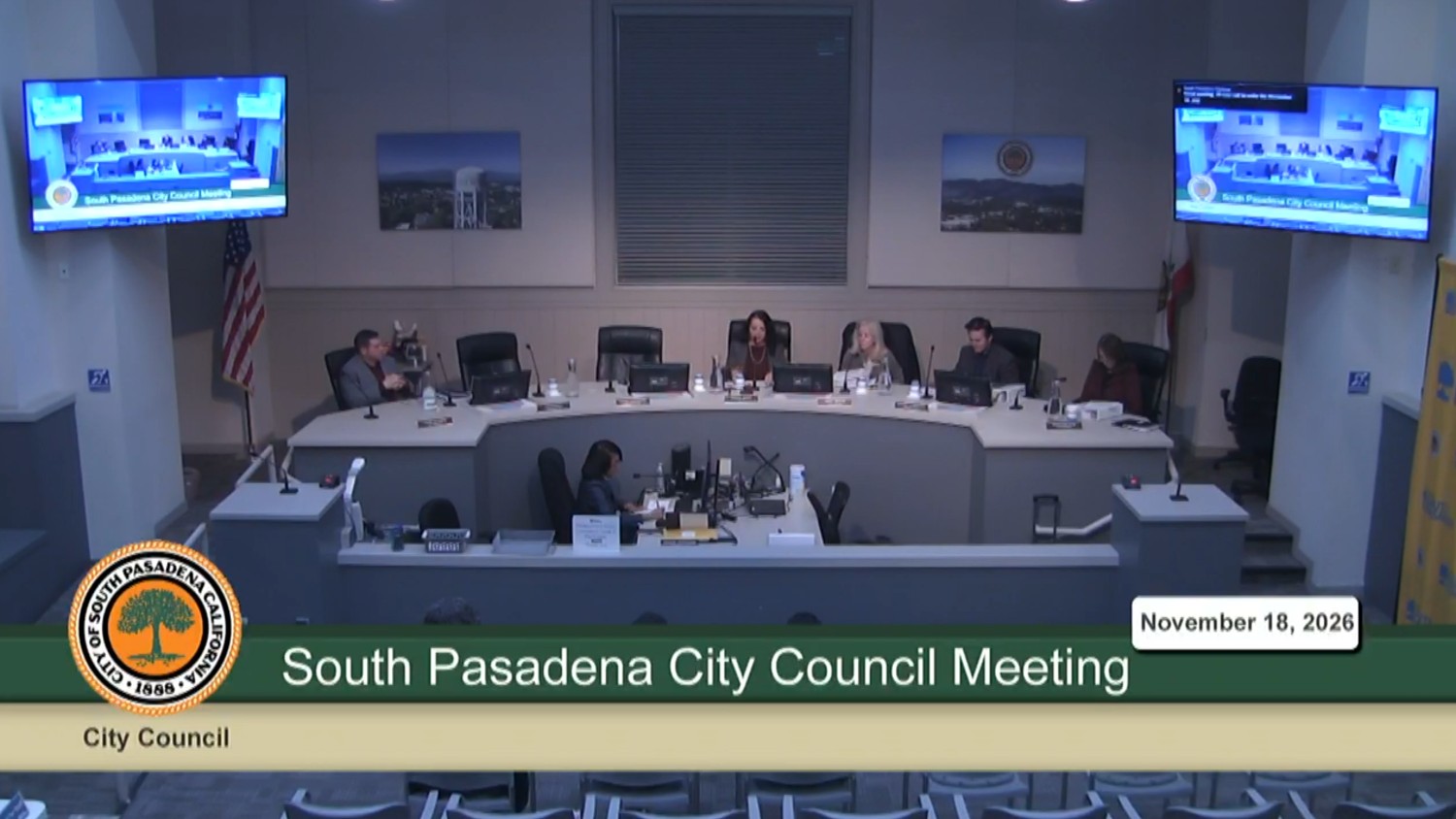

The South Pasadena City Council on Wednesday, Nov. 18, approved a $16 million construction contract for traffic-signal upgrades on Fair Oaks Avenue, adopted a new fee waiver policy, introduced a rewritten noise ordinance on a 3-1 vote and authorized the purchase of a single propane forklift for Public Works after a 2-2 deadlock on how to replace the department’s failing equipment.
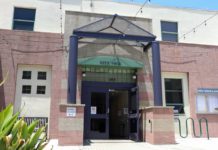
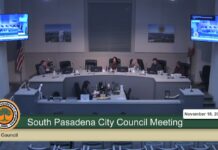
Mayor Sheila Rossi presided, joined by Mayor Pro Tem Omari Ferguson and Councilmembers Michael A. Cacciotti and Janet Braun. Councilmember Jon Primuth was absent. The open session began at 7:09 p.m. in Council Chambers, 1424 Mission Street. For a look at what was on the agenda, see our agenda preview.
Closed Session & Agenda Changes
The Council met in closed session at 6 p.m. City Attorney Diaz reported that there was no reportable action for the Council or the Successor Agency. Before the closed session, architect David Getson of Living Process LLC told the Council that his firm would help with design, permitting and materials procurement if the city directs some of the Caltrans-owned residential lots in South Pasadena to nonprofit developers such as Habitat for Humanity.

At the start of the open session, staff asked to continue Item 19, the first reading of Ordinance No. 2422 on historic resources, SB 79 and the zoning map. The Council held the public hearing open and continued it to Dec. 2 at 7 p.m. in a 4-0 vote.
General Public Comment
Benjamin Basson reported a raised section of pavement near the railroad crossing at Arroyo Drive and Monterey Road that he said is causing drivers to swerve. The mayor asked that Public Works follow up with him. Robert Barone, who attended last week’s community meeting on the Huntington Drive and Fremont Avenue project, said residents do not get a real chance to review changes before meetings and asked how revisions are approved.
Yvonne LaRose thanked residents, city staff, senior center participants and neighbors for their support during her hospitalization and recovery, and the mayor said the Council was glad to have her back. Josh Betta asked the Council by Zoom to name the city’s water tower for the late Dorothy Cohen, a former councilmember and mayor, install a bronze plaque at its base and hold a dedication ceremony. The Council took no action because the request was not on the agenda.
Consent Calendar & Mills Act Contracts
The Council approved Items 4, 8 through 11 and 13 through 18 of the consent calendar in a single 4-0 vote. Items 5, 6, 7 and 12 were pulled for separate consideration.
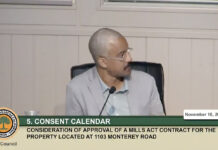
Items 5, 6 and 7 were Mills Act historic-property tax contracts. Mayor Rossi stepped out for Item 5, a contract for the Leo Longley House at 1103 Monterey Road, because the property is within 500 feet of her home. Senior Planner Steven Peterson said the house was built between 1885 and 1888 and was the home of South Pasadena’s second mayor, and that the owners have prepared a 10-year maintenance plan. Item 5 passed 3-0. Items 6 and 7 each passed 4-0.
Before the vote on Item 5, Ferguson questioned what public funds should support when private historic homes are involved and asked for clearer criteria. Cacciotti said he supports the program but also wants to look at it being modified – running with Fergusons comments, noting that the owners of 1103 Monterey would save about $181,000 in property taxes over 10 years, of which the city receives roughly a quarter, or about $4,700 a year. Other council members noted that the Cultural Heritage Commission reviews each application carefully and that the program is set by state law, with the Council deciding its local guidelines. City staff reported about 30 Mills Act contracts are currently outstanding, and staff said it could bring the program back for a study session. Following the vote, the Council agreed on a motion and a second to place a future discussion of Mills Act criteria on a coming agenda. READ ABOUT THIS – CLICK HERE
Fair Oaks Traffic Signal Contract
The Council approved Item 12, the construction contract for the North-South Fair Oaks traffic signal intelligent transportation system project, in a 4-0 vote. The agenda lists the contract at $16,069,567. Staff said the project replaces traffic signals on Fair Oaks Avenue between Columbia Street and Huntington Drive, rebuilds ADA ramps and adds some landscaping at corners. It also includes the Fair Oaks and Huntington Drive intersection as designed in the Huntington Drive project, which staff said is at 90% design, to avoid doing the work twice. Under that design, the slip lane that lets westbound Huntington Drive traffic turn right onto northbound Fair Oaks would be removed.
Staff said a separate slip lane on Fremont Avenue is proposed for removal under the Huntington Drive project, not this contract, and that it expects to return with additional options in the first quarter of next year. Staff also said it spoke with Caltrans about a month ago about the 36-inch railings on the Fair Oaks pedestrian overpass and other bridges over the 110 Freeway and is waiting for an answer.
Christian Mazza told the Council that notice to residents about major changes has been lacking and asked the city to do more outreach. Albin Benzoni asked that project drawings be made clearer, objected to landscaping that would remove about four parking spaces on the west side of Fair Oaks, and urged the city to get written confirmation from Caltrans on the railing height. A council member also asked about funding to repaint the artist-decorated traffic signal cabinets that will be replaced. Staff said it could use project contingency funds if the Council directs it to.
Downtown Design Standards
The Council voted 4-0 to adopt Resolution No. 8038, amending the Downtown Specific Plan to establish objective design standards, and to introduce Ordinance No. 2423 on first reading. Community Development Director Erica Ramirez said the standards, intended to give measurable and verifiable requirements for multifamily and mixed-use projects, offer two architectural pathways, American Mercantile and Spanish Colonial Revival. They would apply to new multifamily and mixed-use buildings and to projects that demolish or add more than 50% of existing floor area, among other triggers.
The zoning code amendment would also require ministerial-review projects of 10 units or more to follow the downtown standards, even outside the downtown plan area, until standards are written for the rest of the city. Ramirez said the Planning Commission recommended adoption 4-1 on Oct. 20. The second reading is set for Dec. 2, with the zoning change taking effect Jan. 1. A second phase covering areas outside downtown is targeted for March 2027. No one spoke on the item.
Noise Ordinance Advances 3-1
The Council voted 3-1 to introduce a rewrite of the city’s noise ordinance, Chapter 19A of the Municipal Code, which was originally adopted in 1970. Ferguson cast the “no” vote. Staff said the update follows more than 75 field measurements around the city, a review of 10 other jurisdictions and Council direction on May 20, Sept. 16 and Oct. 7. It sorts the city into three noise zones, with a five-decibel step between zones, and nighttime limits begin at 10 p.m. Exemptions include school activities, emergency work, city-sponsored events and permitted construction and filming. Noise would be measured at the nearest legally accessible property line over a 10-minute period.
Ferguson, who showed a small battery-powered air compressor he said can exceed the limit, asked that the exemption for power yard equipment be broadened and that a minimum distance from the source be added, citing hillside homes with narrow setbacks. Staff said a fixed distance could put the measurement point in the street and capture traffic noise. Rossi said the item had been before the Council several times and that limits had been raised slightly after commercial noise was studied. She moved to approve it.
Jose Zavala urged the Council to be reasonable and move forward. Samuels said the proposal seemed to react to a particular situation and could burden local businesses. The ordinance is on first reading.
New Fee Waiver Policy
The Council voted 4-0 to adopt a revised fee waiver policy and rescind the 2015 co-sponsorship policy. Community Services Director Melissa Snyder said approvals will now identify the specific organization, activity, fees and conditions, and will weigh public benefit, financial need and the fiscal impact on the city. Staff estimated existing fee waivers and reductions total about $606,500, including about $29,000 for special event permits and a little over $500,000 for field and facility rentals. Staff said that amount is the estimated value of fees waived rather than cash spent, and that insurance, security deposits and applicant-specific staffing and public safety costs are not waived. Staff will report annually, with the report expected in January.
The Council added several amendments: public benefit will consider whether an event is open to the public and whether it is free or low cost; South Pasadena nonprofit and youth organizations are named as eligible; a nonprofit rate will be set for groups outside the city; and the city manager will have authority to approve fee waivers in emergency and intergovernmental situations. Zavala urged an inclusive approach for small nonprofits, and Betta praised staff.
Forklifts: One Propane Unit Approved
Public Works asked the Council to replace a forklift from the late 1990s at the Mission Yard that was pulled from service for safety concerns, and to buy a second for the Garfield Reservoir. Staff offered three options: two propane units for about $120,000, one electric and one propane for about $140,000, or two electric units for nearly $159,000. The budget includes about $120,000. Staff estimated yearly operating costs at about $5,000 for propane and $2,500 for electric. Staff noted that the Mission Yard lacks the electrical capacity to charge an electric unit without upgrades, and that the electric model offered comes with a lead-acid battery.
Cacciotti argued for two electric forklifts, citing the city’s total-cost-of-ownership policy, emissions, state air-quality rules and about $198,000 in AB 2766 vehicle-fee funds. Under the rules as staff described them, a propane forklift bought now would generally face a Jan. 1, 2038 phase-out, subject to exemptions. Ferguson, citing the immediate need, battery performance and storage, and unknown infrastructure costs at the Mission Yard, favored propane. Rossi said she was wary of drawing on the AB 2766 fund because the city will need it for upcoming fleet replacements, including police vehicles. Wes Rudiman and Zavala urged electric forklifts, and Betta urged the Council to focus on cost and what employees need to do their jobs.
A motion to buy two propane forklifts failed 2-2, with Braun and Ferguson in favor and Cacciotti and Rossi opposed. A second motion to buy one propane forklift to meet staff’s immediate need passed 3-1, with Cacciotti opposed. Staff is expected to return Dec. 16 with information on electric options, electrical upgrades at the facilities and available rebates.
Council Comments
Cacciotti thanked voters for supporting Measure SOS, the street repair measure, noting that election results had not yet been certified. Rossi said the Measure SOS committee will be thanked at the Dec. 2 meeting, along with five or six residents who will receive lifetime service awards, and that the State of the City will follow. She also announced that the Tiger Run is Saturday morning, Dec. 5, and that a holiday lighting ceremony with Santa begins at 4 p.m. that evening.
The City Council’s next meetings are Dec. 2 and Dec. 16 at 7 p.m. in Council Chambers, 1424 Mission Street.