













About 100,000 state employees have gone four months without a contract. Mediation resumes Friday, Oct. 30, five days before Californians elect Gov. Gavin Newsom’s successor.
A DMV counter worker with five to eight years on the job earns about $30 an hour after the 3% pay cut Gov. Gavin Newsom sought in 2025, roughly 18% below the $37.15 average wage across Los Angeles and Orange counties. Over a full year, that’s about $14,000 less than the average L.A.-area worker, in a region where households already spend about $12,700 a year more than the national average, according to federal labor data.
First Ever Strike
California’s largest state worker union walked off the job Wednesday, Oct. 21, in the first strike in its 44-year history. Members of SEIU Local 1000 picketed outside DMV headquarters in Sacramento and at state buildings in Los Angeles, Norwalk, San Bernardino, Oakland, San Francisco, Fresno and San Diego. The Sacramento Bee called it the largest state worker strike in California history.
The walkout lasted one day. The fight behind it has lasted far longer, and it runs straight through the services Californians use to get through daily life: driver’s licenses, unemployment checks, disability payments and food aid.
In the 18 months before the strike, three separate checks on state power pushed back on how the Newsom administration was handling its own workforce.
The California State Auditor found the governor’s office ordered tens of thousands of employees back to their desks four days a week without gathering key information on office space and cost, and estimated that keeping telework could save taxpayers up to $225 million a year. Newsom’s office disputed the findings.

The Legislature passed a bipartisan telework bill with more than two-thirds support in both houses. Newsom vetoed it.
The state’s own labor referee, the Public Employment Relations Board, has issued two formal complaints against the administration this year, turned down the administration’s request to stop the strike, and declared bargaining at an impasse over the administration’s objection.
Any one of those could pass for a routine Sacramento squabble. Together they show a decision about how California delivers basic services being made without key numbers, then defended against every check that questioned it, until the people who staff DMV counters, unemployment offices and dozens of other agencies walked out.
What Happened at the DMV and Other State Offices on Strike Day
About 95,000 Local 1000 members were eligible to walk out. About 5,000 more were legally required to stay on the job because their absence would threaten public health or safety, most of them in health care and public safety posts.
Before the strike, a DMV spokesperson warned that services could be delayed and offices might close early. Local 1000 President Anica Walls said residents should also expect possible delays at the Employment Development Department, or EDD, which runs the state’s unemployment and disability insurance programs. She asked Californians “to give our employees some grace” and told DMV customers who found limited service to book another day. On strike day, CalMatters reported operations were modified or limited at some DMV offices and state parks.
In Sacramento, strikers shut down several downtown blocks marching from the California Department of Human Resources, or CalHR, the agency that bargains for the governor, to the state Capitol.
Ten years ago, Local 1000 came within days of a strike before a last-minute deal with Gov. Jerry Brown’s administration called it off. This time, no deal came. It is the second state worker walkout under Newsom; state scientists held a three-day strike in 2023.
The dispute reaches deep into the San Gabriel Valley and the rest of Los Angeles County, home to about 20,000 state workers, second only to Sacramento County, according to state Controller data reported in 2025. State Sen. Lola Smallwood-Cuevas, D-Los Angeles, said she stands “in complete solidarity with SEIU Local 1000.”
Why 100,000 California State Workers Have No Contract
Local 1000 represents about 100,000 employees across roughly 140 state departments, nearly half of California’s state workforce. They staff DMV offices and work as accountants, analysts, nurses, IT technicians and custodians. Their three-year contract expired June 30.
The union wants a 20% raise over three years, a larger state contribution toward health insurance, and relief from Newsom’s four-day in-office order. It points to a $20 billion increase in state general fund spending over the past two years. “The budget is balanced on state employees’ backs,” Walls said on strike day.
Formal talks stalled after July 29. CalHR says the union refused to return to the table unless the state moved off the four-day mandate. The union says CalHR rejected every proposal that touched the budget, including the raise and the health care contributions.
The state has not said publicly what, if anything, it has offered on wages. In a labor board filing, CalHR said there were informal side conversations about economic proposals during the summer stall. Union chief negotiator Bobby Roy told The Sacramento Bee those talks were never official offers that could be taken to members.
“This is the worst bargaining cycle I’ve witnessed,” steward Giovanni Martinez, a state worker of about 10 years, told Labor Notes. Members backed the strike with a 96% yes vote, announced Oct. 8.
Three Pay Cuts in Eight Years
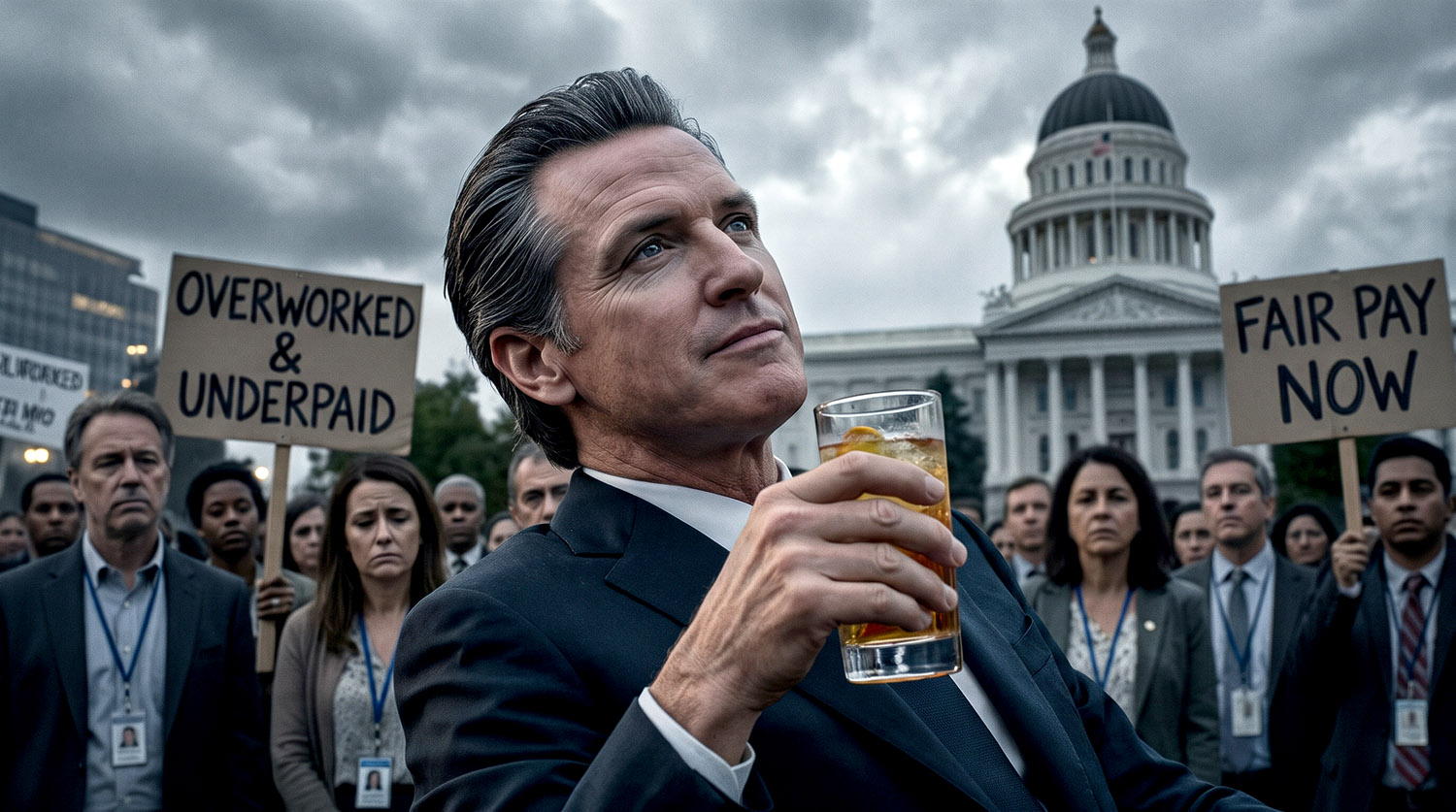
Is Sacramento Balancing The Budget On The Backs of State Employees?
State workers have taken pay cuts in three of Newsom’s eight years in office, according to CalMatters.
The most recent came in June 2025, when the governor and Legislature asked unions to reopen contracts to help close a budget gap. Local 1000 kept a scheduled 3% raise but accepted a two-year Personal Leave Program that cuts take-home pay 3% from July 2025 through June 2027, in exchange for five hours of leave a month that can later be cashed out. That cut is still in effect today.
A second 3% raise was pushed back to July 2027. The administration also withheld an extra 1% raise the old contract promised if the economy hit certain targets.
What the State Auditor Found About the Return-to-Office Order
Newsom issued Executive Order N-22-25 on March 3, 2025, making four in-office days a week the default for state workers starting July 1, 2025. The 2025 budget deal pushed that back a year for Local 1000 members. It took effect July 1, 2026, doubling the previous two-day requirement.
In August 2025, State Auditor Grant Parks reported that the governor’s office did not gather important information about space needs and costs before issuing the order. The audit estimated that letting employees telework three or more days a week could save up to $225 million a year and shrink the state’s office footprint by nearly a third. Forty-six percent of departments surveyed said return-to-office mandates made hiring and keeping staff harder. As of June 2025, the state had not determined how much additional office space it would need to bring everyone back. The report’s title put it bluntly: a one-size-fits-all approach to telework is “counter to state policy.”
Newsom’s office responded that the audit “is not a scientific study” and does not give a complete picture of the state workforce.
When the order took effect this summer, EDD, the agency that pays unemployment benefits, had to phase some employee groups back in because it lacked workstations, and it exempted all of its call center units, according to Sacramento news site The Abridged. On day one, several EDD employees told The Sacramento Bee they were doing the same work they did at home, only from a downtown office.
In June, the labor board’s general counsel issued a complaint alleging the state broke state labor law by imposing the four-day order without bargaining over it. The state has argued the union gave up that right in its 2025 side deal.
The Telework Bill Newsom Vetoed Despite Two-Thirds Support
Assembly Bill 1729, by Assemblymembers Alex Lee, D-San Jose, and Josh Hoover, R-Folsom, would have required state agencies to give a written justification when they order employees into the office, and directed the Department of General Services to publish a dashboard on telework’s cost savings. It passed the Assembly 67-7 and the Senate 31-6, both well past the two-thirds mark needed to override a veto.
Newsom vetoed it in September, writing that “in-person collaboration is an essential part of a productive and effective workplace” and that existing policy already lets departments grant exemptions case by case.
The bill had critics inside the Legislature, too. Sen. Catherine Blakespear, D-Encinitas, argued that making telework the default went too far.
What the State Labor Board Has Done
The Public Employment Relations Board, known as PERB, referees disputes between the state and its unions.
In June, PERB’s general counsel issued the complaint over the return-to-office order.
In late September, PERB issued a second complaint after the union accused CalHR of stalling talks and rejecting proposals outright. CalMatters reported the board concluded CalHR “refused to meet and confer in good faith.” A complaint sends a case toward a hearing; it is not a final ruling.
On Oct. 2, PERB declared an impasse at the union’s request, the same day CalHR filed an opposition blaming the union for “the lack of negotiations since July 29.”
The week before the walkout, CalHR asked PERB to block the strike, arguing the union had not properly identified which essential workers would stay on the job. The union said it had. PERB rejected the request.
On Oct. 27, 20 to 30 union members interrupted CalHR’s annual conference at a Sacramento hotel, accusing the state of trying to intimidate strikers. Union official Jonah Paul said managers had told workers that striking was illegal, citing a no-strike clause in the old contract. “It’s unacceptable to try and intimidate people,” Paul told The Sacramento Bee.
What the Newsom Administration Says
CalHR spokesperson Angela Musallam has said repeatedly that the department remains focused on a “fair and responsible agreement” and remains available at the bargaining table. CalHR says departments have contingency plans to keep government running during any disruption.
The administration also has a budget case. In its November 2025 fiscal forecast, the nonpartisan Legislative Analyst’s Office, or LAO, projected an $18 billion deficit for 2026-27 and warned of shortfalls near $35 billion a year starting in 2027-28. Newsom’s January budget put the 2026-27 gap far lower, at about $2.9 billion. And in 2023, the LAO noted that CalHR’s own pay study found most Local 1000 job groups it examined were paid above market.
Walls counters that her members’ pay amounts to less than 3% of the state budget.
What Happens Next, and Why It Matters on Nov. 3
Mediation resumes Friday, Oct. 30. The union has said it is prepared to escalate, including with another strike, if the state keeps bargaining in bad faith.
Newsom is termed out and leaves office in January. On Nov. 3, voters choose between Democrat Xavier Becerra and Republican Steve Hilton to replace him. Without a deal, the next governor inherits the contract, and the four-day office mandate, an executive order, becomes the new governor’s to keep or undo. All 80 Assembly seats and half the state Senate, the two houses that passed AB 1729 by supermajorities, are on the same ballot.
“Administrations change, but our demands won’t,” Walls said.
For current DMV office status and online services, visit dmv.ca.gov.