















It’s just one more step.
In 2015, signaling a significant effort to clear the air, the South Pasadena became the first city in the nation to be certified by the American Green Zone Alliance (AGZA) for servicing and maintaining all city grounds and municipal properties with low-noise, zero-emission battery machinery and manual hand tools.
AGZA certified green zones, according to its website, are a defined property or collection of properties on which routine landscape maintenance is performed with low-impact equipment and people-powered tools.
Which meant nearly 10 years ago city workers mowing, hedging, edging, trimming, sawing and blowing performed all lawn and garden maintenance tasks without the use of gas-powered equipment. Electric use also eased tensions, lowering the noise level around town with the quieter machinery.
The certification marked just the beginning for a progressive community seeing the need to do what it could to create a clean air lifestyle for residents. Over the years, other cities followed South Pasadena’s lead.
South Pasadena could have stopped there in its pursuit in making a lasting environmental impact on society. Yet, that wasn’t enough. So it didn’t.
Environmental regulatory efforts have become a way of life in town as about three years ago the city placed a total ban on gas-powered leaf blowers for residents and professional gardeners, joining a growing number of other municipalities throughout the region working to eliminate the polluting devices in favor of electric models.
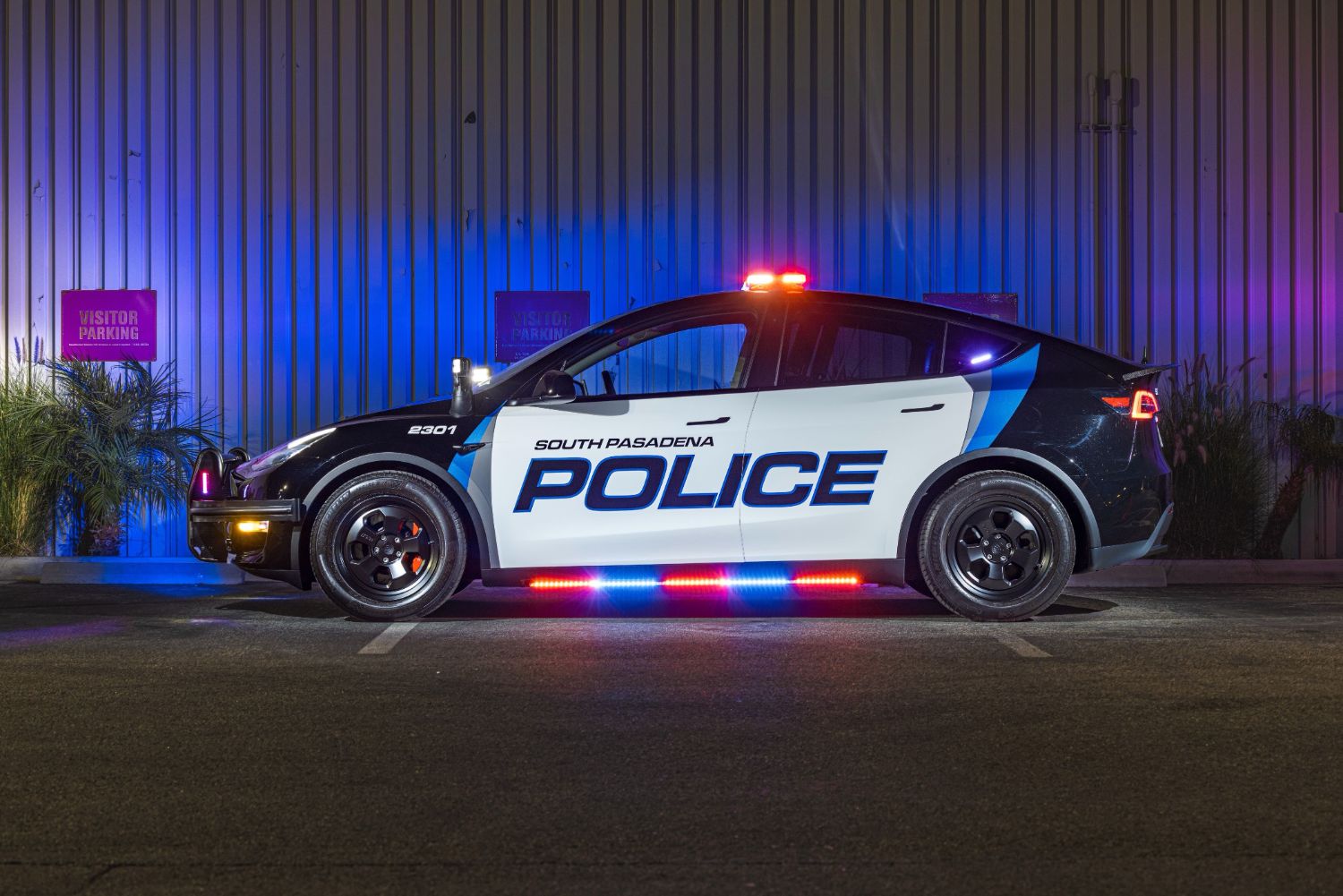
And with last week’s announcement that South Pasadena became the nation’s first police force in the nation to go all-electric by unveiling its groundbreaking 20 new Tesla fleet, all with a 5-star safety rating, one more milestone was met.
“This transition reflects the city’s vision of a sustainable future based on both sound fiscal management and environmental stewardship,” Evelyn Zneimer, South Pasadena Mayor, said in a statement. “The City Council is fully behind this transition. We will have a 21st Century police force that is safe, clean and saves taxpayer dollars. We’re very excited to be working with our regional and corporate partners to make this happen.”

“It’s Time,” the overall theme of the SPPD electric patrol car press announcement on July 29, underscores the importance of eliminating harmful pollutants, from the city’s perspective.
“Finishing the job of cleaning up the region’s unhealthy smog and protecting our atmosphere will require wholesale adoption of zero emission vehicles that produce no emissions while driving,” explained Michael Cacciotti, a South Pasadena City Councilmember and the South Coast Air Quality Management District (SCAQMD) vice chair, who championed the effort. “This is important, particularly in the Los Angeles area which still has the most unhealthful air in the nation. We hope other police departments in the region and state will switch, too.”
The longtime councilmember, with 23 years on the job, said the vehicles will “fight the climate crisis, protect public health, reduce toxic air pollution, and our dependence on high priced foreign oil.”
As part of his remarks during the major media event, attracting worldwide media attention, Cacciotti touched on a future of driverless vehicles, flying cars, and humanoid robots, stressed that “now in 2024, it is time to highlight America’s, and maybe the world’s, first state of the art battery electric police fleet in South Pasadena,” he told the large gathering.
Among the speakers, joining the councilmember, were: California Resources Board (CARB) Executive Officer Steven Cliff, Larry McCallon, chair of SCAQMD’s Mobile Air Pollution Reductions Review Committee (MSRC), LA County Board of Supervisor Kathryn Barger, State Assembly member Mike Fong, State Senator Anthony Portantino and South Pasadena Police Chief Brian Solinsky.
Cacciotti spearheaded the all-electric patrol car effort back in 2021, engaging in communications with Solinsky, South Pasadena Fire Chief Paul Riddle and executive staff about four possibilities:
- Transitioning to a battery-electric public safety fleet.
- Participating in SoCal Edison’s Charge Ready Program, which assists business and property owners with deploying the infrastructure and equipment necessary to support electric vehicle (EV) charging stations at their locations.
- Exploring the cost of installing solar panels and battery/energy storage at City Hall.
- Apply for Mobile Source Air Pollution Reduction Review Committee (MSRC) incentive funds. The agency’s Transformative Transportation Strategies & Mobility Solution Program focuses on concepts that effectively reduce air pollution.
His vision was well received and given its blessing by the City Council, those in law enforcement, public safety and some key city commissions.
“And so in September 2022, after multiple meetings, discussion and public comments, a majority of the City Council approved moving forward with three related projects,” noted Cacciotti, saying the electrification of the police fleet, SCE’s Charge Ready Program (EV charging infrastructure) and the Clean Power Alliance, Power Ready Program, calling for the installation of solar panels and energy storage, were all a go.
In reality, Cacciotti said the push to bring electrification to South Pasadena’s vehicle police fleet actually began more than two decades ago beginning in 2001 when as a state prosecutor handling cases against what he calls “dishonest smog check stations,” he said, “I learned of the harmful impacts of air pollution on human health.”
That inspired him in 2002 to go out and purchase what he jokingly calls an “ugly hybrid Toyota Prius,” later sharing its technology benefits with city staff and council members, “who led us on this path to this historic moment,” he said as part of his press conference remarks.
Between 2004 and now, Cacciotti said the City of South Pasadena has purchased a number of next generation hybrid and electric vehicles, including securing, at no cost to the city, a pair of battery electric BMW Mini Coopers from the German auto maker to test for two years. About five years ago, he joined SPPD Sergeant Mike Neff and Riddle in test driving a Ford Fusion hybrid police pursuit vehicle at the Auto Club Speedway in Fontana, and before that Cacciotti was able to secure, also at no cost to the city, a Ford Crown Vic police vehicle whose fuel system had been converted to CNG for use as a canine vehicle.
“Switching to these vehicles offers the police department the opportunity to acquire a cutting-edge fleet,” said Solinsky in a statement, talking about the benefits to the SPPD of going all-electric. “This initiative not only ensures the safest vehicles for officers and staff but also leads to substantial reductions in both fuel and maintenance costs. Simultaneously, this transition enhances service levels for the residents of South Pasadena by minimizing maintenance downtime commonly seen with traditional gas combustion engines.”
South Pasadena city officials say the transition from gas-powered to electric vehicles should save roughly $4,000 per year in energy costs when it comes to brakes, oil changes, air filters and more.
Thirty-four level 2 chargers will be installed around City Hall, of which will be made available to the public. Total capital costs – EV fleet charging infrastructure installation of solar panels and energy storage – is $4 million, with more than half shared by project partners, including:
- Nearly $500,000 in grant funding from the MSRC.
- Approximately $530,000 from an in-kind contribution by the SCE Charge Ready program.
- A no cost solar and energy storage system installed by the Clean Power Alliance’s Power Ready Program.
Local authorities say the net price tag to the city will be $1.85 million.
Cacciotti can see the day when communities across the USA follow suit, hitching onto to the success of a small Southern California town of just under 27,000 residents setting another example of emission free living.
Making that happen is, well, is just one more step.
“What our city and project partners have done in a typical small American town – South Pasadena – is provide a model that can be easily replicated in almost any police department in our country,” said Cacciotti. “Hopefully, we’re on our way to making that a reality.”







Worst thing our city has done. I really don’t see a point in spending millions of our tax money on electric police cars that “better the enviorment”. Theres no point in buying electric cars to better the enviorment if you wont be charging them with renewable energy which our grids are powered by natural gas. Not only that but police cars are kept running on purpose when police are on scene, all this would do is drain the battery of the car which makes things difficult when police are ment to keep us safe.