













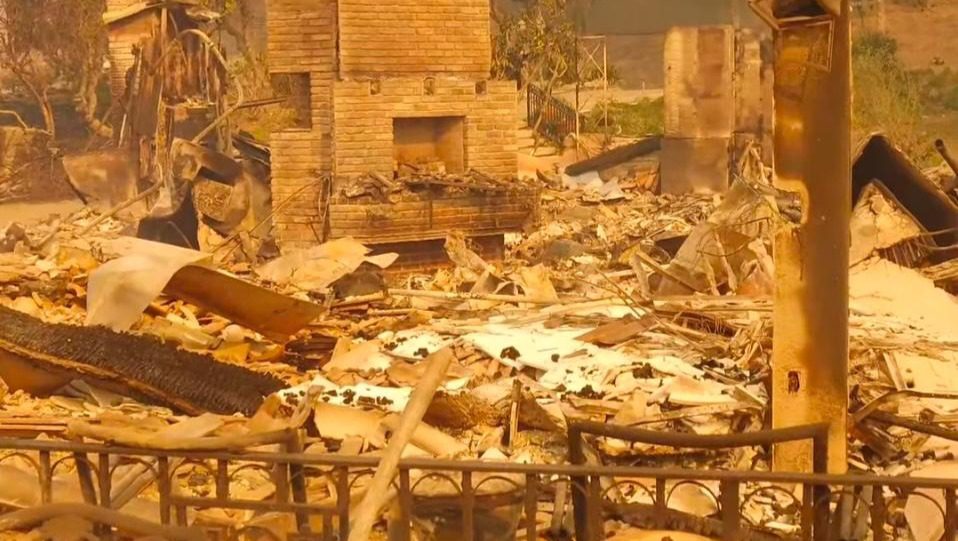
The Los Angeles County Fire Department on Tuesday released its long-awaited investigative reports on the cause of the January 2025 Eaton Fire, concluding that electrical arcing on an out-of-service Southern California Edison transmission tower ignited the blaze that killed 19 people and destroyed or damaged more than 9,000 homes and businesses across Altadena, Pasadena, Sierra Madre, and the surrounding foothill communities.
The findings, contained in an initial report and a supplemental report, close the question that has hung over the San Gabriel Valley for a year and a half: what started the fire. They arrive with significant portions redacted, a reflection of the Los Angeles County District Attorney’s ongoing review of the evidence, which leaves open the possibility of criminal exposure for the utility.
What the Investigation Found

The investigation was conducted jointly by the LACoFD Arson Fire Investigation Unit and CAL FIRE, working alongside retained electrical and metallurgical experts. Using the National Wildfire Coordinating Group’s investigative methodology, the team traced the fire’s area of origin to the dry, receptive fuel bed directly below SCE transmission towers on the spur ridge above the Eaton Wash.
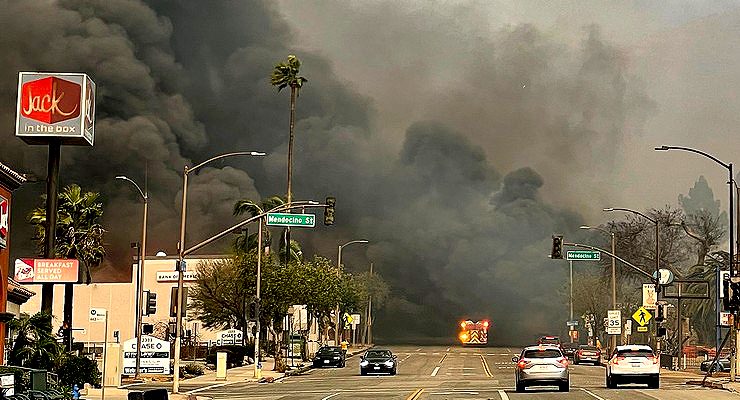
Video evidence gathered by the investigation team showed two electrical arcing events occurring in quick succession on the evening of January 7, 2025. Burning material fell from the tower’s location into the dry vegetation below. Within roughly 12 seconds, the fuel bed ignited. Driven by extreme Santa Ana winds, high temperatures, and critically low humidity, the fire grew almost instantly into a conflagration that swept through the San Gabriel Mountains and into Altadena, Pasadena, Sierra Madre, and La Canada Flintridge.
The report describes the arcing events as ejecting hot metal particles onto the fuel bed below the towers. Among the evidence cited is a 911 call from a Pasadena resident who spotted flames across the canyon from his rear window and described a fire roughly ten feet square at the base of a high-voltage electrical tower.
The tower at the center of the findings has been the focus of scrutiny since the fire’s earliest days. Known as M16T1, or Tower 208, it sat on the dormant Mesa-Sylmar line and had not carried power for more than 50 years. Edison International CEO Pedro Pizarro acknowledged in early 2025 that a leading theory was induction, a rare phenomenon in which the magnetic field of nearby energized lines induces current in an idle, unconnected line. Edison reported to state regulators that four of its lines over Eaton Canyon, including the dormant Mesa-Sylmar line, saw a momentary increase in electrical current at about the time the fire began, following a fault on the Eagle Rock-Gould line roughly five circuit miles away.
The tower itself was dismantled in May 2025 and flown off the hillside by helicopter for laboratory examination.
![PHOTO: PasadenaNOW.com | Cell phone images of the first moments after the Eaton Fire ignited on Tuesday, Jan. 7, 2025, on the mountainside opposite Midwick Drive’s terminus at N. Altadena Drive in Altadena. [Jennifer Errico]](https://media.southpasadenan.com/wp-content/uploads/South-Pasadena-News-1-9-2025-PADADENA-NOW-NEWS-Start-of-Eaton-Canyon-Fire-Photo-01.jpg "| The South Pasadenan | South Pasadena News")
The Fire Department’s release pointedly cites the California Public Utilities Code, noting that SCE is required to maintain and operate its electrical lines and equipment in a manner that minimizes the risk of catastrophic wildfire. That single sentence carries enormous legal weight. It frames the official cause determination against the statutory standard the utility now faces in roughly 1,000 consolidated lawsuits, government claims, and the District Attorney’s criminal review.
Fire Chief Anthony C. Marrone acknowledged the limits of any report in the face of what the community endured. “I recognize that no report or investigation into the Eaton Fire can ease the deep pain and tragedy our residents have endured,” Marrone said, adding that the department’s focus remains on helping residents rebuild and ensuring lessons learned drive lasting change in memory of the 19 lives lost.
Edison’s Response
SCE said it received the report and is reviewing it. “We have taken our potential role in the start of this fire seriously from the very beginning,” spokesperson Kathleen Dunleavy said, reiterating the company’s prior position that its equipment was likely associated with the ignition. The utility pointed to its Wildfire Recovery Compensation Program, which last month reported paying more than 314 million dollars to fire victims. Participants who accept offers waive their right to sue.
Edison has long since stopped disputing the broad outline. The company told regulators in 2025 that circumstantial evidence, including video of flashes around the idle tower, suggested its equipment may have played a role, and it moved to harden idle towers and lines across its network against re-energization. But Edison has also gone on offense, filing cross-complaints against Los Angeles County, Pasadena Water and Power, five other water agencies, and Southern California Gas, alleging their failures worsened the fire’s toll. Pasadena rejected those claims outright, saying the evidence shows Edison’s equipment caused the fire and the utility should accept responsibility.
The Legal Landscape Now
Tuesday’s report lands in the middle of an extraordinary legal convergence. The District Attorney’s office is reviewing whether Edison should face criminal prosecution, a probe the company disclosed in its February 2026 securities filings while stating it is not aware of any basis for felony liability. The redactions in the reports released Tuesday are attributed in part to that ongoing review, along with privacy protections under multiple Government Code sections.
The U.S. Department of Justice sued Edison in September 2025, seeking more than 40 million dollars for fire suppression costs and rehabilitation of nearly 8,000 burned acres of the Angeles National Forest. Los Angeles County, Pasadena, Sierra Madre, and the Pasadena Unified School District have all filed their own suits. Nearly 1,000 civil cases are converging in Los Angeles County Superior Court, with bellwether trials prioritizing elderly and medically fragile plaintiffs.
Under the state’s 2019 wildfire law, Edison may be reimbursed from California’s roughly 21 billion dollar Wildfire Fund if it is found to have acted as a reasonable operator, a determination Tuesday’s report will now heavily inform.
The Questions That Remain
The cause finding answers what started the fire. It does not answer what happened afterward, and those inquiries continue on separate tracks. The McChrystal Group’s after-action review found outdated policies, inconsistent practices, and communications vulnerabilities in the county’s alert and evacuation response. A Citygate Associates investigation released in May examined the overnight evacuation decisions in West Altadena, where 17 of the 19 deaths occurred and where evacuation orders came hours after the fire’s westward turn. California Attorney General Rob Bonta’s office has opened a civil rights investigation into whether race, age, or disability discrimination played a role in the emergency response to the historically Black community of West Altadena. The average age of those who died was 77.
The Eaton Fire burned 14,021 acres and took nearly a month to fully extinguish. For the thousands of families still rebuilding across the foothills, Tuesday’s report converts 18 months of suspicion into an official determination, and shifts the fight from what happened to who pays, and whether anyone is held criminally accountable.
The redacted initial and supplemental reports are available through the County of Los Angeles After-Action Review page at lacounty.gov/aar.