
















I’m not a preservationist, not in the way people usually mean it. I served nine years on the board of the South Pasadena Preservation Foundation, including as its president, and on the board of South Pasadena Beautiful before that. I learned a lot – from the best.
I didn’t only do it for the architecture. I primarily served on the boards to help protect quality of life and the investments we have all made building our families, growing our homes, helping to stop the 710 – blood, sweat and tears included.
So when South Pasadena Mayor Pro Tem Omari Ferguson spent Wednesday night questioning whether the city should keep “offering a discount to people that happen to own older homes,” I had one question. How can I help him fully grasp what he’s talking about?
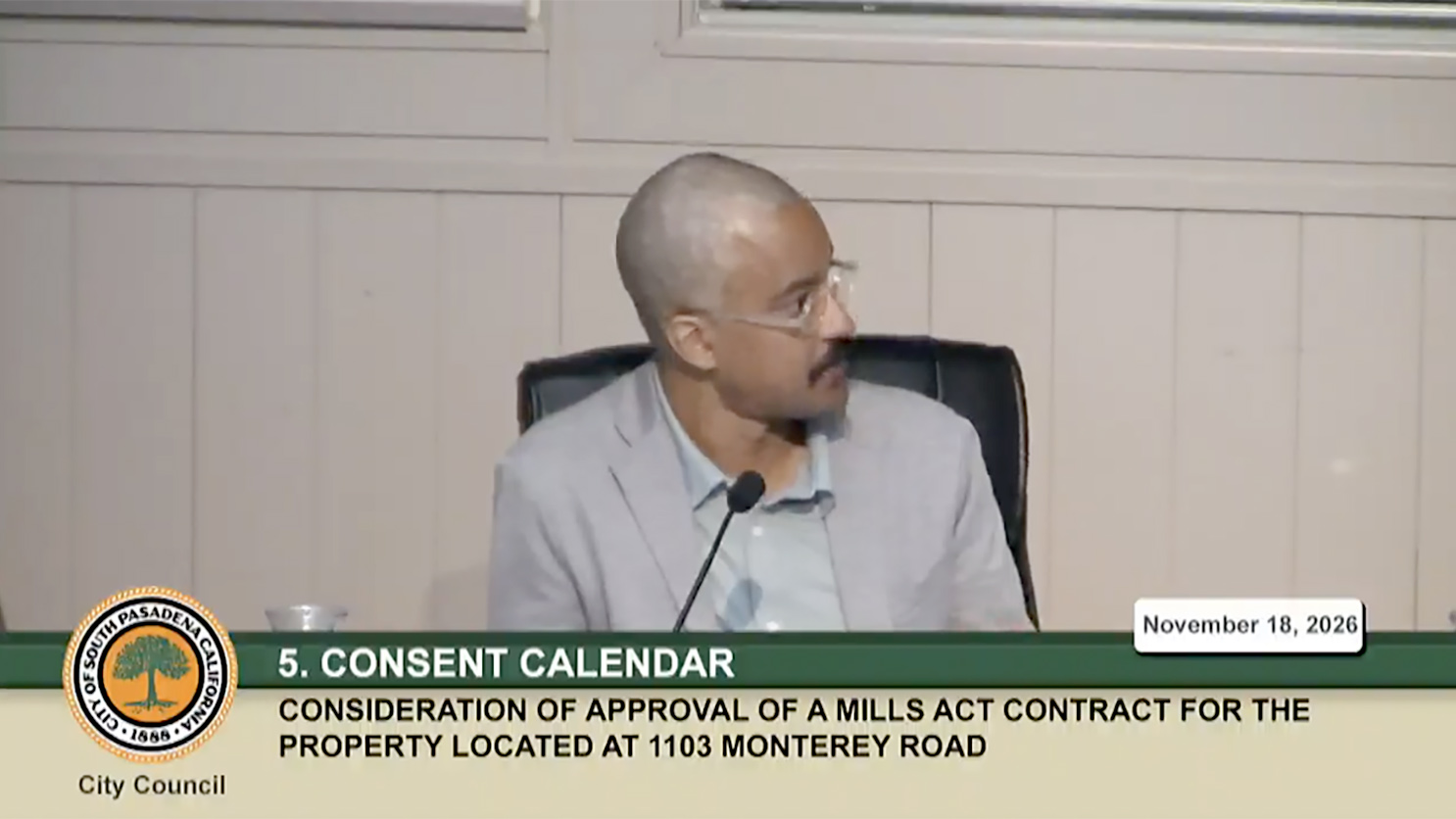
Ferguson pulled three routine Mills Act contracts off the consent calendar, spent nearly half an hour of the council’s time questioning a program he then voted ‘yes’ for three times, and left with a motion to put The Mills Act up for revisions, or maybe elimination. Historians, planners, commissioners, site visits, public hearings: A full year of scrutiny and compliance on the properties. Then Ferguson pulled all three to ask whether any of it was right.
Ferguson becomes mayor December 16. He will not have more power, but there will be more responsibility.
The Mills Act: A Law Written In Our Own Backyard
Our next mayor should know this. The Mills Act was partly written right here in South Pasadena.
It carries the name of state Sen. James R. Mills of San Diego, who pushed it through the Legislature in 1972 after a developer proposed tearing down the Hotel del Coronado. But one of its co-authors was South Pasadena architect Ray Girvigian, who worked on it for free as the American Institute of Architects’ state preservation coordinator.
Girvigian settled in South Pasadena in 1967. He was one of the original 710 freeway fighters. He produced the 1974 study that led California to restore its 1872 State Capitol instead of replacing it. He died in 2022.

Maintaining and Upgrading A Historic Home – The Tax Offset Reality Gauntlet
Owning a historic home in South Pasadena isn’t like owning any other house. Your roof, windows, foundation and porch have to meet the U.S. Secretary of the Interior’s Standards. The Cultural Heritage Commission reviews your work. So does the planning department. If your house is on a state or national register, those rules apply too. You can’t run to a big box store and slap on whatever materials to replace worn-out or broken things. You do it right, and doing it right is expensive.
The Mills Act gives those owners a little breathing room, and incentive to add value to the community. Many times the program allows just enough of a tax break to make the work financially possible at all. It’s a property tax offset, and in exchange the owner signs a 10-year contract on specific work. If the owner doesn’t come through, the penalty is 12.5 percent of the home’s market value. It’s not easy and it’s no joke.
That’s not a tax loophole. It’s a commitment, and the city gets the better end of it.
It’s Costly To Fix A Historic House In South Pasadena
Here’s what Ferguson didn’t mention. California ranks as the most expensive state in the country to renovate a home. South Pasadena is one of the most expensive in the state on top of that.
In a historic South Pasadena house you don’t swap in vinyl windows. You rebuild the original wood ones. You match the old materials, hire a preservation architect, and do it all to federal standards with the city checking your work. Every one of those steps costs more than the ordinary version.
Then there are the taxes. South Pasadena homeowners already pay property taxes, plus parcel taxes and bonds on top, and the city just asked voters for more to fix the streets. Ferguson used that streets measure as a reason to question the Mills Act. He has it backwards.
Ferguson says the city can’t ask voters to pay for streets and give old houses a tax break at the same time. Think about who he’s talking about. These are the same homeowners who have paid their property taxes for decades and driven home on crumbling streets the whole time. Now they’re paying the streets bond too, like everyone else.
Any property tax not extracted for the streets bond measure as a result of a Mills Act home amounts to pocket change – literally. Meanwhile historic homeowners are pouring far more into their houses than they save while on The Mills Act, at the highest renovation prices in the country.
If anything, the Mills Act is the city’s small way of saying ‘thanks for keeping our neighborhoods nice’, and ‘sorry it took so long to fix the streets’. The Streets Bond fixes the streets. The Mills Act incentivizes livability and community values. Mayor Pro Tem is comparing 20 years of City Councils that did not get the streets fixed until now with homeowners who are literally maintaining the historic homes and keeping them viable and livable.
“But They’re Getting Free HVAC”
I’ve heard the pushback. Somebody’s Mills Act house got central air, or a pair of new dormers to finish the attic, they must be gaming the system! Not.
Here’s how it actually works. Touch a historic house in South Pasadena and every part of the job falls under the Cultural Heritage Commission and the Secretary of the Interior’s Standards. A dormer has to match the house’s original lines and materials. Ductwork has to be routed so it doesn’t scar original walls, ceilings or trim. The outdoor equipment has to sit where it won’t mar the historic look. The same job on a 1990s tract house costs a fraction of that.
Yes, the city’s rules allow “systems upgrades” in a Mills Act work plan. A 100-year-old house needs modern wiring, plumbing and heat to stay livable, and an empty house falls apart. But the commission doesn’t wave things through. On one recent Oaklawn Avenue application, staff threw out the electrical and furnace items when they ran the numbers on the tax break. And under city code, no owner’s tax savings can exceed what they invest in the house.
Nobody is getting free air conditioning. The Mills Act covers a sliver of the extra cost of doing the work the historic way.
Follow The Money He’s Worried About
Ferguson said “public funds are being kind of redirected.” No public money changes hands. The owner pays a little less property tax, and South Pasadena only keeps about 25¢ of every property tax dollar to begin with, as pointed out by Councilmember Cacciotti during discussion. Most of the rest goes to the school district, the county and other state government agencies.
Here’s what the city actually gives up, from its own staff reports:
– 1103 Monterey Road, approved Wednesday: about $4,700 a year.
– 203 Oaklawn Avenue: about $5,171 a year, against a $444,484 restoration plan.
– 1500 Rollin Street, approved Wednesday: about $4,365 a year, against roughly $171,000 in work.
– Burwood House, 335 Monterey Road: about $5,592 a year. The owner’s tax benefit for 2023 to 2028 was set to match the $224,000 in repairs planned for those years.
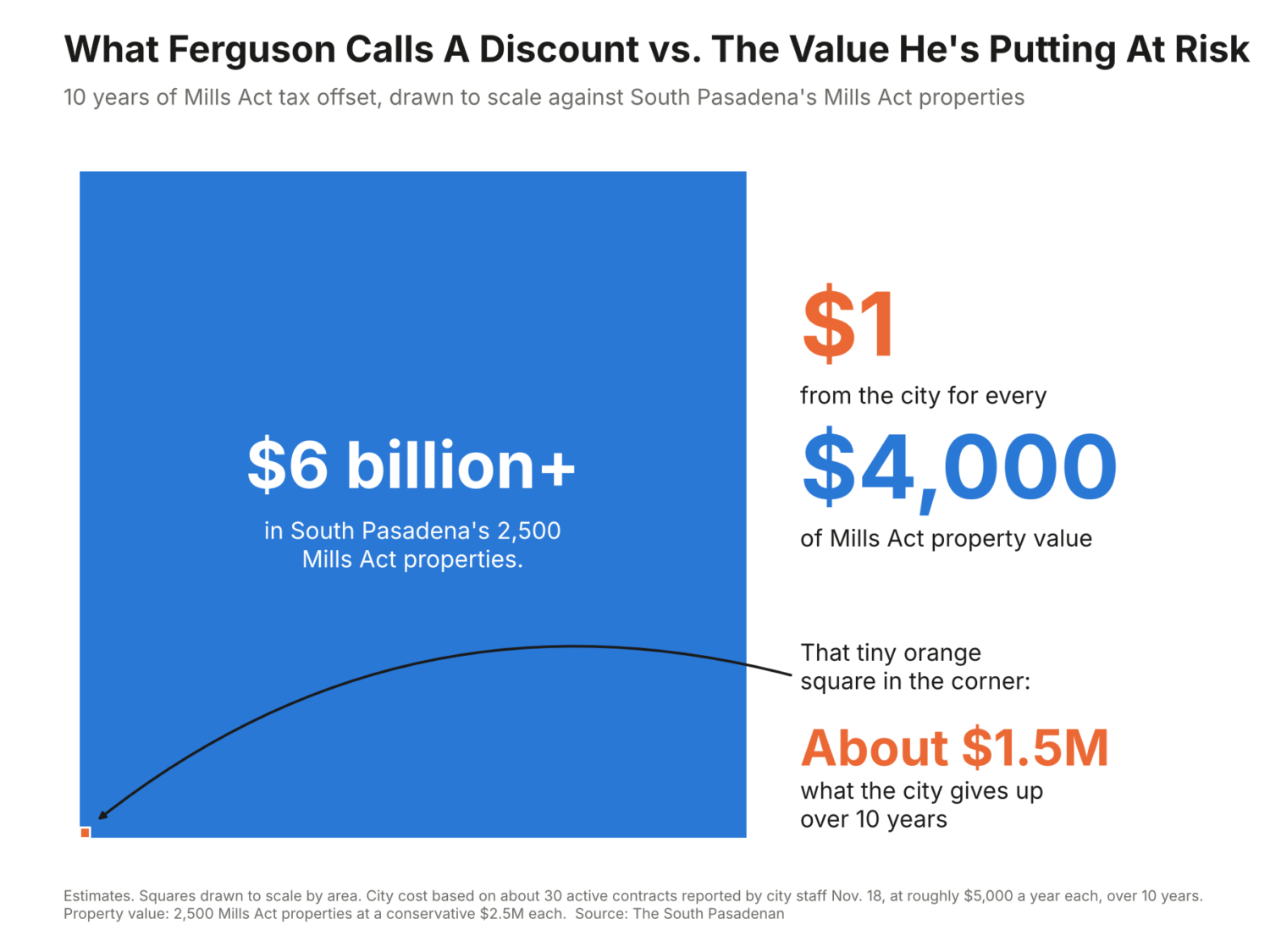
Call it $5,000 a year tax incentive per house in a Mills Act program. With about 30 contracts potentially on the books now, that’s around $150,000 a year – against a general fund of roughly $45 million.
Do the division. It comes out to 0.0033 of the city’s general fund. Not 3%. Not even 1%. Reminder: the city is not spending this money. It’s simply a minutia of property tax that it doesn’t extract. That’s the “spend” Ferguson warned about. He told the council it carries “budget ramifications” and asked “what things we’re not doing as a result of that spend.”
Furthermore, when a house eventually leaves the Mills Act, the city gets its tax revenue back. It collects full taxes on a home worth far more than before. Meanwhile, the work has raised or maintained the value of the whole block.
Councilmember Michael Cacciotti followed Ferguson’s logic and chimed in that “we’re losing a lot of money every single year.” He cited $181,000 on one house and $220,000 on another. Those are the owners’ total savings over 10 years, spread across every taxing agency. That’s not what the city is missing out on. Councilmember Janet Braun had to walk him through it on the dais. The city’s actual share on that first house is about $4,700 a year. Cacciotti says he supports the program, and he voted for all three contracts. He had the math wrong anyway.
Now Look At What The Mills Act Incentive Protects
Here’s what Mayor Pro Tem is missing.
A historic South Pasadena home in good shape is worth $2.5 to $3 million and up. Let one fall apart and the value can drop by half. Now do that across the whole town. The city’s own Mills Act application says South Pasadena has more than 2,500 historic properties. At even $2.5 million apiece, that’s more than $6 billion in historic housing. The city’s share of every Mills Act tax break granted in the last 25 years adds up to a few million dollars, at most.
About 10 years ago I ran these numbers and came up with roughly 500-to-1 positive valuation on the City’s Mills Act participation. Run the numbers through again today with the city’s own figures and 500-to-1 looks conservative, over time.
And the city gets it back. A Mills Act house doesn’t stay discounted forever. When a contract ends, the house is taxed on its full value again, and that value is the restored or upgraded one. Property values typically increase on the whole block as well as the historic house – so every neighbor who sells is reassessed at the higher price the restored house helped create.
Ferguson sees a discount to “…people that happen to own older homes.” He’s got it backwards. It’s an investment. The city gives up a few thousand a year in tax relief and gets back a bigger tax base, house by house, block by block, for good – all while building value into the entire community.
And that doesn’t count what can’t be put on a spreadsheet:
– One rundown landmark drags down the value of every house on its block. A block of them drags down the town.
– Hollywood shoots here. Blockbusters, TV shows, national ads and magazine spreads come to South Pasadena for one reason: it looks like South Pasadena. That doesn’t happen in a town that’s falling apart.
– People move here for the tree-lined streets, the porches and the houses that have stood for a hundred years. That livability is the whole point. For most of us it’s priceless.
That includes Ferguson. On Wednesday he described himself as a “more recent resident” during the Mills Act item. He should ask himself what made it worth choosing.

The Bigger Fight He’s Walking Into
This isn’t just about a tax break. The timing couldn’t be worse.
SB 79, the state’s transit-zone housing law, took effect July 1. Our own reporting found 581 parcels in South Pasadena affected by it. The council has spent much of this year working to blunt it. That meant community meetings, an urgency ordinance to delay it downtown, and an alternative plan, all under Mayor Sheila Rossi’s leadership. The council is due to take up the historic resources ordinance tied to SB 79 again on Dec. 2.
Historic designation is one of the city’s strongest shields in that fight, and the Mills Act is one of the few incentives that gets owners to seek designation and keep their homes worth protecting.
South Pasadena isn’t refusing to build. The city has a state-certified housing plan with room for well over its 2,067-unit state target. The city doesn’t need to bulldoze its historic districts to meet it. Weakening the Mills Act right now hands that argument away while the city is in the middle of the fight.
The Question For Our Next Mayor
Ferguson says he’s “not saying let’s get rid of the Mills Act.” Then he moved to put it back on the table, called the savings on one owner’s tax bill “somewhat absurd,” and said there are “other ways to value” preservation without naming one.
I’ve asked him three questions and I’ll publish his answers.
• At the meeting you said you’re not trying to get rid of the Mills Act, but you also questioned whether the city should be offering older-home owners a property tax break at all. Where do you stand on the program, and what would you change?
• You said the council needs clearer criteria for what it’s “willing to use public funds for.” Is there a specific kind of project or contract getting approved now that you think shouldn’t be?
• Mills Act applicants go through the Cultural Heritage Commission, planning staff review, a 10-year maintenance plan, and ongoing compliance monitoring. What would you say to homeowners who came away from Wednesday thinking you see them as taking advantage of the program?