

















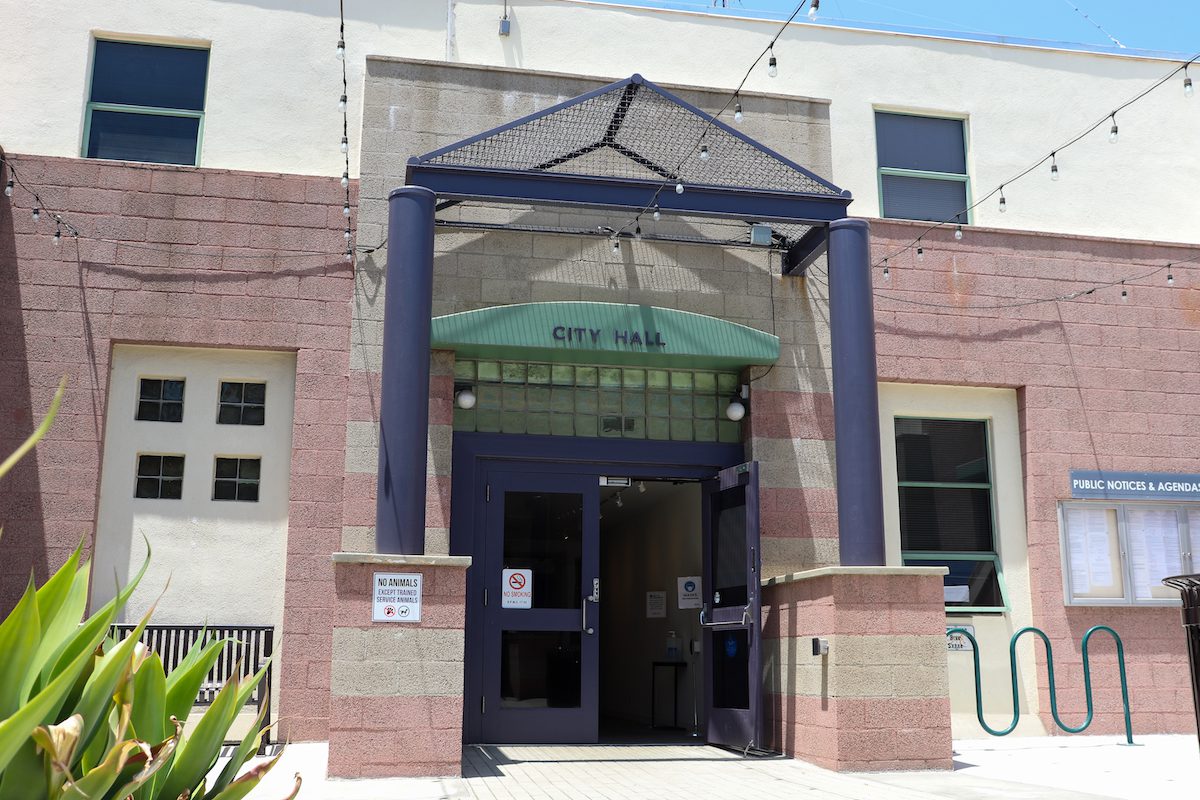

The September 2 South Pasadena City Council Meeting Report
The evening’s most consequential business came late: a long-overdue reckoning with the city’s special event fee waiver system, which staff estimates costs the general fund roughly $600,000 a year, most of it in waived field fees for AYSO and Little League. The council also unanimously approved a $650,000 citywide information technology and cybersecurity modernization program, and adopted a new resolution letting the city manager waive permit fees for residents who voluntarily repair public sidewalks, curbs, and gutters at their own expense.
Fremont Corridor Frustration Dominates Public Comment
General public comment opened with a theme that has been building since the council authorized the Fremont Avenue and Huntington Drive protected bike lane project: residents along the corridor saying they were not adequately informed.
Fernando Cespedes of Spruce Street, a 28-year area resident, told the council he and his attorney had been unable to access the approved plan on the city website. He argued Fremont is the wrong street for bicycle paths, calling it a freeway in all but name, and urged that no trees be removed. John Sullivan, who said he has lived on Fremont Avenue for 76 years, called the removal of palm and magnolia trees along the corridor an aesthetically revolting idea that makes a mockery of the City of Trees motto, and suggested Marengo, Ramona, Meridian, Bushnell, or Fair Oaks as safer biking alternatives. He asked the council to reopen the matter with what he called now better informed Fremont residents.
In response to Cespedes, City Manager Todd Hileman clarified that the design is at 60 percent, that the PowerPoints and outreach materials the council has seen and authorized are online, and that he would work with public information staff the next day to make the materials easier to find. Notably, the city held two community meetings on the project in the days just before this council meeting, one Monday and one Tuesday at the middle school auditorium, both well attended according to Councilmember Cacciotti, who showed photos of the sessions during council communications.

The corridor project was approved with Caltrans grant funding, and the tension on display, between regional active-transportation money and corridor residents concerned about trees, parking, and traffic, is likely to intensify as design moves toward construction.
Goats On Elephant Hill Draw Criticism Again
Two public comments on Zoom renewed criticism of the city’s goat grazing program for fire fuel abatement near Elephant Hill. Constance Villalvazo argued the goats consume native and non-native vegetation alike, increasing mudslide risk in a La Nina year, and said she could see goats left overnight on wide swaths of land, which she said is not targeted grazing. A second caller, identified by the clerk as a Gladding, gave a detailed damage tally: a mature Chinese elm fully girdled, holly leaf cherry trees girdled, laurel sumacs and over a dozen toyon partially girdled, and damage to coyote brush and coffeeberry, arguing the fully girdled trees are future standing deadwood. The speaker contrasted the current operator with Sage Environmental, the grazer used five years ago, and directly challenged Mayor Pro Tem Ferguson, who lives near the grazing area, to visit the site.
The grazing program has been defended by Fire Chief Gregory Lloyd as necessary fire prevention, and the criticism from these speakers is now a recurring feature of council meetings.
Other Public Comment
Steve Novotny of Harriman Avenue repeated allegations that city tree trimming on his street since 2021 has been driven by his next-door neighbor, Mayor Pro Tem Ferguson, and claimed a clause in the recently adopted tree ordinance was specially crafted to benefit Ferguson. A speaker identified as Mr. Quinn repeated accusations from a prior meeting concerning a vehicle towed from his property and the police department’s handling of his complaint. Edgar Varela, a South Pasadena Educational Foundation board member speaking as a private citizen, congratulated Community Services Director Melissa Snyder and her team for the summer’s cultural and sports events and urged the city to fund more of them.
A late speaker, Ben Giacometti of Monterey Road, described what he called a ‘sonic attack from unpermitted refrigeration equipment’ installed at the former Foremost Liquor location near his apartment, saying the noise has run continuously for six months and that he filed a formal complaint last week.
Consent Calendar, Library Rules, And The IT Overhaul
The council approved the consent calendar 5-0, pulling items 7 and 10 for public comment.
Item 7, Ordinance 2421, was introduced for first reading 5-0. It amends the municipal code on library rules and, importantly, establishes an administrative appeal process for suspension of library visitation privileges, a due process backstop the code previously lacked. Library Director Matthew Patsel was spared a presentation.
Item 10 was the substantive one: Resolution 8030, appropriating $650,000 in the FY 2026-27 budget for a citywide information technology and cybersecurity infrastructure modernization program covering 13 projects, including modernization of the Water Department’s SCADA network, the industrial control system that runs the city’s water operations. The resolution also authorizes the city manager to procure and execute contracts up to the budgeted amount. It passed 5-0.
The vote formalizes work that IT Systems Manager Tim Schofield has been driving since joining the city in late 2025, when an initial audit found roughly 220 network vulnerabilities and phishing test failure rates around 60 percent. Public commenter Josh Betta, the city’s former finance director, called the vote a reversal of 20 years of history, crediting Schofield and Hileman with taking city technology down to the studs rather than treating it as a software purchasing exercise. Mayor Rossi thanked Schofield for moving the city from a paper-based, fragmented, department-by-department technology posture toward integrated, security-conscious infrastructure, and gave him the gift of not requiring a presentation.
Sidewalk Repair Fees: City Will Get Out Of The Way Of Residents Paying Their Own Money
City Engineer Michael Vartanian presented Resolution 8029, which gives the city manager or designee discretionary, case-by-case authority to reduce or waive encroachment permit and inspection fees when a property owner voluntarily pays the full cost of repairing public right-of-way improvements: sidewalks, driveway approaches, curbs, gutters, and street or alley pavement. All engineering standards, permits, and inspections remain in place; only the fee can be waived. It does not apply to work required as a condition of development approval or to damage the applicant caused. Hileman illustrated the logic: a resident spending $5,000 or $6,000 of their own money to fix a public sidewalk should not be discouraged by a $600 permit fee.
Primuth asked how waivers would be tracked; staff said reports can be run at any time through the city’s new OpenGov system. Cacciotti, drawing on his years as a Caltrans attorney, noted the liability angle: sidewalks fixed by homeowners are sidewalks nobody trips on, and trip-and-fall settlements cost cities millions.
Public comment split. Novotny said the city should collect all fees uniformly and characterized the item as another setup for favoritism benefiting Ferguson, noting underground utility marking work at his neighbor’s property. Sam Burgess supported the resolution and asked how tree roots would be handled; staff confirmed any root cutting requires permitting, inspection, and arborist involvement, standard with every sidewalk permit.
Hileman then corrected the record forcefully, stating the item originated with him after two residents separately approached him about paying thousands of dollars for sidewalk work and balking at the permit fee, and that no council member influenced the recommendation. Mayor Rossi added a second correction on the earlier tree ordinance accusation: the tree ordinance subcommittee consisted of herself and Councilmember Braun working with City Attorney Rozanne Diaz, and Ferguson was deliberately kept away from the item entirely because of the ongoing accusations from his neighbor. The resolution passed 5-0.
The $600,000 Question: Fee Waivers Meet Fiscal Reality
The final business item was a two-part housekeeping and policy discussion that touched a sensitive nerve, money.
First, staff informed the council it is discontinuing the separate special event application and consolidating intake under the existing temporary use permit application, eliminating duplicate paperwork without changing any approval authority. Second, and more significantly, staff asked for direction on replacing the 2015 cosponsorship policy that governs fee waivers for community organizations.
The problem with the 2015 policy is its exhibit, a list of organizations approved for waivers a decade ago that has never been updated. Organizations on the list now run different events, or assume everything they do is automatically waived, leaving staff to make policy calls that are not theirs to make. The proposed replacement routes every waiver request, one-time or recurring, through the City Council, with recurring relationships documented through MOUs.
Then came the number. Betta, in public comment, put it plainly: The elephant in the room is $600,000 in annual fee waivers at a time when the city’s five-year general fund projection is break-even. He praised the council’s courage in touching what he called two decades of controversy, while cautioning that the budget decisions culminating next spring will be serious ones.
Councilmember Braun broke the figure down: roughly $550,000 of the total is AYSO and Little League field use. She called both organizations irreplaceable, noting the city could never run youth sports at that scale itself, but said the historic trade-off, in which the leagues contributed to field maintenance, has eroded since the city took over maintenance. Braun, a former soccer commissioner who recalled personally buying tractors for the fields, called for a sit-down with both leagues to restore some contribution, and volunteered to participate. The mayor endorsed the idea, citing Braun’s deep field history.
The council’s direction to staff sketched the contours of the future policy. Primuth distinguished hard costs, actual staffing the city pays for, from soft costs like forgone facility rent, and suggested caps on staffing-heavy waivers. Ferguson raised financial need as a criterion, asking whether organizations that can afford fees should receive waivers, and flagged insurance and liability exposure.
Mayor Rossi framed the city’s point of view most directly; arguing the real value of the process is less the fees than the relationships. “It’s not so much we want to charge these organizations these fees,” she said. “More than anything, it’s sitting down with basically a contract, in a sense, and an agreement, and saying, okay, who’s responsible for liability? What’s the reporting look like? What kind of nonprofit are you? Do you have some sort of legal structure to be able to take on that liability?” Formalizing those relationships, she said, is “almost more important to me than even the fee piece — just getting that relationship and a little bit more structure and clarity around the relationship between the city and the organizations as we move forward.”
The Mayor noted at least one beloved organization had gone without required county public health permits simply because the relationship had always been informal, exposure that falls on the city if something goes wrong. Council members also distinguished categories of benefit, from the Kiwanis Fourth of July Pancake Breakfast, effectively a donated city program, to the Chamber’s Arts Crawl and the Chinese-American Club’s Moon Festival, which activate streets and program the city, to school fundraisers, many already covered by the joint use agreement with the school district.
The council voted 5-0 to receive and file the two informational pieces. Staff will return with a revised fee waiver policy incorporating the direction.
Context matters here. This council has spent 2026 methodically building financial granularity, from the budget process to the governance study session in August, and the fee waiver review is the same discipline applied to a politically delicate corner of city finances. Nobody on the dais proposed charging the Little League full freight. But with a break-even general fund projection and an $80 million infrastructure bond program underway, the era of informal, undocumented waivers appears to be ending.
Council Communications
Councilmember Cacciotti presented photos: a packed Senior Center event of about 80 people featuring Samoan dancers in the final week of summer programming; a lifted sidewalk slab on Mission Street he reported Monday morning that Public Works Director Julian Lee’s team patched by Tuesday afternoon; a visibility problem at an unpainted red zone on Oak Street near Holy Family that staff will examine; new striping work on Mission Street; the two Fremont corridor community meetings; and his morning at San Gabriel Valley Council of Governments committee meetings in Monrovia, including a Homeless Committee presentation by LA County homeless services officials and the energy, environment, and natural resources committee.
Mayor Rossi announced the 25th commemoration of September 11 at 7:00 a.m. on September 11 at City Hall, led by the city’s public safety team, and the Moon Festival on September 19 at 11:00 a.m. at the Library Community Room. She also congratulated City Attorney Rozanne Diaz on her selection as president of the City Attorneys’ Department of the League of California Cities.
The meeting adjourned to Wednesday, September 16, 2026, at 7:00 p.m.