















The Mills Act is one of the most successful preservation tools South Pasadena has.
Last Wednesday night, Nov. 18, Mayor Pro Tem Omari Ferguson, who becomes mayor Dec. 16, questioned whether the city should be offering it at all. CLICK HERE to read about that. Residents have been calling The South Pasadenan since the meeting, many of them confused about what the program is and why it was under fire. Here is what the public record shows.
What The Mills Act Is
The Mills Act is a California law passed in 1972. It lets cities give owners of designated historic properties a property tax incentive. In return, the owner signs a binding contract promising to restore and maintain the building according to specific guidelines.
The state doesn’t run the program. Each city decides whether to take part, who qualifies and how many contracts to approve. In South Pasadena the City Council has the final say, after review by the Cultural Heritage Commission.
The (very) short version:
– It’s a contract between the homeowner and the city, not a grant. No city check gets written.
– The owner pays lower property taxes and agrees to a list of specific restoration and maintenance work.
– The contract runs 10 years and adds another year automatically on each anniversary.
– It stays with the house. If the home sells, the new owner takes on the same obligations.
– All work has to meet the U.S. Secretary of the Interior’s Standards for historic properties.
– If the city cancels the contract because the owner broke it, the owner owes a penalty of 12.5 percent of the property’s current market value. On a $3 million house that’s $375,000 hit, and the financial penalty is split among the local taxing agencies, including the city.
How The Tax Offset Incentive Actually Works
– The county assessor values a Mills Act property by its estimated rental income instead of its sale price. That usually produces a lower assessed value.
– Savings are commonly described as about 40 to 60 percent off the owner’s property tax bill.
– Owners who have held their homes for a long time often save little or nothing, because Prop 13 has already kept their assessment low. The program mostly helps recent buyers, the people now taking on the expensive job of restoring century-old houses.
– Property tax is split among several agencies. Councilmember Michael Cacciotti said Wednesday that the city keeps only about a quarter of each property tax dollar. Most of the rest goes to the school district, the county and other districts.
The City Gets It’s Tax Revenue Back, Over Time
The tax break doesn’t last forever, and the city isn’t left empty-handed when it ends.
– When an owner gives notice that a contract won’t renew, the home’s taxed value steps back up each year until it reaches full value. By then, that value is the restored house, not the run-down one.
– Restored homes lift the value of the homes around them. When a neighbor without a contract sells, that home is reassessed at the higher price right away.
– The city gives up a few thousand dollars a year per house now. It gets back a bigger tax base, house by house and block by block.
Who Qualifies In South Pasadena
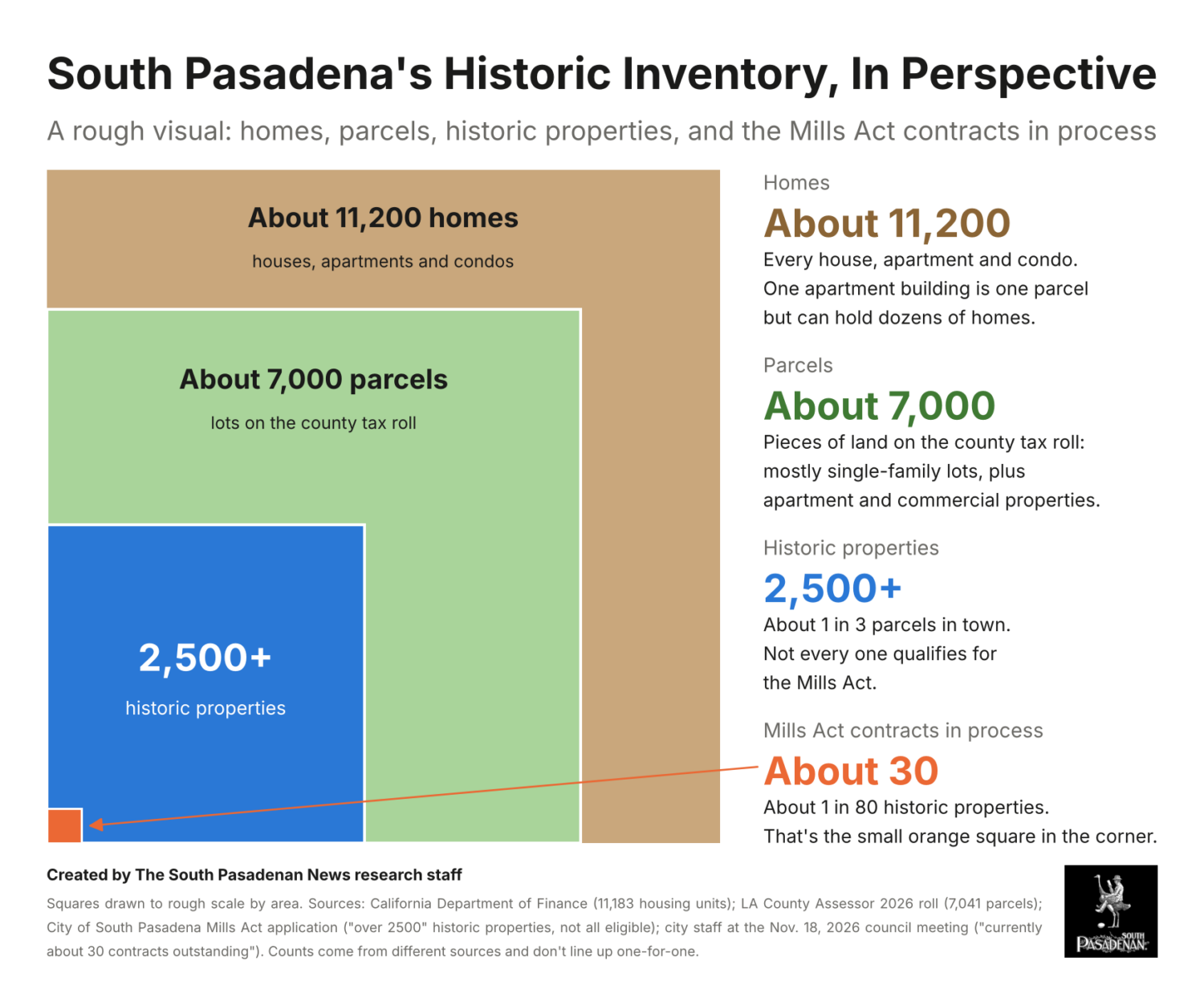
South Pasadena has more than 2,500 historic properties, according to the city, out of about 7,000 parcels citywide on the county assessor’s roll. Not every historic property qualifies for the Mills Act. About 30 hold active contracts, according to planning staff at the Nov. 18 meeting.
The city’s application says it applies the Mills Act more restrictively than other cities. To qualify, a property has to be one of these:
– Listed on, or eligible for, the National Register of Historic Places
– Listed on the California Register of Historical Resources
– A designated South Pasadena landmark
– A contributing property in a designated historic district
Written In Our Own Backyard
The Mills Act carries the name of state Sen. James R. Mills of San Diego, who pushed it through the Legislature in 1972 after a developer proposed tearing down the Hotel del Coronado.
One of its co-authors was South Pasadena architect Ray Girvigian, who worked on it for free as the American Institute of Architects’ state preservation coordinator. Girvigian settled in South Pasadena in 1967. He chaired the city’s first Cultural Heritage Commission, wrote its first historic preservation ordinance and was one of the original 710 Freeway fighters. His 1974 study led California to restore its 1872 State Capitol instead of replacing it. He died in 2022.

A law that has been an incentive for the upkeep and livability of historic buildings across California was partly written by one of our own; and it actually works.
What The City Gets For Its Money
City records show owners spend far more on their houses than the city gives up in taxes.
– 203 Oaklawn Avenue (Oaklawn Historic District, built 1911–12, architect George Lawrence Stimson). The 2024 work plan listed 24 items worth $444,484. The estimated cost to the city was about $51,714 over 10 years. That’s roughly $8.60 of private restoration work on a historic home for every dollar of city revenue forgone.
– 335 Monterey Road (Burwood House, Landmark No. 47, built 1910). When the council approved it in 2020, staff put the owner’s tax benefit for 2023–2028 at $224,000, which matched the $224,000 in repairs planned for those years. The city’s estimated cost was about $5,592 a year.
– 1103 Monterey Road (the Leo Longley House, built in the 1880s, home of South Pasadena’s second mayor). Approved Wednesday. The plan’s main focus is foundation and structural work. The city’s cost is about $4,700 a year, according to the staff report Braun cited.
– 1500 Rollin Street. Approved Wednesday. The commission reviewed a rehabilitation plan of about $171,000, including structural retrofitting and system upgrades.
Call it about $5,000 a year per contract. Across about 30 contracts, that’s around $150,000 a year, against a city general fund of roughly $45 million. That’s about a third of one percent.
How The Property Tax Money Actually Shakes Out Overall
Most people never see the whole picture of where their property tax goes. Here it is, start to finish.
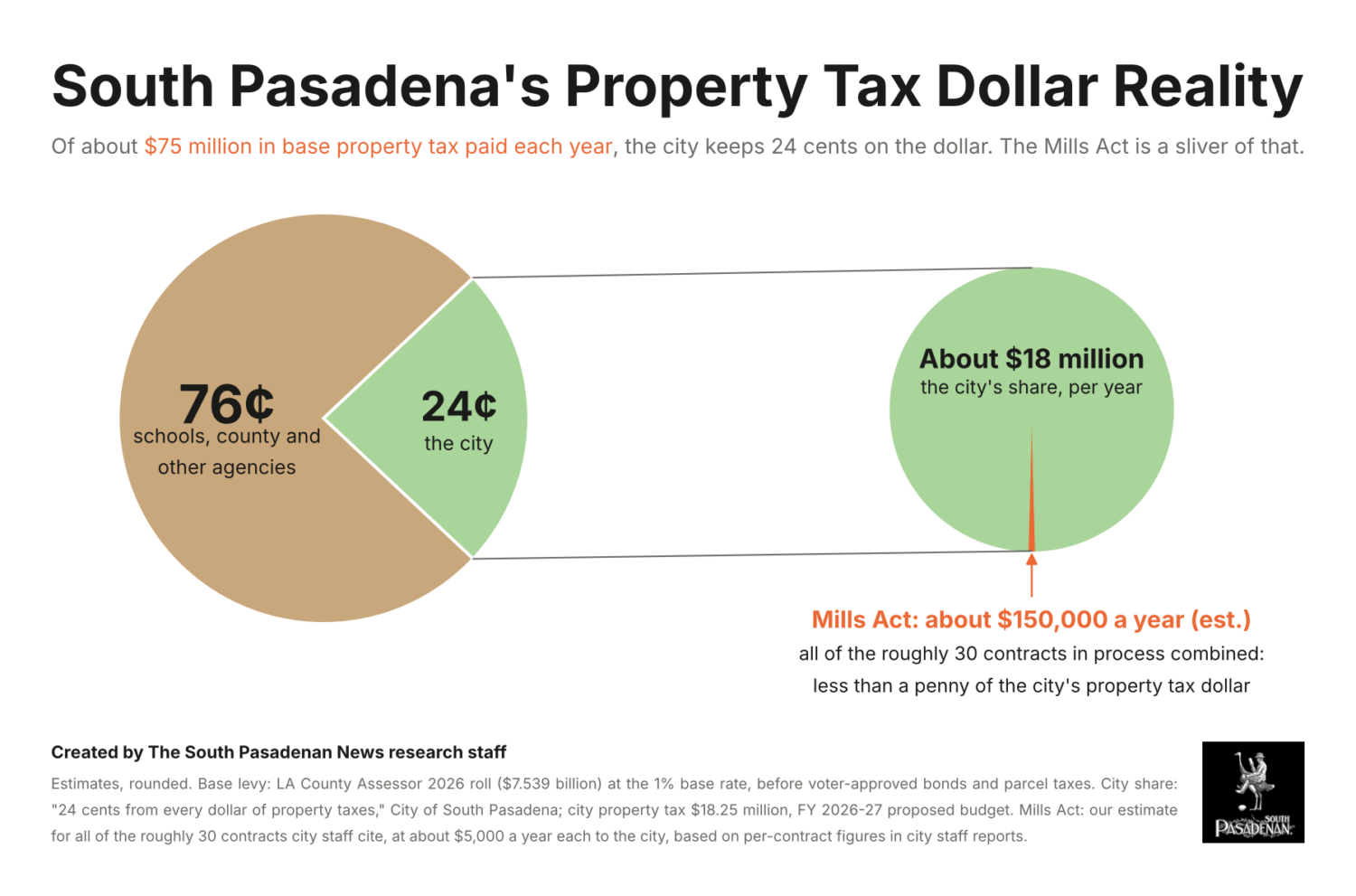
– The whole town’s bill: South Pasadena’s 2026 tax roll is $7.54 billion. At the 1 percent base rate, property owners pay about $75 million a year in base property tax, before voter-approved bonds and parcel taxes.
– The city’s cut: the city receives about 24 cents of every property tax dollar, by its own count. The rest goes to the schools, the county and other agencies.
– What that adds up to: the city budgets $17.4 million in property tax this year and projects $18.25 million next year. That’s about 40 percent of the city’s general fund, its biggest single source of money.
– The Mills Act’s piece: about $150,000 a year of the city’s share, by our estimate. That figure covers all of the roughly 30 contracts city staff cited, at about $5,000 a year each, based on the per-contract numbers in city staff reports. The three contracts approved Nov. 18 account for roughly $13,000 to $15,000 of it. Either way, it’s less than one penny of every property tax dollar the city collects.
– Across every agency: the Mills Act’s total effect on the $75 million bill is roughly $600,000 a year, still under 1 percent.
– Against the town itself: every house, condo, apartment building and storefront in South Pasadena is worth an estimated $14 billion to $16 billion at today’s prices. The city’s yearly Mills Act cost is about one-thousandth of one percent of that.
The money the city gives up is real, but real small. What it protects is the oldest and most valuable part of that $14 billion to $16 billion.
What It Takes To Get Into A Mills Act Agreement
The Mills Act isn’t a loophole. Getting a contract takes most of a year of paperwork, inspections and public hearings. Under the city’s application and municipal code, an owner has to:
– File a letter of intent with the Planning Department, with photos of the home’s current condition. Work started before the letter is filed doesn’t count.
– Host a site visit from a Cultural Heritage Commission subcommittee and city staff, who help rank the restoration work by priority.
– Produce a 10-year rehabilitation, restoration and maintenance plan that meets the Secretary of the Interior’s Standards.
– Get a Certificate of Appropriateness from the Cultural Heritage Commission.
– Submit a financial analysis and a cost estimate from a city-approved preservation architect.
– Pay the city’s Mills Act contract fee, listed at $2,366 in the city’s most recent published fee schedule, plus the cost of any historic evaluation reports and architect fees.
– Go through public hearings before the Cultural Heritage Commission and then the City Council.
– After approval, report on progress at least every three years and allow inspections every five years. The city recently added a monitoring fee on top of the application costs.
Proposals are accepted only from January through March. The Cultural Heritage Commission reviews them through June and sends its recommendations to the council by the end of September. (The Nov. 18 Council Meeting for example)
This year’s contracts followed that path. The commission accepted letters of intent and formed site-visit subcommittees in March. It reviewed applications in May and again at a special meeting at the end of June. The contracts reached the council Nov. 18, about eight months after the commission first took them up.
The commission doesn’t approve everything. In 2020 it sent the Burwood House application back and told the owner to rework the financial analysis and work plan before it would recommend approval.
What Incoming Mayor Ferguson Said, And What The Record Shows
– Ferguson said “public funds are being kind of redirected” to maintain private homes. No public money changes hands. The owner pays less tax, and the city’s share of that is about a quarter.
– Ferguson said that without criteria, in 50 years “pretty much anything in the city would be eligible.” The city adopted detailed Mills Act criteria in 2017.
– Ferguson put the city’s cost at “$4,000 a year” and “$40,000 over 10 years.” The staff report Braun cited says $4,700 a year. That’s about one-hundredth of a percent of the general fund.
– Ferguson called a discount on a roughly $4,000 tax bill “somewhat absurd,” noting he pays “over 3 times that.” Associate Planner Michael Donovan told him that bill belonged to the previous owner, under an old Prop 13 assessment. The new owner’s bill is much higher. Ferguson said someone may have “missed a 0.”
– Ferguson said there are “other ways to value” historic preservation “without spending $40,000 over 10 years.” He didn’t name any.
– Ferguson questioned the program for about 27 minutes, then voted yes on all three contracts.
Braun answered him directly. “I think historically, this city has really valued historic preservation,” she said, and credited the Cultural Heritage Commission for that. She called the commission “very careful” and said “they don’t just approve everything.”
The Rules Already On The Books
Ferguson asked for “clear guidelines” and “guardrails.” The city already has them. Its 2017 Cultural Heritage Ordinance (Ordinance No. 2315) sets out Mills Act rules in Section 2.68 of the municipal code:
– The estimated tax benefit can’t exceed what the owner plans to invest in the property over the first 10 years.
– The work has to deliver a public benefit, such as rehabilitation, system upgrades or restoring character-defining features.
– Work finished before approval doesn’t count, except repairs after a disaster.
– Routine maintenance, most interior work and unrelated landscaping are excluded.
– Under the published code, the city may grant no more than four new contracts a year, with an exception for seismic retrofit work that removes a public safety threat.
That last rule came up Wednesday. Braun asked whether there was a yearly limit on contracts. Staff told the council there is no maximum number. The published municipal code says there is. The South Pasadenan has asked the city to clarify.
The City of South Pasadena Has Already Tightened Oversight
The city has already done the cleanup Ferguson says is needed. Starting in December 2025, planning staff sorted every existing contract into three groups. Group one had finished their required work. Group two were still within their 10-year term with work outstanding. Group three were noncompliant because they had passed 10 years without finishing their work plans. Staff took each group to the Cultural Heritage Commission through spring 2026. The city also added a monitoring fee to cover the cost of oversight.
Councilmember Janet Braun credited the planning department Wednesday for getting “a good handle” on the program. Ferguson agreed the department is doing good work.
The Mills Act Critics
Mills Act costs have drawn objections before. At an Oct. 15, 2025 meeting, the council approved three contracts on a 4–1 vote. Public commenters had objected to the revenue impact on schools and to the kinds of work being covered.
On Wednesday, resident Brian Samuels said he supports the program but wants it limited to historic features, not upgrades like HVAC or seismic work. The city’s rules already exclude routine maintenance and most interior work. They also require every owner’s investment to match or exceed the tax savings. On historic homes, even system upgrades have to be done to preservation standards, at a higher cost than the same work on an ordinary house.
Heads Up South Pasadena: Attend or Tune-In To the December 2 Council Meeting
Ferguson’s motion puts a Mills Act policy discussion on a future council agenda. City staff offered to hold a study session explaining what is and isn’t eligible under the current program. No date has been set.
The South Pasadenan has sent three questions last Thursday evening to Mayor Pro Tem Ferguson about his comments and will publish his answers – he’s yet to respond.