













South Pasadena City Council Meeting | August 5, 2026 | Report
A tennis court grant died on a rare tie vote, overnight parking enforcement got stricter, and the city’s answer to Sacramento’s transit housing mandate was pushed to mid September. Here is what happened at the August 5 South Pasadena City Council meeting, condensed from more than three hours of proceedings.
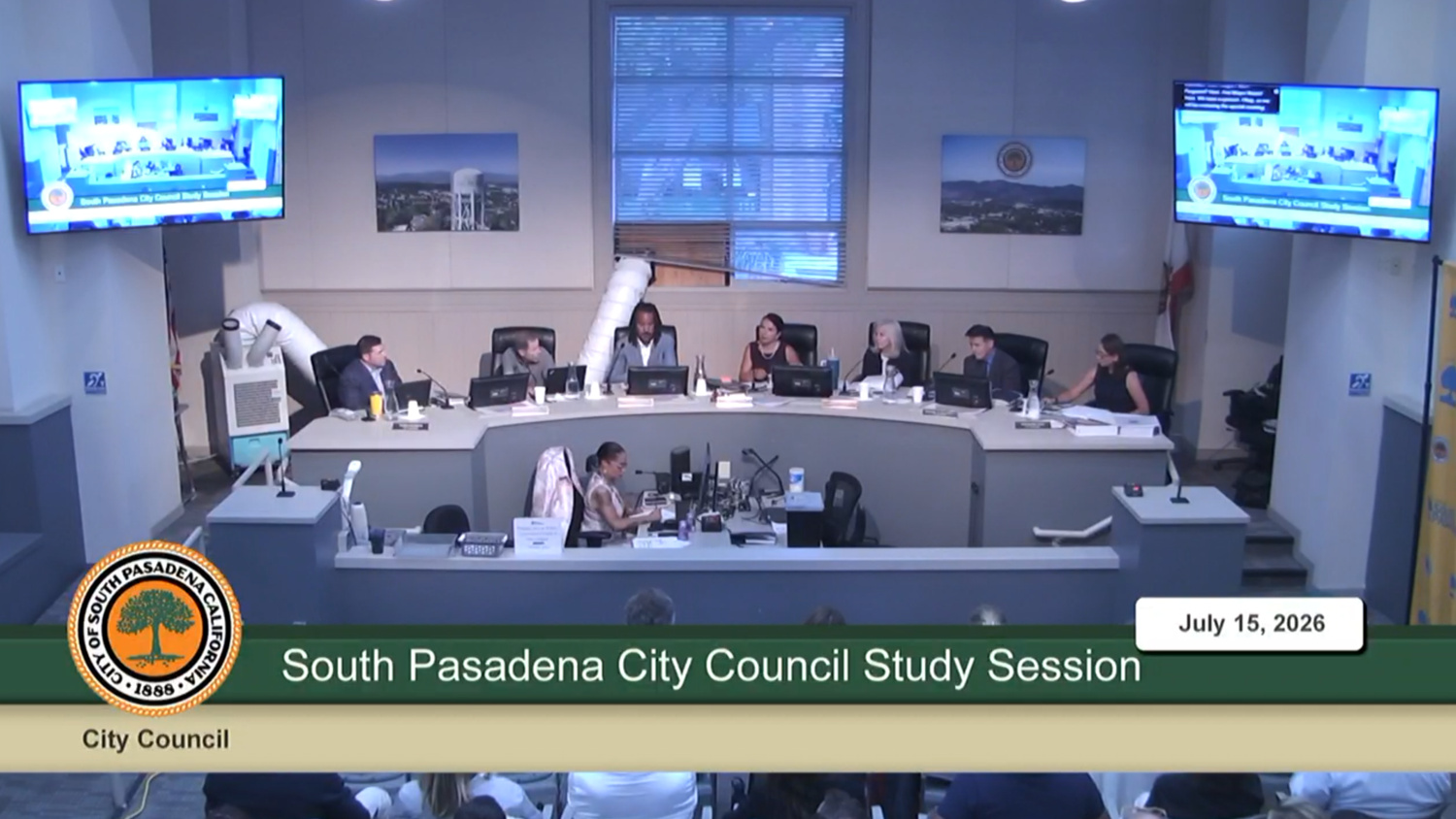
The evening ran in three parts: a 5:05 p.m. closed session, a 6:00 p.m. special study session on council governance, and the regular meeting, which convened at 7:10 p.m. All five members were present: Mayor Sheila Rossi, Mayor Pro Tem Omari Ferguson, and Councilmembers Janet Braun, Jon Primuth, and Michael Cacciotti. The closed session produced no reportable items.
Study Session: Writing the Council’s Rulebook
Before the regular meeting, the council spent an hour giving staff direction on a comprehensive Council Handbook, a project led by Chief City Clerk Nikima Newsome to consolidate meeting procedures and governance policies now scattered across the municipal code, resolutions, and years of unwritten practice.

Mayor Rossi framed the effort as basic professionalization. She and Mayor Pro Tem Ferguson, she said, received little guidance when they joined the council, and new state laws on remote meeting access need to be addressed. Newsome told the council the goal is a single living reference document, reviewed by the city attorney for consistency with the municipal code and the Brown Act, returning to the council for adoption at a future meeting.
Direction given during the session included:
1. Parliamentary authority. The council will formally lean on Rosenberg’s Rules of Order as a guide rather than the heavier Robert’s Rules, matching what the city already provides to boards and commissions. Braun noted one deliberate variance: the council’s practice of holding discussion before calling for a motion, which will be documented.
2. Public comment timing. The fixed 30 minute general public comment window will come off the agenda language. The presiding officer will instead have discretion, subject to council approval, to manage the period, with overflow speakers heard at the end of the meeting. The three minute per speaker limit stays as a stated maximum, with discretion to shorten it when crowds are large. City Attorney Roxanne Diaz advised that a hard time cap interacts badly with new state remote participation rules under SB 707, which can require the comment window to stay open in certain just cause situations.
3. Meeting minutes. The council directed staff to keep strictly action minutes. Braun, a former corporate governance lawyer, and Primuth both cautioned against paraphrased summaries that invite disputes over what was said. Cacciotti agreed but asked staff to return with information on retention periods for meeting recordings, noting that if minutes stay lean, the video and transcript become the historical record and should be preserved, in his words, in perpetuity. Newsome confirmed recordings are currently archived for only a matter of months.
4. Future agenda items. The current rule, requiring the mayor plus a council member to place an item on an agenda, will be rewritten so that any two council members can do so.
5. Certificates and proclamations. Responding to Rossi’s account of fielding a flood of ad hoc requests, from Eagle Scout awards to annual organizational recognitions, the council directed staff toward a standardized online request form, administrative approval and electronic signatures, a running log of certificates issued, and, in Braun’s words, prettier certificates. Proclamations will be sorted into three categories: those tied to municipal departmental functions, traditional annual proclamations, and discretionary ones, with a working cap of roughly two per meeting and mayoral discretion preserved.
6. Presentations. Reports from regional bodies such as the San Gabriel Valley vector control district and Metro will generally flow through the consent calendar or be scheduled by the mayor and city manager, rather than consuming meeting time by default.
Longtime finance watchdog and former city Finance Director Josh Betta, participating by Zoom from Illinois, urged the council to give staff firm direction, keep minutes as action minutes, and think carefully about a handbook that amounts to the council policing itself. Rossi adjourned the session at 7:00 p.m., promising more study sessions on council liaison and regional body assignments.
Consent Calendar and a Recusal
During general public comment, two residents spoke. A speaker who goes by Mister Universal pitched a New Year’s Eve celebration featuring a countdown projected on the South Pasadena water tower with a block party at the train station. Leo Cortez, a resident since 1964, revived his pre pandemic request for a fitness station at Garfield Park south of the restroom and asked for keep clear signage at the library crosswalk, where he said exiting patrons are screened from view by traffic.
At the regular meeting, item 18 was pulled at staff’s request and continued to August 19. Rossi pulled items 8 and 13, the tennis court items, and members of the public pulled items 10 and 13. The remainder of the consent calendar passed 5 to 0.
Before the tennis items, Cacciotti made a formal disclosure: his home sits within 500 feet of Garfield Park. After consulting City Attorney Diaz, he cited the Fair Political Practices Commission’s presumption of a conflict of interest, recused himself from items 8 and 13, and left the chamber for both.
Item 10, the city’s monthly financial report, drew public praise from Betta, who noted the city went 10 to 15 years without financial reports presented in open session and credited Assistant City Manager Nick Kimball and the finance staff with bringing the city into modernity in terms of financial management. The report was received and filed 5 to 0.
Tennis Grant Fails on a Tie; Resurfacing Contract Passes With Strings
The night’s most contested local issue was pickleball, and it split the four voting members straight down the middle.
Item 8 asked the council to authorize a grant application to the United States Tennis Association for up to 16,000 dollars toward resurfacing the Garfield Park tennis courts, offsetting a project Community Services Director Melissa Snyder said would run roughly 35,000 to 40,000 dollars. The catch: accepting the money would prohibit painting permanent lines for any sport other than tennis at Garfield Park for five years.
Rossi said she could support the grant only if both parks’ courts were treated identically, arguing that striping Orange Grove Park for pickleball while locking Garfield Park to tennis would effectively designate Orange Grove as the city’s pickleball center, in a location where she has received a stream of complaints from neighbors about noise, music, and groups of 30 to 40 players until 10 o’clock at night. City Manager Todd Hileman cautioned the council against gaming the grant, saying the city should not submit an application that moved the rules around a little bit. The roll call: Braun and Primuth yes, Ferguson and Rossi no. At 2 to 2 with Cacciotti recused, the grant application failed.
Item 13, the construction contract to actually resurface the courts at both Garfield Park and Orange Grove Park, fared better. The scope covers concrete crack and spalling repairs, repainting, and restriping, with Garfield restriped as tennis only and Orange Grove restriped for both tennis and pickleball, mirroring current conditions. Hileman told the council the work is a roughly five year fix; full reconstruction would cost about half a million dollars per site, and foundational and lighting issues will eventually force that conversation.
Three residents spoke. Gayla Turner, a new homeowner, credited pickleball with anchoring her decision to stay in South Pasadena. Emelia Lomeli-Fannon, a 25 year resident, criticized the condition of the courts and the city’s senior services, citing injuries on unsafe surfaces. Michael Noe, chair of the Natural Resources and Environmental Commission, urged the city to think bigger, proposing an eight court dedicated pickleball complex at Orange Grove and pointing to an August 28 deadline for California’s Outdoor Recreation Legacy Partnership matching funds and USA Pickleball development grants of up to 25,000 dollars. Noe traced the local pickleball boom to Michelle Pusateri’s introductory adult recreation class at Orange Grove Park in October 2022, which has since grown into five classes serving players from preschoolers to seniors in their 80s.
Ferguson pressed for a court reservation system to track utilization, calling it a significantly smaller lift than resurfacing. Rossi reiterated that the status quo at Orange Grove is not working and that a policy framework, permitting, hours, enforcement, has been stalled at the Community Services Commission for a year. Hileman warned that a reservation system alone will not solve anything without an enforcement mechanism behind it.
The final motion, made by Primuth as amended and seconded by Braun, approved the staff recommendation and directed a return to council in the September to October window with Community Services Commission recommendations on use policies, including a reservation system proposal, plus an evaluation of striping at both facilities, leaving the door open to a contract addendum adding pickleball stripes at Garfield Park. It passed 4 to 0, Cacciotti recused.
SB 79: Numbers on the Record, Hearing Continued to September 16
The public hearing on item 16, an ordinance amending Chapter 36 of the municipal code and adopting a Transit Oriented Development alternative plan under Senate Bill 79, with a CEQA exemption determination, was the meeting’s weightiest item, and it ended exactly where staff recommended: continued to September 16.
Before the hearing, Rossi read a detailed statement, as she did at the July 15 meeting, explaining her participation under the FPPC’s public generally exception, which allows an official whose only financial interest is a primary residence to participate when at least 15 percent of properties in her jurisdiction are affected the same way. Her numbers: District 2 contains 1,213 parcels; of the 581 parcels citywide inside the SB 79 quarter mile zone, 490, or 84.3 percent, sit in District 2; those 490 parcels are 40.4 percent of her district, more than two and a half times the threshold. She disclosed a June 9 written advice request to the FPPC and said counsel there raised no concern about her participation on the corridor ordinance or the alternative plan. Her earlier recusal on items involving historic parcels, she said, was a voluntary offer, not an acknowledgment of conflict.
Community Development Director Erica Ramirez reminded the council of the ground already covered: SB 79 overrides local zoning near qualifying transit stops, the council has adopted ordinances delaying its effectuation on designated local landmarks and on downtown parcels already zoned for higher density, and a council ad hoc created July 15 has been evaluating density redistribution scenarios without reaching consensus. Staff’s recommendation was to take public comment, give feedback to the ad hoc, and continue the hearing to September 16.
The substantive discussion centered on a consequential legal question raised with special counsel Gabrielle Jensen, appearing remotely: whether adopting a TOD alternative plan removes the rest of the SB 79 overlay along with it. Jensen’s interpretation was yes. Under an alternative plan, the statute’s density bonus provisions, tenant protections, and union labor requirements for buildings 85 feet and over would not apply; the alternative plan’s own requirements would govern instead, though the statute still requires the city to maintain the same total unit capacity and floor area ratio. Recent letters from the state Department of Housing and Community Development to Los Angeles, San Francisco, and Beverly Hills suggest the default height limits also fall away under an alternative plan, meaning projects could potentially go higher.
Ramirez flagged the troubling arithmetic that follows: staff’s alternative plan scenarios kept 65 foot heights in residential neighborhoods on the assumption the default applied, but if the overlay disappears, 65 feet could become a base height on small residential lots with no affordability requirement attached. Cacciotti added a note of caution about relying on HCD interpretations at all, pointing out that a court of appeal overturned one of the agency’s readings of housing law in the South Bay just months ago.
Rossi summed up the crux: does an alternative plan let the city reshape the oval into a polygon of our community’s choosing, or does it throw out the rulebook entirely? Until HCD answers in writing, she said, it is hard to move forward. After a single public comment, the hearing was continued to September 16 at 7:00 p.m. on a 5 to 0 vote.
Overnight Parking: Grace Period Eliminated, 2 A.M. Start Preserved
Item 17 introduced Ordinance 2420, amending sections 19.58 and 19.64 of the municipal code on overnight parking. David Gazarian, management analyst for the police department, presented the staff proposal: move the overnight restriction’s start from 2:00 a.m. to 1:00 a.m., eliminate the 30 minute grace period that has complicated enforcement, and extend the maximum temporary overnight permit from three to seven consecutive days, all preceded by a public education campaign and a 30 day enforcement grace period.
Police Chief Derek Elmore fielded questions about the separate 72 hour parking rule, clarifying it is state law aimed at abandoned and stolen vehicles, enforced only on complaint, and, as Rossi and Elmore both acknowledged, sometimes weaponized in neighbor disputes. Elmore reported roughly 200 calls in the past six months regarding oversized vehicles and 72 hour violations, producing more than 50 citations.
Ferguson opposed the package, arguing that if the pathway to compliance can take longer than 30 minutes under the city’s clunky permitting process, the city would be ticketing people while they try to comply, and that moving enforcement to 1:05 a.m. from an effective 2:30 a.m. is a big change for a citywide policy. Braun wanted the permit extension separated from the enforcement changes. Primuth backed staff in full, saying the council was second guessing a well researched recommendation.
The council landed on a compromise: keep the 2:00 a.m. start time, eliminate the 30 minute grace period, and adopt the three to seven day permit extension. Questions about how the city classifies commercial and oversized vehicles, raised by Ferguson after a family U-Haul ticketing story from Rossi, will return at the first meeting in September, likely as a separate ordinance to avoid delaying this one. The amended first reading passed 4 to 1, Ferguson dissenting, with a second reading to follow.
Legislative Committee Established; Rossi and Ferguson Appointed
Item 19 adopted Resolution 8022, creating a standing City Council Legislative Committee. Alma Medina, assistant to the city manager, described it as the third step in a sequence: the council adopted its legislative policy and 2026 platform in December 2025, approved an advocacy agreement with Townsend Public Affairs in July, and now needs a nimble council level body to receive briefings at the speed bills move through Sacramento.
The committee consists of two council members appointed by the mayor and confirmed annually after the December organizational meeting. It is advisory only, subject to the Brown Act, and carries no direct fiscal impact. Betta, again on Zoom, questioned whether the committee would push legislative judgment calls onto an already stretched staff; Hileman responded that the recommendation came from staff, that the Townsend consultant will carry the workload, and that the committee is about keeping council in the loop on unfunded mandates and funding opportunities, not drafting new initiatives. The resolution passed 5 to 0, with Rossi and Ferguson appointed as the inaugural members.
Council Communications: Tenant Protections and a Housing Registry
During council communications, Cacciotti relayed a warning from constituent Anne Bagasao that the California Tenant Protection Act expires January 1, 2030, and asked that tenant affordability, possibly including adjustments to rent stabilization or a registry, be taken up next year. Rossi noted the issue is entangled with SB 79, since an alternative plan would need to replicate the tenant protections the overlay would otherwise provide, another question awaiting HCD’s answer.
Ferguson then moved for a discussion of creating a local housing registry, a database he has sought for some time, arguing the city cannot track the performance of sweeping zoning changes like SB 9 and SB 79 without one. Rossi cautioned that the item was not on the council’s adopted priorities and not on the agenda; the motion died without a second, with colleagues signaling support for taking it up as a priority next year and for revisiting a prior consultant report on registry costs.
Rossi closed with a report on her seat on the SCAG SoCal Connect committee and work on an LA 2028 Olympics toolkit, telling colleagues the council needs to start planning for the Games as a whole.
The meeting adjourned to Wednesday, August 19, 2026, at 7:00 p.m.