












If you stepped outside in South Pasadena this morning, you may have heard them before you saw them — the low growl of vintage radial engines coming in over the rooftops, a couple thousand feet off the deck, banking up toward the Rose Bowl. That is the Condor Squadron, the nationally known group of warbird pilots who fly formation each Memorial Day over South Pasadena, Pasadena, San Marino and foothill cities. Watch closely and you may see one aircraft pull up and climb away from the others, leaving an empty place in the sky where a wingman should be. That gap is the whole point. It is a salute to the ones who did not come home.
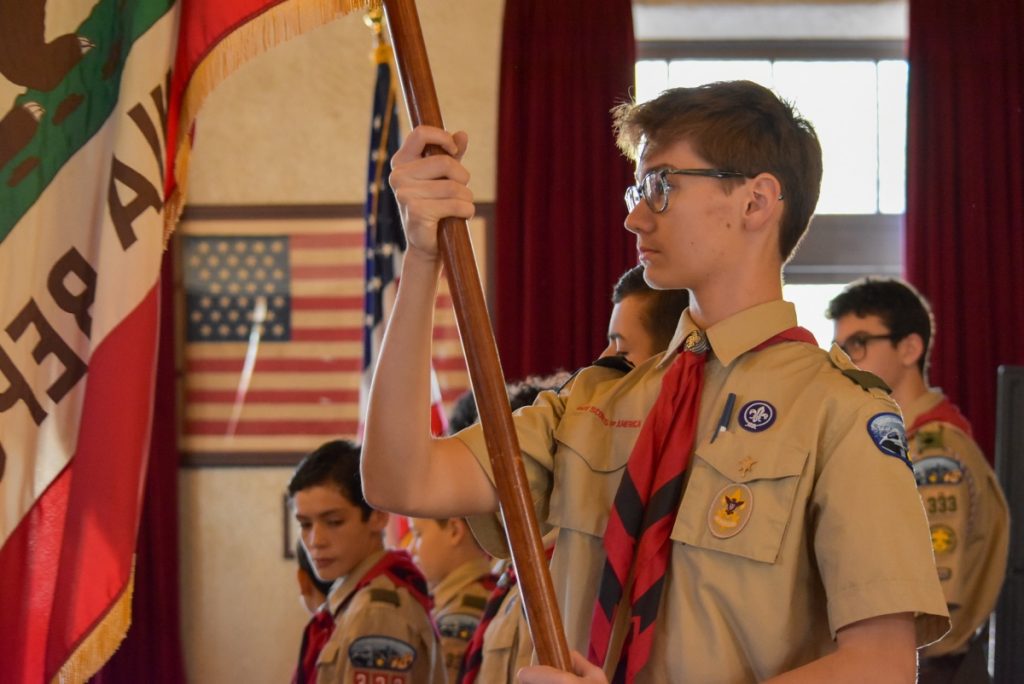
On the ground, at the same hour, something just as old and just as deliberate is taking place. At the War Memorial Building on Fair Oaks, at Lacy Park in San Marino, at Pasadena’s century-old flagpole on Orange Grove, a small detail steps off carrying the flag of the United States. We call them the color guard. Most of us have watched one a hundred times — at a ballgame, at a funeral, before kickoff at the Super Bowl. Far fewer of us could say what they are actually doing, or why it matters. That is worth fixing.
The “colors” are the flags themselves — the national colors first, often with a state flag, a service flag, or an organization’s flag beside them. The “guard” is exactly what the word says. The bearers who carry the colors are flanked by guards, and the reason is not decoration. It is history written into muscle memory.

On the battlefields of earlier centuries, a unit’s flag was how soldiers found one another through smoke and noise. The colors marked where the line stood. To advance the flag was to advance; to lose it was the deepest disgrace a unit could suffer. Men gave their lives so the colors would not fall, and other men stood beside the bearer for one job only — to keep that flag in the air. Everything a modern color guard does is a memory of that vow. When the detail keeps the U.S. flag on the marching right, carried highest, never dipped to any person and never allowed to touch the ground, they are keeping a promise older than the country itself: this flag does not fall.
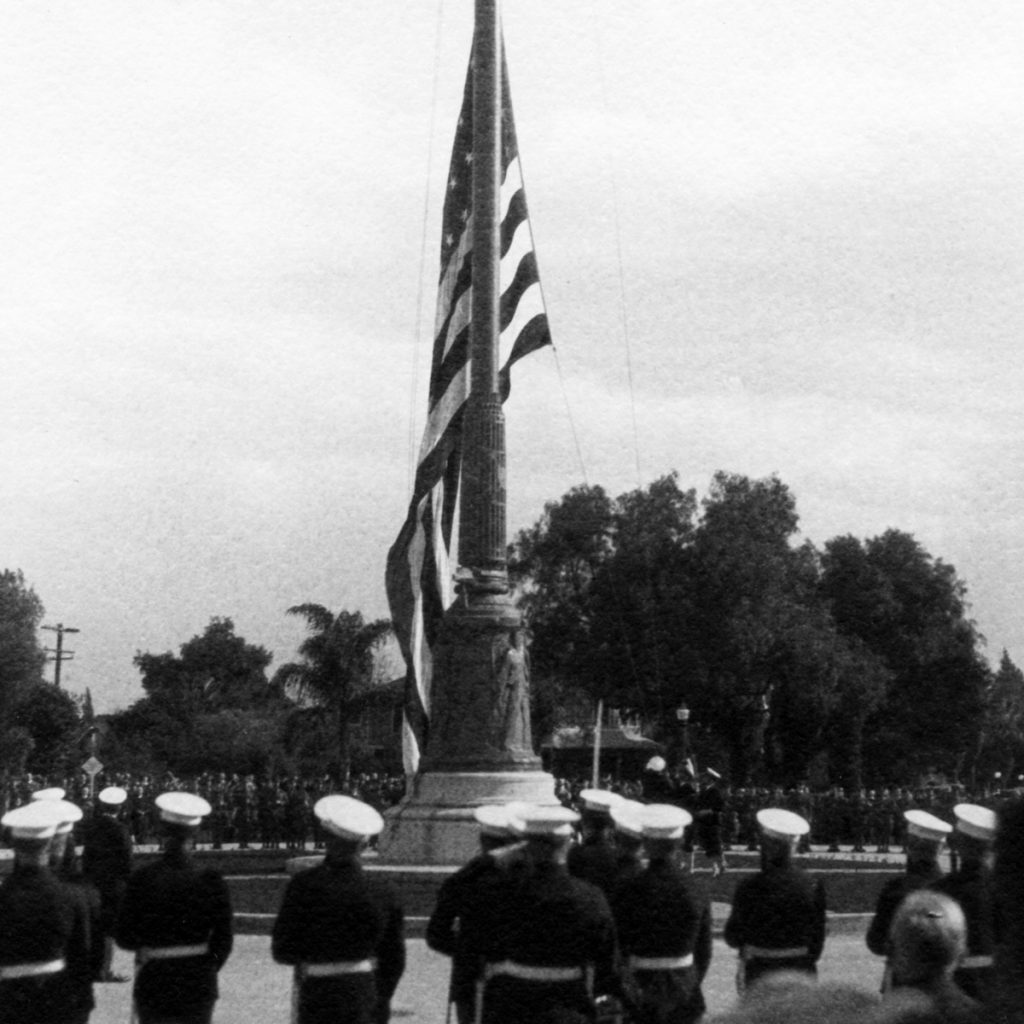
The formalities carry meaning, too, if you know where to look. The colors are presented and posted at the start of a ceremony and retired at the end — never simply set down and forgotten. On Memorial Day the flag flies at half-staff from sunrise until noon, then rises briskly to the top of the pole for the rest of the day. The lowered flag in the morning mourns the dead. The flag raised at noon says the living have taken up the cause they died for. At a military funeral, that same flag is folded into a tight blue triangle and placed in the hands of a widow or a mother “on behalf of a grateful nation,” while a rifle detail fires three volleys and a single bugler plays Taps. None of it is improvised. All of it says the same thing: we remember, and we will not let go.
This is where the Boy Scouts come in — and why it mattered that they did. For generations, the Scouts were often the ones who posted the colors at the local ceremony, because learning to do it correctly was itself a civics lesson no textbook could deliver. A twelve-year-old who has been taught to carry the flag without letting it dip, to call the commands, to stand still while the names of the dead are read aloud, has learned something about belonging to a country that most adults never quite put into words. Some of us first carried the colors at exactly that age, in a Scout uniform, and never forgot the weight of it.
When the Scouts can’t be there, the line doesn’t end — it gets handed to someone else. You can call the American Legion or the VFW; here in South Pasadena, American Legion Post 140 has kept the War Memorial Building and the tradition since the 1920s. You can call a local JROTC unit or the Naval Sea Cadets, who help present the colors at the San Marino service. And you can call the Marines: Pasadena’s ceremony closes with funeral honors rendered by the 2nd Battalion, 23rd Marines. The duty gets passed hand to hand, generation to generation. That passing-down is the tradition. The flag is just the thing we hand across.
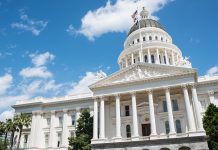
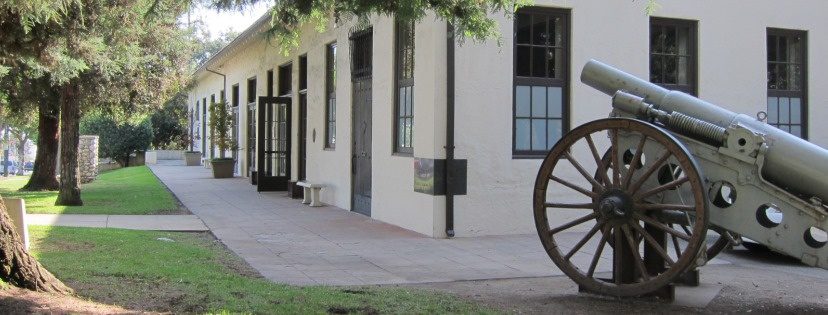
There is a reason each of these towns guards its own memorial. South Pasadena’s War Memorial Building on Fair Oaks went up in 1923 for the men of the Great War — its cornerstone laid by a French marshal, a tree on its grounds planted by General Pershing himself. San Marino reads the names of its fallen aloud at Lacy Park, a bell ringing after each one. Pasadena’s flagpole at Colorado and Orange Grove, dedicated in 1927, still carries the names of the city’s World War I dead carved into its base, even as traffic streams past without a glance. Different towns, different stones, the same vow.
And that, in the end, is what the color guard is for. It is the one moment in a distracted, divided country when everyone in the crowd faces the same direction, falls silent at the same instant, and puts a hand over the same heart. Veterans salute. Children copy them. Strangers stand shoulder to shoulder. For about ninety seconds, we are unmistakably one people, gathered around one flag, remembering the same names.
You don’t have to have worn a uniform to feel it. You only have to show up — this morning at nine on Fair Oaks, or out at Lacy Park, or wherever you happen to be — and watch the colors come forward. Stand up. Take off your hat. Then look up at the empty space in the formation overhead. That space is for someone. The least we can do is be there to see it, and to remember why it’s empty.
Learn & perform the basic color guard ceremony
POSTING THE COLORS – Audible Call Commands
“Color guard, attention.” — Detail snaps to attention, flags vertical.
“Forward, march.” — Step off together, deliberate pace, advance to the front.
“Color guard, halt.” — Stop as one, facing the audience.
“Post the colors.” — Bearers step forward and seat each flag firmly in its stand.
“Color guard, fall in” (or “cover and align”). — Bearers step back, detail re-forms in line.
“Hand salute, two.” (optional, if rendering honors before the anthem) — Salute up on “salute,” down on “two.”
— Pledge of Allegiance and/or National Anthem here. U.S. flag stays upright; other flags dip. —
RETIRING THE COLORS
“Color guard, attention.” — Detail comes back to attention.
“Retrieve the colors.” — Bearers step forward and lift each flag from its stand.
“Color guard, fall in.” — Detail re-forms with colors carried.
“Forward, march.” — Step off and proceed.
“Color guard, halt.” (at the exit point, if needed) — Halt, then dismiss
If you want to teach a patrol how to do this: Start with the detail itself. A clean, simple color guard is four Scouts: two color bearers in the center and two guards on the outside flanks. The bearer on the right carries the United States flag — always the right, which is the position of honor — and the bearer on the left carries the troop or state flag. The two guards frame them and, in the old days, would have been the ones literally protecting the colors. A fifth Scout, usually the most squared-away of the group, serves as the caller and gives the commands. Everyone wears the same uniform, and most units add white gloves. The flags ride in a carrying sling — that little leather cup at the belt — so the bearer’s hands stay steady and the flag stays upright and free, never tilted, never trailing, and never, ever touching the ground.
The ceremony itself is mostly walking slowly and standing still, done with intention. On “Color guard, attention” the detail comes to attention; on “Forward, march” they step off together and advance to the front at a deliberate, unhurried pace — this is not a stroll and not a parade march, it’s somewhere dignified in between. They halt facing the audience, and on “Post the colors” the bearers step forward and seat each flag in its stand. Then comes the part everyone watches for: the Pledge or the National Anthem. Here’s the one rule a Scout must never get wrong — during the salute, the state and troop flags dip in honor, but the United States flag never dips to anyone or anything. It stays upright. At the close, “Retire the colors” reverses the whole sequence: the bearers retrieve the flags from the stands, the detail re-forms, and they march off the same way they came on.
The secret to making it look effortless is the same secret behind anything that looks effortless: Rehearsal. Walk them through the spacing, the halt, the timing of the posting, and the footwork until it’s automatic, because the public reads hesitation as disrespect even when none is meant. Tell the Scouts plainly why each piece exists — that the guards on the flanks are an echo of men who once died keeping that flag aloft — and the whole thing stops being choreography and becomes what it’s supposed to be: a promise, kept correctly, in front of the people who came to watch them keep it.
Four Marines in dress blues stand at attention with rifles as they carry the American flag in a color-guard ceremony in a stadium setting. PHOTO: USMC TV Color Guard – Sergeant Cameron Williams, 40th Color Sgt. of the Marine Corps, Official U.S. Marine Corps Color Guard, gives us insight into who the “Commandant’s Four” are and how they represent the Marine Corps. “It is very important that not only we are able to show that the Marine Corps is still the very strong force that it was years ago,” said Williams, “ but we also need to show, ceremonially, that we can create a product that the nation can be proud of.”