










Sometimes it’s better to glance in the rearview mirror than to merely focus on the road ahead. At least that’s how I felt after the Dodgers were ignominiously ousted from the playoffs in four straight games at the hands of the Milwaukee Brewers on October 15.
As a lifetime Dodgers fan (even when I lived in Northern California), I’ve already survived a multitude of crushing Dodger defeats and endured many trips to Candlestick Park in San Francisco wearing a blue cap. After moving back to Southern California in 2006, I was excited to be back in ‘Dodger Country’ and honored to be appointed to serve as the Director of Library, Arts, and Culture for the City of South Pasadena at the same time. During my 13-year tenure, the library showcased a continuous stream of well-attended events and programs. Hundreds of public film screenings, concerts, author talks, poetry readings, plays, stand-up comedy shows, and special anniversary celebrations were presented in the historic, beloved Community Room. Besides the indoor gatherings, dozens more were convened in the adjoining Library Park.
The Community Room was initially constructed as the South Pasadena Carnegie Library and completed in 1907. In 1930, the building was moved to the middle of the Library Park and in 1982 it became the Community Room as the Library was expanded and renovated. Through the decades, the Community Room was equipped with new carpeting, window coverings, 200 chairs, a Steinway piano, and finally, an up-to-date, high-end audiovisual system, all purchased with the great support of the City of South Pasadena, the Friends of the Library, and the Restoration Concert Committee. Its exterior roofline is still adorned with bas relief friezes by acclaimed sculptor Merrell Gage with classical literary themes and its interior ceiling area’s massive beams were decorated with hand-painting muralist Lucile Lloyd. In other words, it is a wonderful, picturesque public venue.
Perhaps not surprisingly, baseball-related shows focusing on the Los Angeles Dodgers continually proved to be among the most popular gatherings there. After all, Dodger Stadium is only a scant 15-minute drive and uncountable thousands of ‘true blue’ fans populate the surrounding metropolitan area.

Showcased at the library were official Dodgers team historian Mark Langill, longtime team photographer Jon SooHoo, former General Manager Ned Colletti, discussing his “The Big Chair: The Smooth Hops and Bad Bounces,” iconic stadium “Peanut Man” Roger Owens, Jason Turbow on his “They Bled Blue: The 1981 Los Angeles Dodgers,” as well as former outfielder, bestselling author, and television sports announcer, Jay Johnstone.
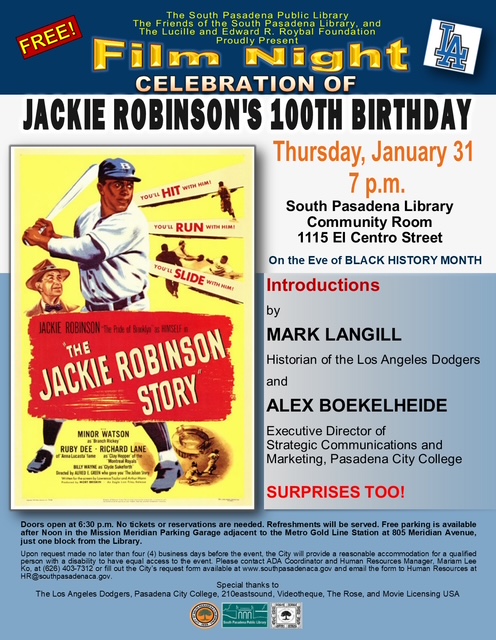
One of the most riveting Dodger Nights was a Centennial Birthday Celebration for Pasadena-raised Jackie Robinson (1919-1972). It showcased the delightful 1950 full-length feature, “The Jackie Robinson Story” starring the groundbreaking ballplayer and civil rights leader as himself. The occasion honored Jackie’s magnificent achievements as a multi-sport athlete at Pasadena City College and UCLA, and his monumental breaking of the major league color barrier in 1947. Eventually Jackie led the Brooklyn Dodgers to finally defeat the New York Yankees for their long-awaited, first World Series Championship in 1955.
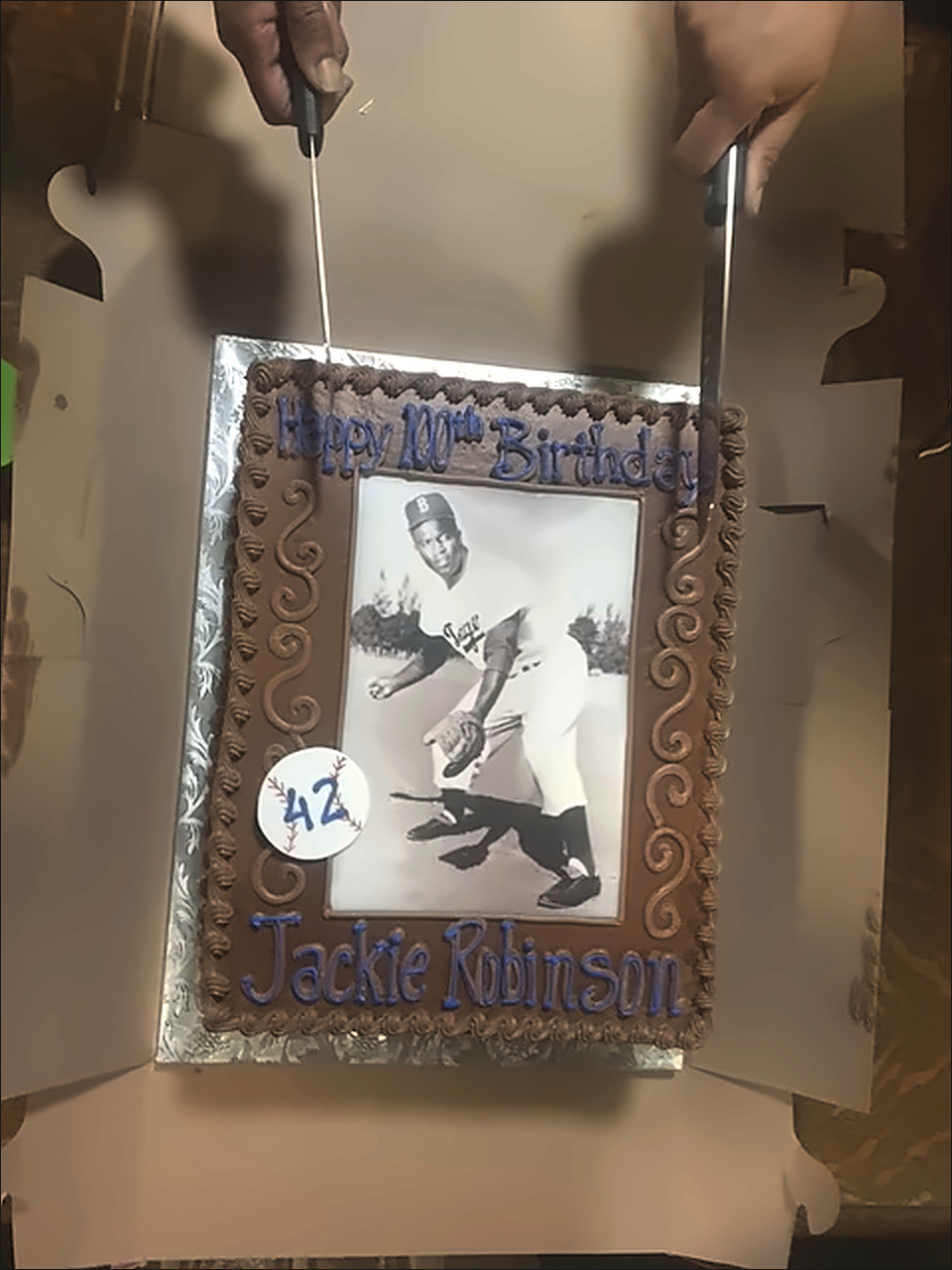
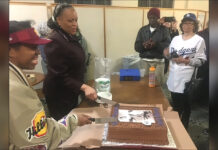
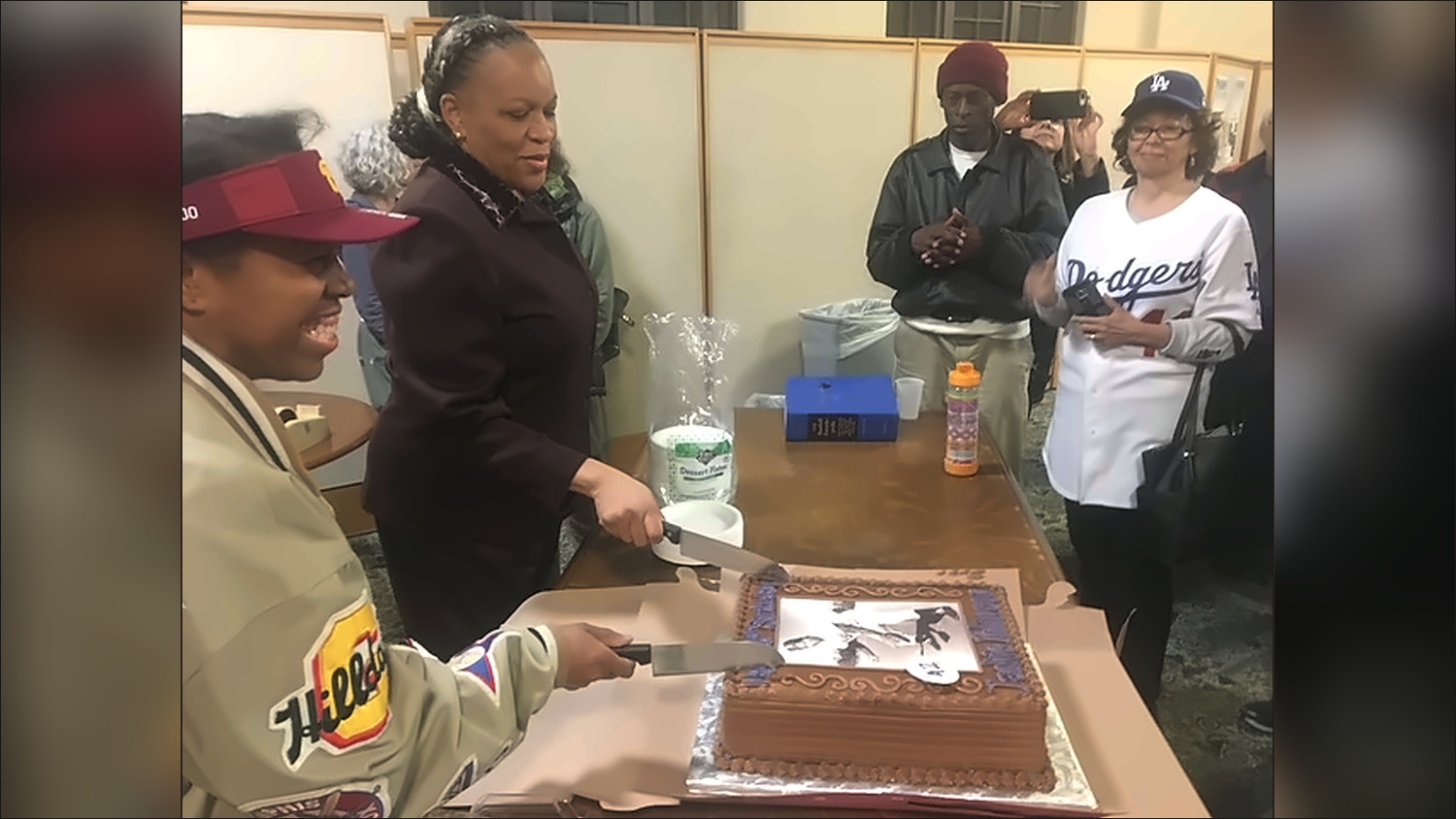
The gala kicked off with our national anthem sung by Jackie’s niece Rosie Robinson, accompanied by another niece, Kathy Robinson Young. After the screening of the inspiring, family-friendly “The Jackie Robinson Story,” starring the immortal as himself, the pair continued the festivities with the serenading of the assembled multitude in a rousing rendition of “Happy Birthday to You.” They concluded the night by blowing out the candles and cutting the custom cake for all in attendance.
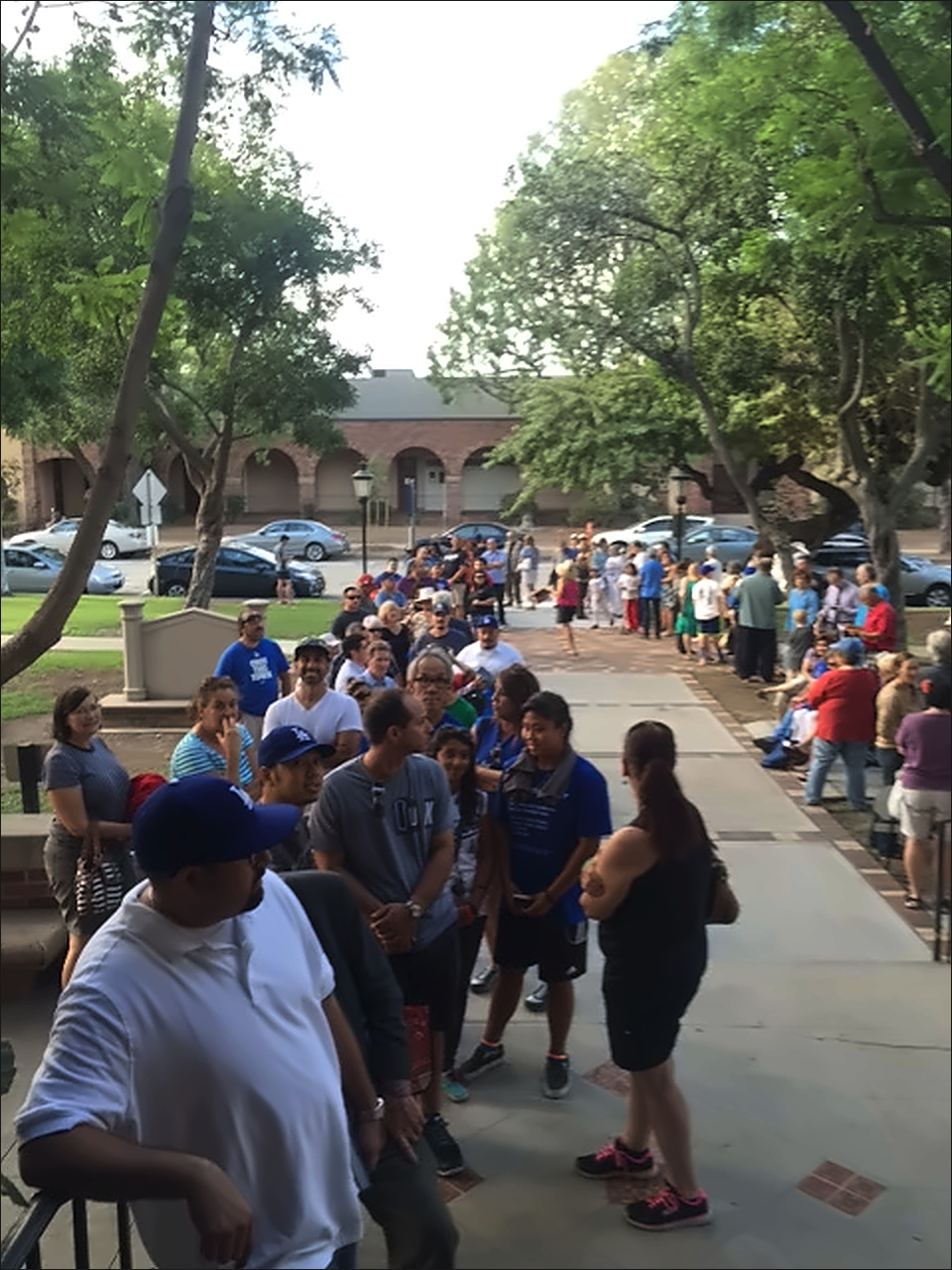
In 2018, more than 100 fans started lining up outside the Community Room more than an hour early for the Tommy Lasorda Author Night. The Hall of Fame manager discussed his revealing “Tommy Lasorda: My Way” with co-author Colin Gunderson. The sometimes hilarious dialogue was moderated by Mark Langill, followed by a freewheeling hour-long question-and-answer session. One facet of the evening that was especially endearing was the age range of audience members which stretched from about 9 to 90. The program commenced with a book-signing that drew almost every attendee to patiently line up again. It had been announced that Tommy would only be signing copies of his latest book, but nevertheless, he signed every ball, cap, and t-shirt presented to him.
Again in 2018, another major bash took place when freshman Dodgers play-by-play commentator Joe Davis was personally introduced for the first time in his new hometown of South Pasadena by L.A. Times Assistant Sports Editor Houston Mitchell who conducted the interview. Davis had recently finished his impressive first season succeeding the legendary Vin Scully, who had been at the microphone for an astonishing 67 years before retiring after the 2016 season. During that span, Vin Scully was universally regarded as the greatest sports broadcaster in history, seemingly becoming irreplaceable in the process. Filling Vin’s shoes was a formidable, practically impossible task. But against all odds, Davis had won almost everyone over in grand style.
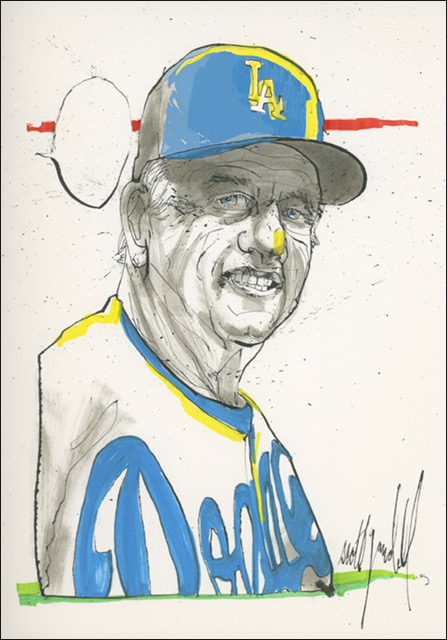
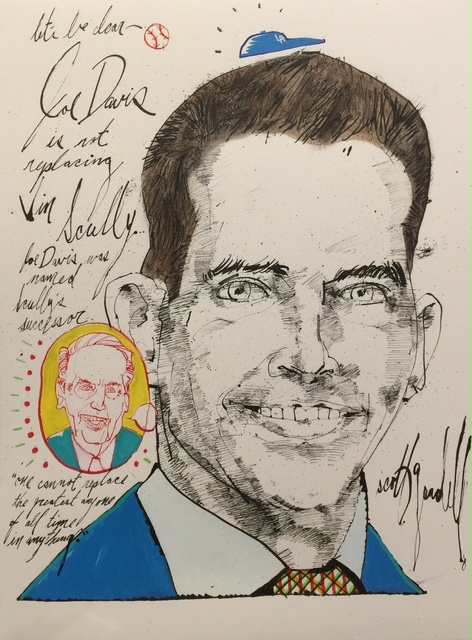
Initially, I was able to reach out to Joe through my friend Mark Gallatin, his next-door neighbor. The Pasadena Weekly was planning a big story to promote the occasion and they needed a striking photo or illustration of the handsome 28 year-old commentator for their cover. I approached Scott Gandell, who co-operated South Pasadena Mercantile a few blocks from the library. Scott is an award-winning illustrator, designer, and printmaker and his work has been published in a variety of magazines, newspapers, and books. It has also been exhibited in galleries across the U.S. and Canada. Scott had already composed striking drawings of Tommy Lasorda, Dave Alvin, and Eliza Gilkyson that had appeared in the Pasadena Weekly.
Scott promptly sent me his energetic, eye-catching portrait of Joe just as planned. But as much as I loved it, I knew it should be run by Joe, just to make sure it met his approval. After I emailed it to Joe a couple of times, I continued to wait for a reply, even though he was supposedly standing by. Continuing with other work, I checked back regularly for his response.
The Weekly’s Arts Editor started emailing, texting, and calling me to tell me the deadline for the illustration had arrived and they needed the artwork immediately. Fortunately, I had Joe’s phone number, but could only leave a voicemail. I was about to contact PW and report that the cover illustration for them had fallen through, when an email from Joe arrived. All it said was, “I’m just not comfortable with it.”
The article for the splashy Joe Davis cover story had already been submitted to PW. The community’s enthusiasm to meet the young play-by-play caller had been building and lots more was expected. Publicity releases had been disseminated to a variety of local media outlets, as well as to every Dodgers fan club, as well as to the Baseball Reliquary. Started in 1999 by librarian and old friend Terry Cannon (who passed way too soon in 2020), the highly-regarded Reliquary is an educational non-profit dedicated to celebrating baseball culture. It also retains an expansive reach to many passionate fans across the region. The Baseball Reliquary continues under the resilient leadership of Joe Price, Professor Emeritus of Religious Studies at Whittier College. The Reliquary’s massive collection of books, artifacts, and memorabilia are now housed at Whittier College where their 2026 “Shrine of the Eternals” Induction Ceremony will be held on Sunday, November 8th.
Thankfully, the PW Arts Editor substituted an attractive photo of a beaming Davis in a dapper blue suit for the next Pasadena Weekly cover. It was eye-catching and served its purpose in greatly expanding our audience that packed the Community Room. The throng also included Joe’s parents who had traveled all the way from Michigan. I was glad I didn’t do anything to make Joe uncomfortable.
During his scintillating talk, Joe was eloquent, humble, and skillfully exhibited his knack for storytelling. He was charming in recounting his meteoric rise from quarterbacking the Betoit College, Wisconsin football team to becoming a nationally known play-by-play caller on Fox-TV. Along the way Joe covered college football and the NFL for ESPN and took over the broadcasting chores for the Schaumberg Flyers and Montgomery Biscuits Minor League Baseball teams. Then remarkably he catapulted all the way to the booth for the iconic Los Angeles Dodgers. Since then, Joe has also thrived as the key television broadcaster for the World Series and the Super Bowl and in 2025 was awarded a Sports Emmy for “Outstanding Play-by-Play Personality.”
After his library talk, Joe introduced his parents to the audience. They were friendly and deservedly very proud. To this day, I am very thankful to him for helping out the South Pasadena Library and greatly enjoy listening to him when I routinely watch the Dodgers on TV. Nevertheless, I still think that Scott Gandell’s jolly portraiture of him deserves to be seen and think it might be a good time to reveal it after all these years, especially since the Dodgers’ season has shockingly ended so abruptly. Maybe some fans might appreciate some levity. Anyway, at this point, Joe Davis is an American institution and if images of celebrated world leaders can be caricatured in unflattering, often grotesque ways, I think Joe can withstand being depicted in a jovial manner. Even the saintly Vin Scully was often caricatured in a less than flattering fashion, but he remained above it all, of course.
In 2025, Joe Davis and his growing family befittingly moved on from South Pasadena to a magnificent mansion in (North) Pasadena. Although Joe no longer lives in South Pas, the memories of personally being introduced to him at the South Pasadena Library linger on. Most of all, I’m grateful we are still able to hear Joe Davis call the World Series –even if the Dodgers are not playing.